

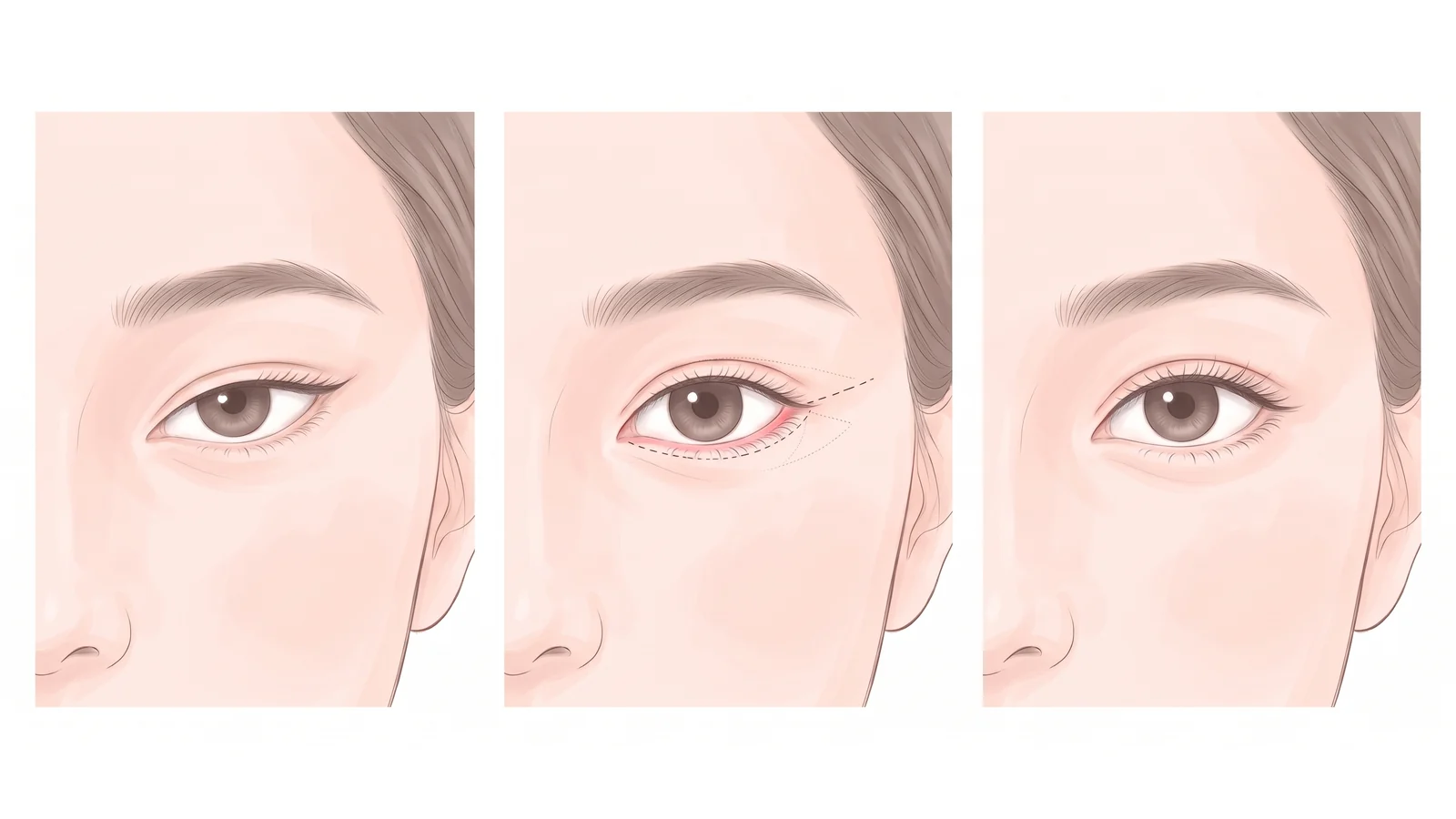
The lateral canthus, where the upper and lower eyelids meet at the outer corner, is the point that lateral canthoplasty in Korea moves outward, while lower canthoplasty eases the outer lower lid slightly down. Dr. Jang Jin-woo performs both in one operation of about 30–60 minutes under local anesthesia or IV sedation, and the stitches come out after 5–7 days.
Is it for you?
Who considers lateral and lower canthoplasty
Eye shape is set by two measurements that people rarely name: how long the opening is from corner to corner, and the angle of the line between the inner and outer corners. When the outer corner stops early or tilts sharply upward, the eyes can look short or stern even with a well-formed eyelid crease. Lateral canthoplasty works on the length; lower canthoplasty works on the angle and the curve of the lower lid.
The space available is anatomical and differs from person to person. Behind the outer corner lies the bony rim of the eye socket, and the soft tissue between the corner and that rim limits how far the opening can be extended. Lower-lid tone matters too: a lid that is already loose, or eyes that sit forward, are more prone to the lid pulling down once its outer part is released.
Usually a good fit
- Eyes that look short from side to side, with the outer corner ending early
- A steep upward tilt at the outer corner you would like softened
- Lower lids that sit high and make the eye look narrow vertically
- Firm lower-lid tone and soft tissue room beyond the corner
- Planning double eyelid or inner-corner surgery and wanting the outer corner matched
- Able to stay in Seoul 5–7 days until the stitches are out
We may suggest waiting
- Little soft tissue room between the outer corner and the socket rim
- Loose lower lids or prominent eyes, where the lid can pull down
- Ongoing dry eye, eye infection or irritation
- Expecting a large change in how wide the eyes are
- Pregnancy or breastfeeding
- A recent canthoplasty elsewhere that has not yet settled
Before & after
Lateral canthoplasty before and after
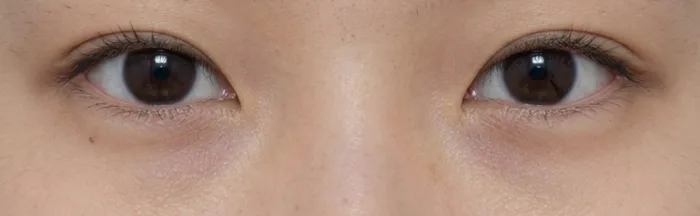 BEFORE
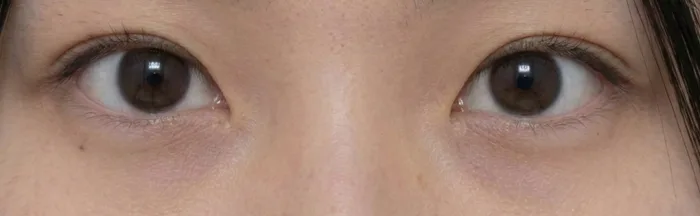 AFTER
How it works
How lateral and lower canthoplasty change the outer corner
At the outer corner, a fibrous band called the lateral canthal tendon anchors both eyelids to the bone of the eye socket rim. The pink lining of the lids, the conjunctiva, folds around the corner on the inside. Lateral canthoplasty (eye shape surgery at the outer corner) makes a short incision at this point and resets the skin and lining further out, so the visible opening ends a little further toward the temple. Lower canthoplasty works from the inner side of the lower lid: the outer third of the lid margin is released and set slightly lower, which softens an upward tilt and shows a little more of the eye from top to bottom.
The two parts are listed together on the clinic's menu as a single operation. A review of cosmetic lateral canthoplasty describes the procedure as common in East Asia, and notes that complications and unsatisfying results are not rare; the authors focus on preserving the angle of the outer corner to reduce them (Kim, 2016). A second technique review in the same journal describes how lengthening the outer corner and adjusting its tilt can be combined with double eyelid surgery or medial epicanthoplasty (Chae, 2016).
Recent data on the combined approach are limited. A 2025 cohort that enlarged the eye opening outward and downward in one procedure reported longer and taller fissures with a lower canthal tilt at six months and no major complications, though the study had no control group (Xu, 2025).
Measuring the corner
At consultationDr. Jang Jin-woo looks at the length of the eye opening, the outer-corner tilt, the tissue room beyond the corner and how firm the lower lids are before marking how far to extend.
Opening the outer corner
Under local anesthesia, or IV sedation if you choose it, a short incision is made at the lateral canthus and the skin and inner lining are reset further out.
Lowering the outer lower lid
From inside the lower lid, the outer part of the lid margin is released and fixed a little lower, so the corner line slopes more gently.
Closing the corner
About 30–60 minutes in totalThe corner is closed with fine stitches and cold compresses start. You come back once, after 5–7 days, to have the stitches removed.
Eye-shape surgery on the ENTER Plastic Surgery menu
| What differs | Lateral & lower canthoplasty | Medial epicanthoplasty | Incisional double eyelid surgery |
|---|---|---|---|
| Part of the eye changed | Outer corner and outer lower lid | Inner-corner fold | Upper-eyelid crease |
| Direction of change | Longer outward, softer tail | More of the inner corner shown | A defined fold above the lashes |
| Numbing | Local, or IV sedation | Local, or IV sedation | Local, IV sedation if needed |
| Swelling and bruising (clinic guidance) | 3–7 days | 3–7 days | 2–3 weeks |
| Shape settles over | About 2–3 months | About 2–3 months | About 3–6 months |
| Visits after surgery | 1, for stitch removal | 1, for stitch removal | 1–2 dressing and review checks |
Values are the clinic's guidance for each operation done alone; a combined plan has its own schedule.

Your doctor
Chief Director · Korean board-certified plastic surgeon
“Natural, yet clearly visible change.”Eyelid and facelift surgery at ENTER is planned and performed by Dr. Jang himself.
- NowChief Director, ENTER Plastic Surgery
- TrainingPlastic surgery, Kyung Hee University Medical Center
- FormerChief Director, Jang Plastic Surgery
- FormerDirector, Secret Plastic Surgery
- MemberKSPRS · KSAPS · ISAPS · ESOPRS · ASPS
At a glance
Lateral and lower canthoplasty: key facts
| Procedure time | About 30–60 minutes |
|---|---|
| Anesthesia | Local anesthesia, or IV sedation |
| Recovery | Swelling and bruising 3–7 days; line settles in about 2–3 months |
| Follow-up visits | 1 visit, for stitch removal at 5–7 days |
| Stitches | Removed about 5–7 days after surgery |
| Earliest flight home | After stitch removal, 5–7 days after surgery |
Prices
What lateral and lower canthoplasty costs in South Korea
The clinic's fee schedule lists lateral and lower canthoplasty as one combined operation, and that line is the surgery fee shown below. The schedule has no separate line for the outer corner or the lower lid on its own, so if you want only one part, ask for a written quote for that plan.
IV sedation is a separate charge that applies to every surgery at the clinic, so if you choose sedation over local anesthesia alone, add that line to the surgery fee. Both amounts are listed excluding VAT (10% VAT is added at payment). A combination with double eyelid or inner-corner surgery is priced as a separate plan.
Prices exclude VAT (10% VAT is added at payment).
Recovery
Healing timeline for lateral and lower canthoplasty
A small amount of blood on tissue or tears for the first one to two days is normal. Cold compresses begin as soon as you are home.
Cold compresses continue through day three. Do not blow your nose for two weeks, and be careful when you sneeze, since pressure reaches the healing corners.
Change to warm compresses: 30 seconds of warmth followed by 5 minutes of rest, repeated. Swelling and bruising settle within about 3–7 days.
You return once to have the stitches removed, and from that visit on the clinic considers a flight home fine.
The two-week break from nose blowing ends. The corners can still look slightly firm or pink while the incision lines mature.
The new corner line settles over about two to three months, which is the point to judge the final shape and symmetry.
Safety
Complications to weigh before outer-corner eye surgery
Because the outer corner is a small structure that holds both eyelids in place, small differences in healing show. Call the clinic straight away about swelling that keeps increasing, severe pain or any change in vision.
- Swelling, bruising and slight bleeding at the corners in the first days.
- Re-adhesion, where the opened corner partly closes again as it heals and the change becomes smaller.
- A visible scar line, or pink inner lining showing at the outer corner.
- Asymmetry between the two eyes in length, tilt or lower-lid curve.
- The lower lid pulling down too far (scleral show) or turning outward (ectropion), with dryness or irritation.
- Revision surgery to adjust the corner once the tissue has settled.
The evidence base is thin. In a series of more than 200 patients, the author judged every result acceptable yet described the method as less than perfect and gave no measured outcomes (Shin, 2004). Treat published case series as descriptions of one surgeon's experience.
Evidence
Research behind this page
- Cosmetic Lateral Canthoplasty: Preserving the Lateral Canthal AngleArchives of Plastic Surgery · 2016 · Kim Y et al. · doi:10.5999/aps.2016.43.4.316
Technique review (2016): cosmetic lateral canthoplasty is common in East Asia, but complications and unsatisfying results are not rare; the authors propose preserving the outer canthal angle to reduce them.
- An Integrated Lateral Canthoplasty for Simultaneous Lateral and Vertical Palpebral Fissure EnlargementAesthetic Surgery Journal · 2025 · Xu P et al. · doi:10.1093/asj/sjaf062
Uncontrolled 2025 cohort: an integrated procedure that lengthened the eye opening outward and lowered the outer lower lid increased fissure width and height and reduced canthal tilt at six months, with no major complications.
- Cosmetic Lateral Canthoplasty: Lateral Canthoplasty to Lengthen the Lateral Canthal Angle and Correct the Outer Tail of the EyeArchives of Plastic Surgery · 2016 · Chae S · doi:10.5999/aps.2016.43.4.321
Technique review (2016): describes lengthening the outer corner and adjusting its tilt, and how lateral canthoplasty can be combined with double eyelid surgery or medial epicanthoplasty.
- Cosmetic Lateral CanthoplastyAesthetic Plastic Surgery · 2004 · Shin Y · doi:10.1007/s00266-003-0060-7
Early case series (2004) of more than 200 cosmetic lateral canthoplasties: results were reported as acceptable, though the author called the method imperfect and gave no quantitative evaluation.
FAQ
Lateral and lower canthoplasty FAQ
How long will the outer corners look swollen after canthoplasty?
Swelling and bruising settle in about 3–7 days in the clinic's guidance. Use cold compresses for the first three days, then warm ones from day four. A little blood on tissue for one to two days is normal; swelling that keeps growing or pain that gets worse needs a call to the clinic.
How many days should I stay in Seoul for lateral canthoplasty?
Plan on 5–7 days after surgery. The stitches are removed at a single visit in that window, and the clinic's guidance is that you can fly after the stitches are out. Add a day if you can, so a delayed appointment does not push into your flight.
Which doctor operates on the eye corners at ENTER Plastic Surgery?
Dr. Jang Jin-woo, a Korean board-certified plastic surgeon, performs lateral and lower canthoplasty. Dr. Jang trained in plastic surgery at Kyung Hee University Medical Center and is a member of the Korean Society for Aesthetic Plastic Surgery and the International Society of Aesthetic Plastic Surgery (ISAPS).
Does the canthoplasty price include sedation and VAT?
No. The surgery fee is ₩2,600,000 + VAT for the outer and lower corner together, and IV sedation is ₩300,000 + VAT on top if you choose it. Korea's 10% VAT is added to both at payment. Local anesthesia alone adds no sedation line.
How do I start planning lateral canthoplasty from overseas?
Send the form on this page or message us on WhatsApp with your travel window and what you would like to change at the corners. We will get back to you as soon as possible. English-speaking staff are available at the clinic, which helps on the day of surgery and at the stitch removal visit.
Is there a deposit for booking eye corner surgery?
Deposit and cancellation rules depend on the booking, so get them in writing before you transfer money. Check them against your flights, because moving the surgery date also moves the stitch removal visit 5–7 days later, and that visit decides when you can fly.
What is the difference between lateral canthoplasty and canthopexy?
Lateral canthoplasty opens and resets the outer corner to change the eye's shape and length. Canthopexy tightens or re-anchors the lateral canthal tendon without opening the corner, and is mainly used to support a loose lower lid. They answer different problems, and the operation on this page is canthoplasty.
Is lower canthoplasty the same as lateral canthoplasty?
They are separate parts of one plan. Lateral canthoplasty extends the corner outward. Lower canthoplasty lowers the outer part of the lower lid so the corner tilts down more gently and the eye looks a little taller. The clinic's menu lists the two together as one operation.
Can lateral canthoplasty be combined with double eyelid surgery?
Yes, it can be planned together with double eyelid surgery or medial epicanthoplasty, and published technique reviews describe these combinations. A combined plan changes the operating time and healing schedule, so ask for a single quote and a recovery plan that covers every part before you book.
Will lateral canthoplasty make my eyes look much bigger?
The change is modest. The bony socket rim and the tissue beyond the outer corner limit how far the opening can move, and the corner can partly close again while healing. The aim is a longer, softer outer line that still looks like your own eyes; results vary between people.
Is lateral canthoplasty done under general anaesthesia, as it is spelled in the UK?
No. The clinic performs lateral and lower canthoplasty under local anesthesia, with IV sedation available if you would rather be drowsy during the operation. Sedation is billed as a separate line. Arrange for someone to accompany you back to your hotel if you have sedation.
What happens if I am unhappy with the new corner shape?
Wait for the shape to settle first, which takes about two to three months in the clinic's guidance, since swelling and early scar tightness change how the corner looks. After that, a revision consultation looks at symmetry and how much the corner has re-adhered before any further surgery is planned.
Google reviews
Reviews on Google Maps
Great experience! Dr. is very sweet and kind. He listened to what I wanted to fix and correct. He explained everything very well. Wasn’t pushy and didn’t try to sell anything extra. This isn’t a clinic that comes out on instagram, which I…
 Jennifer LyuA month ago
I came to Enter Plastic Surgery on a friend’s recommendation for under-eye fat repositioning. I was pretty nervous going in, but the doctor took the time to explain what would work for my under-eyes, what the procedure involved, and what…
 Michael2 months ago
The staff are incredibly friendly, and the consultation was very thorough. I was very worried since it was my first procedure, but the director explained the aftercare in detail, so I felt completely confident trusting them!!
 ROOHEUI SHIN (RHS)2 months ago · Translated by Google