

Lower blepharoplasty in Seoul, Korea treats the lower lid when loose skin, fine creases and bulging fat appear together under the eye. Dr. Jang Jin-woo works either through an incision just below the lashes, which allows excess skin to be trimmed, or from inside the lid when the skin is still firm. Surgery takes 30–90 minutes under IV sedation.
Is it for you?
Who lower blepharoplasty is meant for
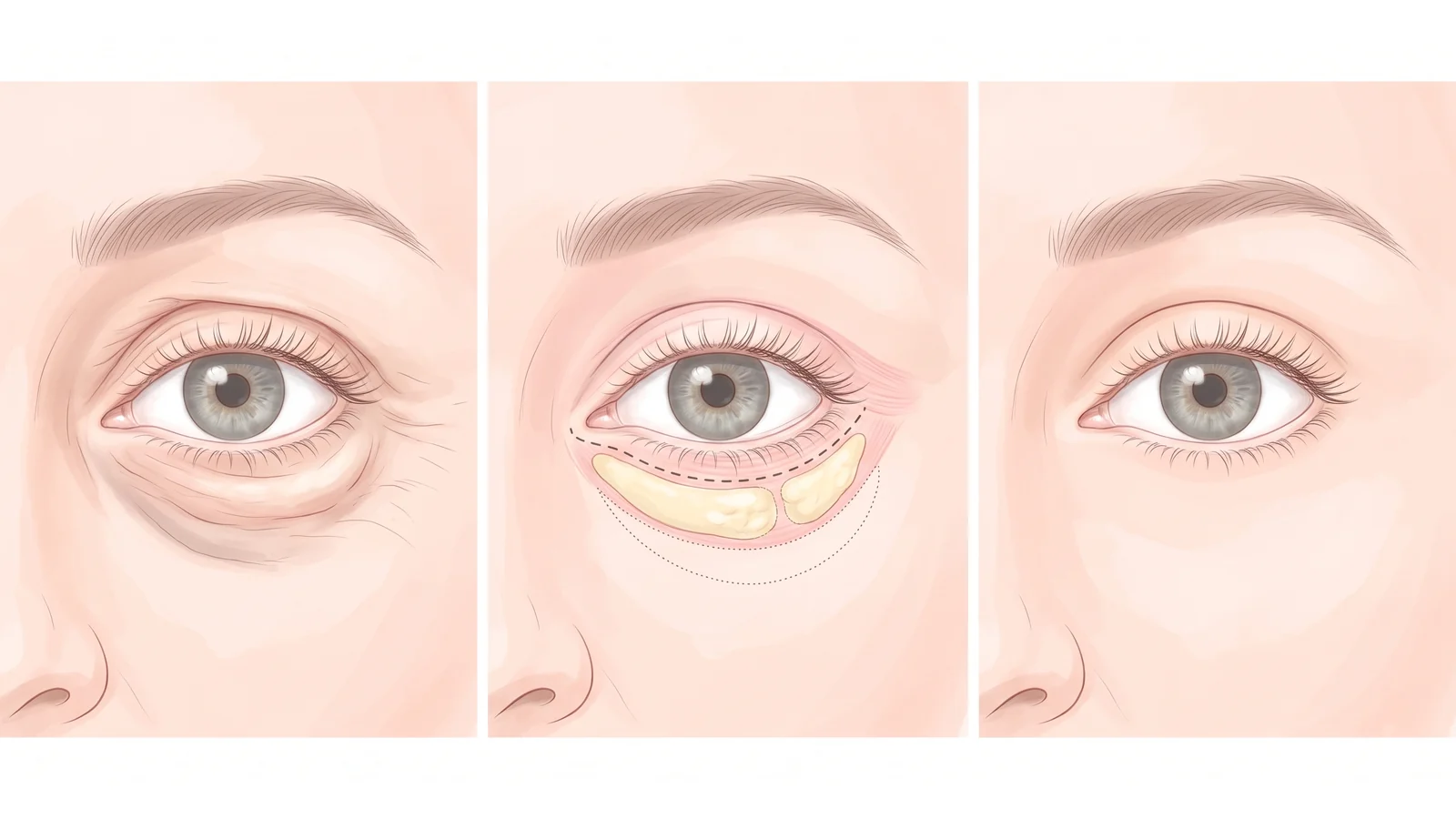
The lower lid ages in layers. Skin thins and creases, the thin muscle beneath it slackens, and the fat that cushions the eye pushes forward into a bag. When two or three of these show at once, a procedure that works on a single layer leaves the others behind, and that combination is what lower blepharoplasty is planned for. Skin, muscle and fat are each assessed and adjusted to the degree they have changed.
How much the skin has loosened sets the route. Firm skin over a bulge points to the inner approach, where nothing on the outside is cut. Crepey skin that folds into creases when you look up is a reason for the incision below the lashes, because that is the route through which skin can be removed. Shadow under the eye has more than one cause as well: a bag casting a shadow changes with surgery, while brown pigment in the skin itself does not.
Usually a good fit
- Loose lower-lid skin with fine creases
- Bulging fat that forms a bag under the eye
- Shadowing cast by the bag and the hollow below it
- Healthy eyes, with no untreated dryness or infection
- Able to stay in Seoul for about one week after surgery
We may suggest waiting
- Brown or bluish dark circles with no bag or loose skin
- Untreated dry eye or an active eye infection
- A lower lid that already sits low or pulls down
- Pregnancy or breastfeeding
- Hoping to avoid any incision or sedation
Before & after
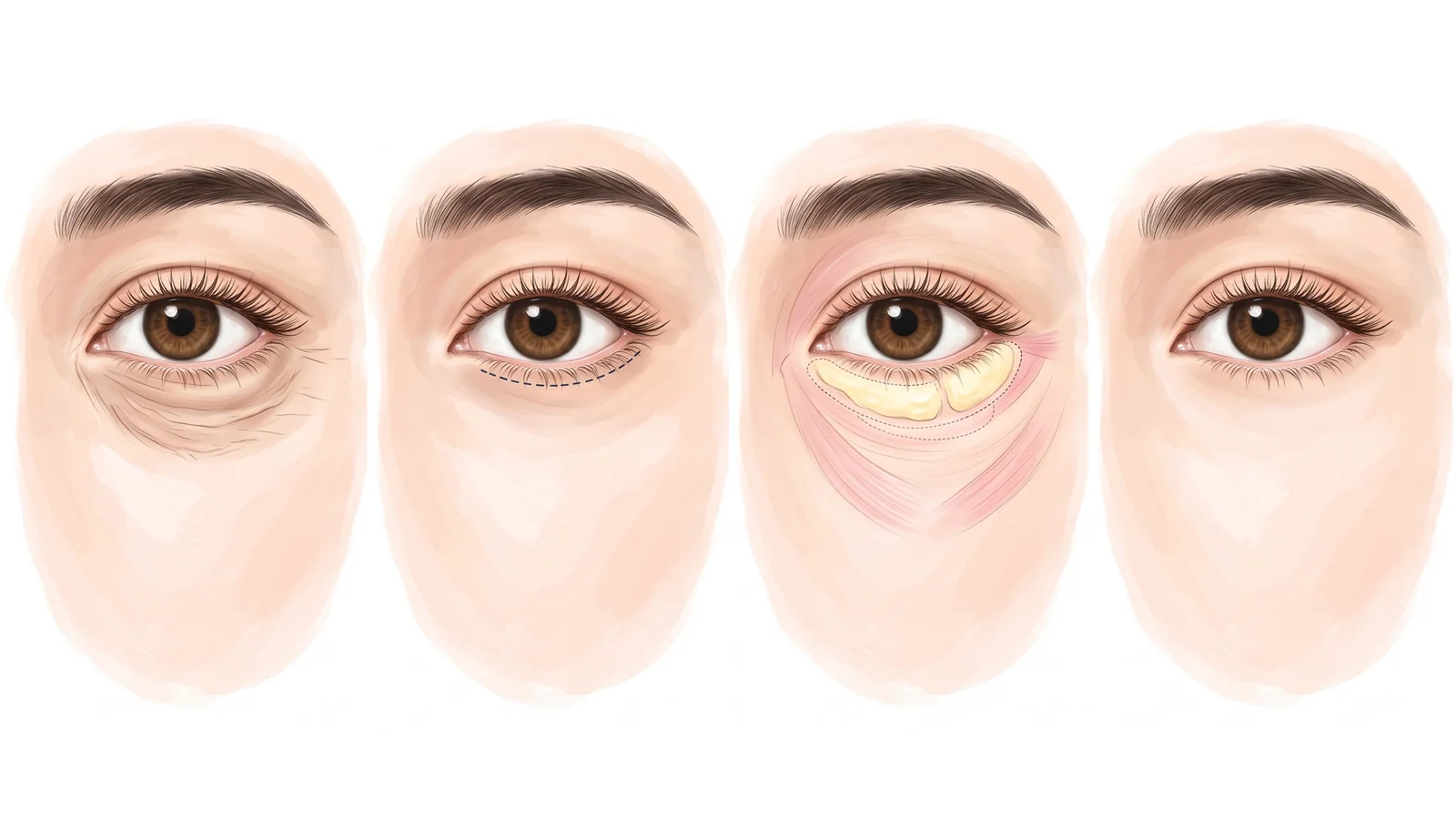
Lower blepharoplasty before and after
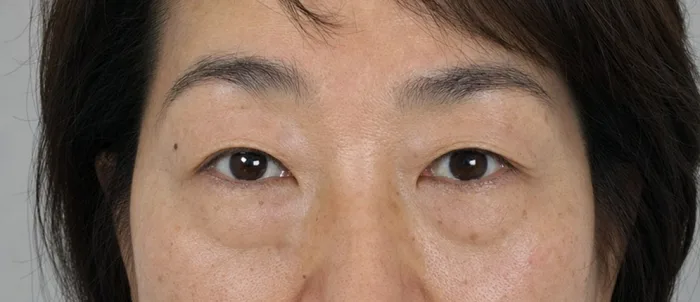 BEFORE
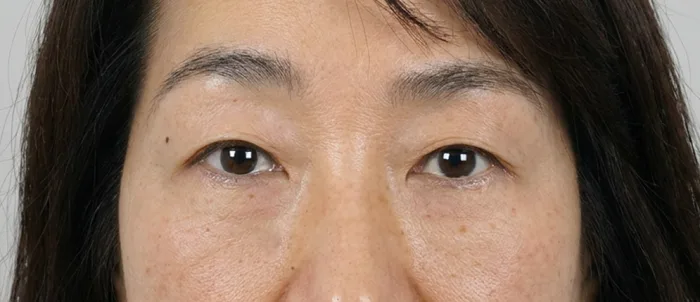 AFTER
How it works
How lower blepharoplasty reshapes the lower lid
Lower blepharoplasty is surgery on the lower eyelid that removes or repositions tissue so the lid and the top of the cheek meet in a smoother line. Two routes are used at ENTER Plastic Surgery. In the transcutaneous route, the incision follows the line just under the lower lashes, where it can settle into a natural crease; through it, excess skin is trimmed, the orbicularis muscle is tightened and fat is adjusted. In the transconjunctival route, the opening is on the pink inner lining of the lid, so there is no incision on the outer skin, and the work is limited to the fat.
What happens to the fat matters as much as the skin. Taking too much can leave the area hollow, so fat is reduced where it bulges and can be spread toward the groove where volume is missing. When researchers measured the two fat techniques, cutting fat away left a shorter lower lid, whereas moving it produced a smoother lid-cheek junction at a mean of 5.6 months (Ramesh, 2019); the authors suggested choosing the combination patient by patient. A 2025 systematic review of 36 studies described lower blepharoplasty as safe overall, with no reports of serious problems such as vision loss, and asked for stricter studies comparing techniques (Gimenez, 2025).
Reading the lower lid
At consultationDr. Jang Jin-woo checks skin laxity, fine creases, where the fat bulges and how firm the lid is, then decides between the incision under the lashes and the inner route.
Incision line under the lashes
With IV sedation, and local anesthesia added if needed, a fine incision is marked just below the lower lash line. In the inner route the opening is made inside the lid instead.
Skin, muscle and fat refined
30–90 minutes in totalBulging fat is trimmed or shifted toward the hollow, the muscle is tightened, and a measured strip of excess skin is removed so the lid is not pulled down.
Fine closure
The skin incision is closed with fine stitches that come out at about 5–7 days. An opening inside the lid is closed with stitches that dissolve.
Lower-lid options on the ENTER Plastic Surgery menu
| What differs | Lower blepharoplasty | Under-eye fat repositioning | Under-eye HA filler |
|---|---|---|---|
| Main concern addressed | Loose skin, creases and bulging fat | A fat bag above a hollow groove | A hollow with little or no bag |
| Where the work happens | Under the lashes, or inside the lid | Inside the lid | Injection; no incision |
| Excess skin | Trimmed on the skin route | Left in place | Left in place |
| Time | 30–90 minutes | 30–60 minutes | 15–30 minutes |
| Anesthesia | IV sedation, plus local as needed | IV sedation, plus local as needed | Numbing cream |
| Stitches | Out at 5–7 days (skin); dissolve (inner) | Dissolve on their own | None |
| Earliest flight (clinic guidance) | After 7 days | About 1 week | Same day or next day |
Durations and flight timing come from the clinic's treatment guide; each person heals at a different pace.

Your doctor
Chief Director · Korean board-certified plastic surgeon
“Natural, yet clearly visible change.”Eyelid and facelift surgery at ENTER is planned and performed by Dr. Jang himself.
- NowChief Director, ENTER Plastic Surgery
- TrainingPlastic surgery, Kyung Hee University Medical Center
- FormerChief Director, Jang Plastic Surgery
- FormerDirector, Secret Plastic Surgery
- MemberKSPRS · KSAPS · ISAPS · ESOPRS · ASPS
At a glance
Lower blepharoplasty in figures
| Procedure time | 30–90 minutes |
|---|---|
| Anesthesia | IV sedation, with local anesthesia if needed |
| Recovery | About 1 week; daily life at about 1 month; scar matures in 3–6 months |
| Follow-up visits | 1–2 follow-up visits |
| Stitches | Skin incision: removed about 5–7 days after surgery; inner-lid (conjunctival) incision: dissolve on their own |
| Return to exercise | Generally, light walking is encouraged from surgery day; jogging, aerobics, weight training and heavy lifting are avoided for about 2 weeks (published guidance 10–14 days, some 2–3 weeks) |
| Earliest flight home | After 7 days, once skin stitches are out |
Prices
Lower blepharoplasty cost in South Korea
The listed surgery fee is per operation. IV sedation appears as a second line on every surgical bill at the clinic, so budget for both. Each figure below is excluding VAT, with 10% VAT added at payment.
Medication, aftercare products and anything combined with another eyelid procedure sit outside these two lines. Request a written quote that itemizes them before you fix travel dates. If you set it beside a quote from home, compare like with like: fees quoted elsewhere may or may not include anesthesia and facility costs.
Prices exclude VAT (10% VAT is added at payment).
Recovery
What healing looks like after lower blepharoplasty
Swelling and tightness begin within hours. A little blood seeping from the incision during the first one to two days is normal.
Cold compresses for the first three days keep swelling down. Rest with your head raised on pillows and avoid bending forward or lifting.
Change to warm compresses: 30 seconds of warmth, then 5 minutes off, repeated. Do not blow your nose for two weeks, and sneeze gently with your mouth open.
Skin stitches come out at about one week, and the clinic's guidance is that you can fly home after this visit. With the inner route there is nothing to remove.
The ban on nose blowing ends. Keep watching for swelling that grows on one side, increasing pain or blurred vision, and report any of them at once.
Going out and everyday routines feel comfortable again at around one month after surgery.
The incision line keeps fading and flattening. It takes about three to six months to mature, so judge the scar at the end of that window.
Safety
Risks of lower blepharoplasty
Because skin and muscle can both be shortened, the concern specific to this surgery is the position of the lower lid. Removing a measured amount of skin is how the operation tries to protect it, yet no technique takes the risk away entirely.
- Lower-lid retraction, where the lid edge is pulled down and more white of the eye shows (scleral show).
- Ectropion, the lid edge turning outward, which can cause watering and irritation.
- Dry, gritty or watery eyes for weeks after surgery.
- Bruising, swelling and asymmetry between the two sides while healing.
- A visible or slightly raised incision line under the lashes during the months it matures.
- Bleeding behind the lid or infection, which needs prompt care, and revision surgery if contour or lid position is uneven.
Published complication rates are low, though follow-up in the studies tends to be short. A review covering 10,698 patients found reoperation in 0.77%, scleral show in 0.37% and ectropion in 0.24%, yet little photographic evidence on how long results hold (Wilson, 2018). Those are pooled literature figures and do not predict an individual outcome.
Evidence
Research behind this page
- Safety and Complications in Lower Eyelid Blepharoplasty: A Systematic ReviewPlastic and Reconstructive Surgery - Global Open · 2025 · Gimenez A et al. · doi:10.1097/gox.0000000000007102
Systematic review of 36 studies: lower blepharoplasty was generally safe with few complications and no reported vision loss; stronger comparative studies between techniques are still needed.
- Lower Eyelid Blepharoplasty: Does the Literature Support the Longevity of this Procedure?Aesthetic Surgery Journal · 2018 · Wilson S et al. · doi:10.1093/asj/sjy186
Review of 10,698 patients: low rates of reoperation (0.77%), scleral show (0.37%) and ectropion (0.24%), but long-term durability was poorly documented with photographs.
- Preventing and Managing Dry Eyes after Periorbital Surgery: A Retrospective ReviewPlastic & Reconstructive Surgery · 2009 · Hamawy A et al. · doi:10.1097/prs.0b013e31819346ea
Retrospective review: after periorbital surgery, dry eye lasted beyond two weeks in 10.9% and beyond two months in 2%; most cases improved with conservative care, supporting screening before surgery.
- Objective Comparison of Nasojugal Fold Depth and Lower Eyelid Length After Fat Excision Versus Fat Transpositional Lower BlepharoplastyAesthetic Surgery Journal · 2019 · Ramesh S et al. · doi:10.1093/asj/sjz082
Cohort comparison: fat excision shortened the lower eyelid, while fat transposition smoothed the lid-cheek junction (mean 5.6 months); low-level evidence that favors tailoring the technique.
FAQ
Lower blepharoplasty questions from international patients
When can I go out in public after lower blepharoplasty?
The clinic's guidance is about one week of recovery, with going out and normal daily life feeling comfortable at around one month. Skin stitches come out at one week, and the incision line takes three to six months to fade, so plan photos and events with that timeline in mind.
How long should I plan to stay in Seoul for lower blepharoplasty?
Plan on at least seven days. The clinic's guidance is that you can fly home after the one-week visit, when skin stitches are removed; with the inner route there are no stitches to take out. One or two follow-up visits fall inside that week, so leave a spare day before your return flight.
Who performs lower blepharoplasty at ENTER Plastic Surgery?
The operation is performed by Dr. Jang Jin-woo, a Korean board-certified plastic surgeon whose work centers on eyelid and brow surgery and facelifts. Training was at Kyung Hee University Medical Center, and memberships include KSPRS, KSAPS, ISAPS, ESOPRS and ASPS.
What does the lower blepharoplasty price include?
The surgery fee of ₩2,600,000 covers the operation, and IV sedation is a separate line at ₩300,000. Both exclude VAT, which adds 10% at payment. If you will need medication or aftercare items, ask for them to be listed individually in your written quote.
Can I arrange lower eyelid surgery from overseas?
Yes. Send the form on this page or message us on WhatsApp with your travel window and a short description of your lower lids, and we will get back to you as soon as possible. English-speaking staff are available at the clinic when you come in.
What are the deposit and cancellation terms?
They are set when you book and are not published on this page. Get them in writing before paying, and line them up against your flights, because moving the surgery date also moves the one-week stitch removal that decides when you can leave Korea.
Where is the scar after lower blepharoplasty?
With the skin route, the incision runs just below the lower lashes along the natural line of the lid. It looks pink at first and fades over three to six months. With the inner route there is no incision on the outer skin, because the opening is on the inside of the lid.
Will I be awake during lower eyelid surgery?
You will be under IV sedation, a drowsy and relaxed state, with local anesthetic (anaesthetic, as it is spelled in the UK) added where needed to numb the lid. Sedation is billed separately from the surgery fee, and you should arrange for someone to accompany you back to your hotel.
Can lower eyelid surgery pull the lid down?
It can. Lower-lid retraction, where the lid edge sits lower and more white shows beneath the iris, is a recognized complication, and so is ectropion. Limiting the amount of skin removed is the main safeguard. Report a lid that still looks pulled down once swelling settles, since early care is simpler.
Will my eyes feel dry after lower blepharoplasty?
They may, for a while. In a review of periorbital surgery, dry eye lasting longer than two weeks affected 10.9% of patients and beyond two months 2%, and conservative treatment helped most of them (Hamawy, 2009). Mention any history of dry eye or contact lens trouble before surgery.
Does lower blepharoplasty fix dark circles?
It helps when the darkness is a shadow cast by a bag or a hollow, because surgery changes that contour. Brown pigment in the skin, or a bluish tone from thin skin over blood vessels, is not changed by moving fat or trimming skin, so those circles need a different treatment.
Google reviews
Reviews on Google Maps
Great experience! Dr. is very sweet and kind. He listened to what I wanted to fix and correct. He explained everything very well. Wasn’t pushy and didn’t try to sell anything extra. This isn’t a clinic that comes out on instagram, which I…
 Jennifer LyuA month ago
I came to Enter Plastic Surgery on a friend’s recommendation for under-eye fat repositioning. I was pretty nervous going in, but the doctor took the time to explain what would work for my under-eyes, what the procedure involved, and what…
 Michael2 months ago
The staff are incredibly friendly, and the consultation was very thorough. I was very worried since it was my first procedure, but the director explained the aftercare in detail, so I felt completely confident trusting them!!
 ROOHEUI SHIN (RHS)2 months ago · Translated by Google