

A nasal splint stays on for about 7 days after rhinoplasty in Seoul, Korea, and the clinic's guidance is that you can fly home once it comes off. Dr. Jang Jin-woo, a Korean board-certified plastic surgeon, reshapes the bridge and tip through an open or closed approach, using an implant or cartilage from the ear, the nasal septum or a rib.
Is it for you?
Which noses rhinoplasty is planned for
Rhinoplasty changes structure: the height of the bridge, the projection and outline of the tip, a bump seen in profile, or the width of the nostril base. It fits a concern that lives in that framework, and a schedule that can give the nose months to settle after the first week in a splint.
A short trip and a wish for a small, easily reversed change point elsewhere, since this operation asks for a week of splint time and four weeks without glasses on the bridge. Planning also turns on material. An implant adds height along the bridge, ear and septal cartilage shape and support the tip, and rib cartilage supplies more tissue when the nose needs stronger structure. Each choice changes the price line, the listed operating time and whether a second small incision is needed elsewhere.
Usually a good fit
- A low or flat bridge you would like raised
- A tip that looks wide, rounded or lacks projection
- A bump along the bridge seen in profile
- A nostril base that looks wide from the front
- Able to stay in Seoul about 7 days, until the splint is off
We may suggest waiting
- Wanting a change with no splint and no downtime
- Needing glasses on the bridge daily within 4 weeks
- Active infection or inflammation on or around the nose
- Pregnancy or breastfeeding
- Unable to stay until the splint is removed
How it works
How rhinoplasty reshapes the bridge, tip and nostrils
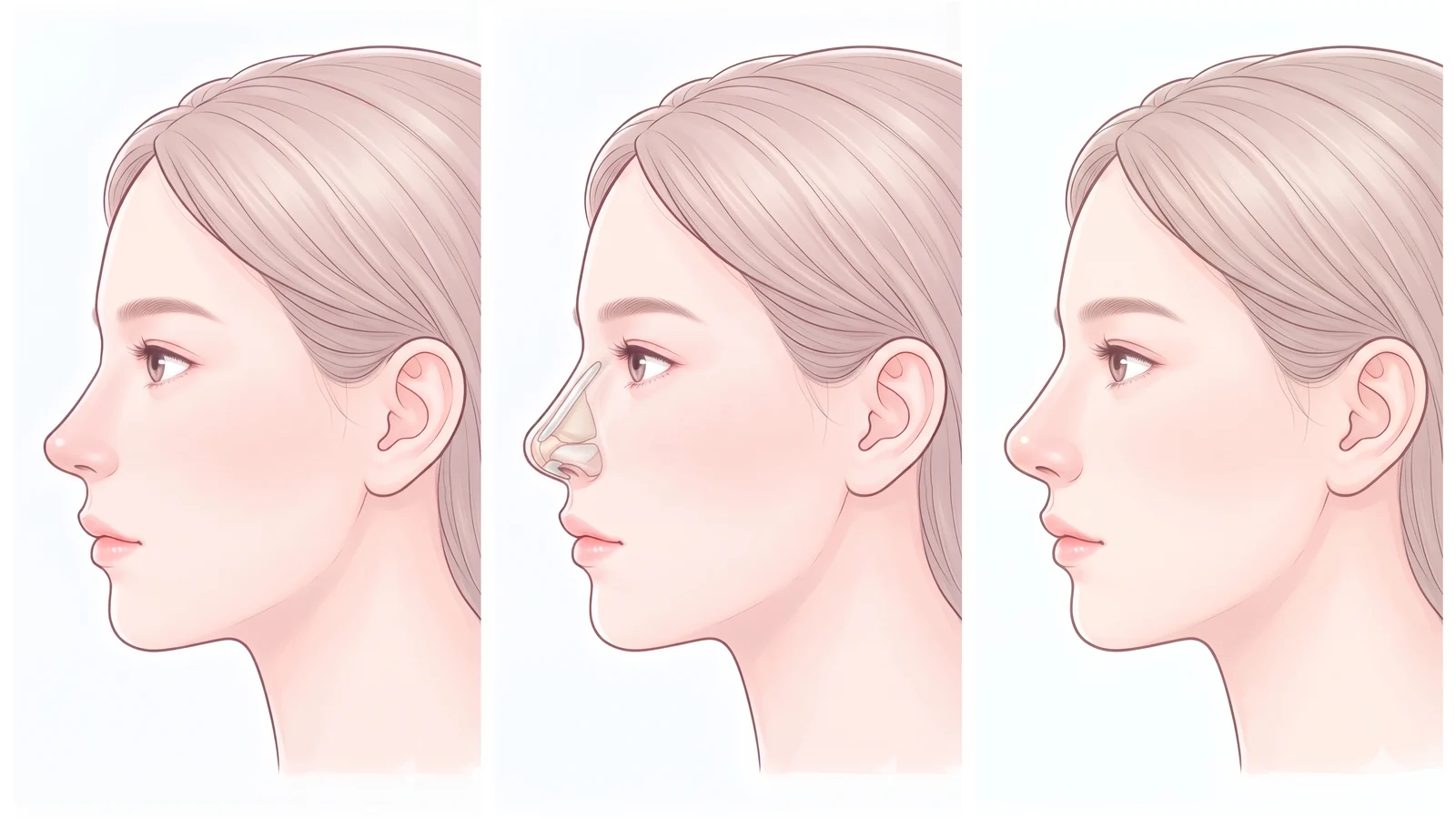
The upper third of the nose is bone; below it sits a frame of cartilage, covered by skin that is thicker over the tip than over the bridge. Rhinoplasty works on that frame. In the open approach, a short incision across the columella (the strip of skin between the nostrils) joins incisions inside the nostrils, so the skin can be lifted and the tip cartilage seen directly. The closed approach keeps every incision inside the nostrils, which gives less room for detailed tip work.
Material shapes much of the plan. The clinic's guide sheet for rhinoplasty lists a silicone implant, which raises the bridge. Ear cartilage, taken from the bowl of the ear, and septal cartilage, from the partition inside the nose, support and refine the tip. Rib cartilage comes either from a donor tissue bank or from your own chest, and harvesting your own rib adds a second surgical site. Hump reduction and bulbous-tip refinement are add-ons to a rhinoplasty, while alar reduction narrows the nostril base through inner incisions, outer incisions in the crease beside the nostril, or both.
No material wins on every measure. A meta-analysis comparing autologous cartilage with silicone implants found higher satisfaction and fewer complications with cartilage, and it flagged differences between studies and possible publication bias (Wu, 2022).
Planning the shape
At consultationDr. Jang Jin-woo assesses the bridge, tip, nostril width and skin thickness, and agrees with you which approach and which material the plan will use.
Sedation and incisions
Under IV sedation, incisions are made inside the nostrils, with a short cut across the columella added when the open approach is planned.
Shaping the frame
The implant or cartilage graft is placed along the bridge or at the tip, a hump is reduced if planned, and the nostril base is narrowed when alar reduction is included.
Splint and stitches
About 7 daysThe incisions are closed and a splint is fixed over the nose. Daily activities can resume straight away, and the splint and stitches come off at about one week.
Rhinoplasty options on the ENTER Plastic Surgery price list
| Point of comparison | Open, basic | Closed, ear cartilage | Open, donor rib | Alar reduction, both |
|---|---|---|---|---|
| Incisions | Inside the nostrils and across the columella | Inside the nostrils | Inside the nostrils and across the columella | Inside the nostril and in the alar crease |
| Main material | Implant-based plan | Cartilage from the ear | Banked donor rib cartilage | No graft; tissue is removed |
| Second surgical site | None | The ear | None | None |
| Listed surgery time | About 2 hours | About 2 hours | About 2.5 hours | About 1.5 hours |
| Price | ₩2,000,000 + VAT | ₩3,300,000 + VAT | ₩6,500,000 + VAT | ₩1,300,000 + VAT |
Surgery times are the clinic's price-list estimates; IV sedation is a separate charge for every operation.

Your doctor
Chief Director · Korean board-certified plastic surgeon
“Natural, yet clearly visible change.”Eyelid and facelift surgery at ENTER is planned and performed by Dr. Jang himself.
- NowChief Director, ENTER Plastic Surgery
- TrainingPlastic surgery, Kyung Hee University Medical Center
- FormerChief Director, Jang Plastic Surgery
- FormerDirector, Secret Plastic Surgery
- MemberKSPRS · KSAPS · ISAPS · ESOPRS · ASPS
At a glance
Rhinoplasty facts for planning the trip
| Anesthesia | IV sedation; general anesthesia is also listed by the clinic |
|---|---|
| Recovery | Splint and stitches about 1 week; daily activities right away |
| Stitches | Splint and stitches off at about 1 week |
| Return to exercise | Generally, light walking every day is encouraged; strenuous exercise is avoided for about 2–3 weeks, diving and skiing for about 2 months and contact sports for about 3 months (published guidance) |
| Earliest flight home | About 7 days, once the splint has been removed |
Prices
Rhinoplasty cost in South Korea, line by line
A rhinoplasty quote at ENTER Plastic Surgery is built from three kinds of line. The base operation is priced by approach and material, so a closed plan with ear cartilage and an open plan with your own rib cartilage sit far apart. Hump reduction and bulbous-tip refinement are add-ons that sit on top of a base operation and are not sold alone. IV sedation is charged as its own line on every surgery the clinic performs, general anesthesia cases included.
Each amount below is listed before VAT, and 10% VAT is added at payment. Ask whether prescribed medication and aftercare items are included, and have them written into the quote before you book flights.
Prices exclude VAT (10% VAT is added at payment).
Recovery
Rhinoplasty recovery, from splint to shape check
The splint goes on and daily activities can start again. A little bleeding from the nostrils over the first one to two days is normal. Take the prescribed medicine every morning and evening.
Use cold compresses for the first three days to keep swelling down.
Switch to warm compresses in a rhythm of 30 seconds of warmth and 5 minutes of rest, repeated.
The splint and stitches come off at about one week. From this point, the clinic's guidance is that you can fly home.
Do not blow your nose hard for two weeks. Wipe away a runny nose gently instead.
Keep glasses and sunglasses off the bridge for four weeks so their weight does not press on the healing nose.
A follow-up check on the shape takes place two to three months after surgery, as the tip swelling keeps easing.
Safety
Risks and limits of rhinoplasty
Call the clinic right away for a fever, pain that does not ease, or bleeding that keeps flowing beyond the first two days.
- Bleeding and swelling, with bruising that can spread around the eyes in the first days.
- Infection around an implant or graft, which may need antibiotics or removal of the material.
- Warping, shifting or resorption of a cartilage graft, or an implant that moves or shows its outline under thin skin.
- Asymmetry, contour irregularity or a tip shape that differs from the plan.
- Changes in breathing through the nose, or reduced feeling at the tip for a period.
- A visible line across the columella after the open approach, or in the alar crease after outer alar reduction.
- Pain or a scar at the chest when your own rib is used, or at the ear when ear cartilage is taken.
- Revision surgery to correct the shape or treat a complication.
Published figures give a sense of scale without predicting any one result. A meta-analysis of 20 studies and 1,648 patients treated with autologous rib cartilage reported warping in 3.05%, infection in 1.45% and revision in 2.25%, and counting chest donor-site problems raised the complication rate further (Chen, 2022). Across dorsal reconstructions, overall complications ran at 7.1%, a little higher with alloplastic implants than with the patient's own tissue (Hudise, 2022). Another review found a 14% complication rate for rib cartilage yet pointed out that it is chosen more in revision work, and it judged the evidence too thin to set firm rules on material choice (Liang, 2018).
Evidence
Research behind this page
- A systematic review and meta-analysis of the efficacy and complication rates of augmentation rhinoplasty with autologous cartilage and silicone prosthesisAnnals of Palliative Medicine · 2022 · Wu C et al. · doi:10.21037/apm-22-111
Meta-analysis of 7 studies and 1,233 patients: augmentation with autologous cartilage gave higher satisfaction and fewer complications and revisions than silicone implants, with heterogeneity and publication bias limiting certainty.
- Complications Associated with Autologous Costal Cartilage Used in Rhinoplasty: An Updated Meta-AnalysisAesthetic Plastic Surgery · 2022 · Chen H et al. · doi:10.1007/s00266-022-03075-3
Updated meta-analysis of 20 studies and 1,648 patients with autologous rib cartilage: warping was the most frequent complication (3.05%), followed by contour irregularity, infection and resorption, and chest donor-site problems added to the total.
- Complications of the nasal dorsum reconstruction using autologous or alloplastic grafts: evidence from systematic review and meta-analysisBrazilian Journal of Otorhinolaryngology · 2022 · Hudise J et al. · doi:10.1016/j.bjorl.2020.07.001
Systematic review of nasal dorsum reconstruction: overall complications 7.1%, slightly higher with alloplastic grafts than autologous tissue; revision, infection, deviation and hypertrophic scarring were the most common, and Asian patients had fewer complications overall.
- A systematic review and meta-analysis of comparison between autologous costal cartilage and alloplastic materials in rhinoplastyJournal of Plastic, Reconstructive & Aesthetic Surgery · 2018 · Liang X et al. · doi:10.1016/j.bjps.2018.03.017
Meta-analysis of autologous rib cartilage versus alloplastic materials: rib cartilage showed a 14% complication rate, possibly reflecting its use in revisions, and high-quality evidence was too scarce to guide material choice.
FAQ
Rhinoplasty questions from visitors to Seoul
How long does swelling last after rhinoplasty?
The splint comes off at about one week, and the bridge looks more defined from then. The tip has thicker skin and holds its swelling longest, so its final outline takes months to show. The clinic books a shape check two to three months after surgery to review how the nose is settling.
How long should I plan to stay in Korea for a nose job?
Plan on about 7 days. The splint and stitches come off at around one week, and the clinic's guidance is that you can fly home after that appointment. A flexible return ticket helps, and remember the two-week rule against blowing your nose hard, which still applies on the flight.
Which doctor operates on the nose at ENTER Plastic Surgery?
Dr. Jang Jin-woo performs the operation. Dr. Jang is a Korean board-certified plastic surgeon who trained in plastic surgery at Kyung Hee University Medical Center, and is a member of the Korean Society for Aesthetic Plastic Surgery and of ISAPS, the International Society of Aesthetic Plastic Surgery.
What does a rhinoplasty quote add on top of the base price?
Two things beyond the base operation. Add-ons such as hump reduction or bulbous-tip refinement are priced separately, and IV sedation is charged at ₩300,000 + VAT for every surgery. All figures exclude VAT, which adds 10% when you pay.
How can I ask about rhinoplasty from overseas?
Fill in the form on this page or send a message on WhatsApp, and we will get back to you as soon as possible. English-speaking staff are available at the clinic. Clear front and side photos of your nose, plus your travel dates, help the first reply be specific to your plan.
Is there a deposit for booking rhinoplasty, and what if I cancel?
Deposit and cancellation terms are agreed for each booking, so request them in writing before paying anything. Check them against your flights as well, because the splint removal at about one week sets your earliest return, and moving the surgery date moves that appointment too.
How do the open and closed approaches differ?
The open approach adds a short incision across the columella so the tip cartilage can be seen directly; the closed approach keeps all incisions inside the nostrils. On the clinic's price list, closed plans use ear cartilage or ear and septal cartilage, and every rib cartilage plan is open.
Does the open approach leave a visible mark under the nose?
It leaves a fine line across the columella, the skin strip between the nostrils, which can stay visible up close. In a review of dorsal reconstruction, hypertrophic scarring appeared in 1.6% of cases overall (Hudise, 2022). The closed approach keeps its incisions inside the nostrils instead.
Should my graft come from the rib or the ear?
That depends on how much support your nose needs. Ear cartilage is curved and limited in amount, which suits tip shaping. Rib cartilage gives a larger, stiffer supply, with a longer listed operating time; your own rib adds a chest incision, and banked donor rib avoids that site but can resorb or warp.
When can I wear glasses again after rhinoplasty?
After four weeks. The clinic asks you to keep glasses and sunglasses off the bridge for the first four weeks, because their weight presses on the healing nose. If you rely on vision correction, bring contact lenses for that period or plan around it before you book.
Will my insurance cover a nose job done in Korea?
We cannot say whether your insurer will cover treatment abroad; check with your provider before you travel. If you need paperwork for a claim, ask for an itemized quote and receipt that list the base operation, any add-ons and IV sedation as separate lines.
Can I go about my day after rhinoplasty?
Yes. Daily activities are possible straight after surgery, with the splint in place. Use cold compresses for the first three days, switch to warm ones from day four in a 30-second and 5-minute rhythm, and take the prescribed medicine morning and evening.
Google reviews
Reviews on Google Maps
Great experience! Dr. is very sweet and kind. He listened to what I wanted to fix and correct. He explained everything very well. Wasn’t pushy and didn’t try to sell anything extra. This isn’t a clinic that comes out on instagram, which I…
 Jennifer LyuA month ago
I came to Enter Plastic Surgery on a friend’s recommendation for under-eye fat repositioning. I was pretty nervous going in, but the doctor took the time to explain what would work for my under-eyes, what the procedure involved, and what…
 Michael2 months ago
The staff are incredibly friendly, and the consultation was very thorough. I was very worried since it was my first procedure, but the director explained the aftercare in detail, so I felt completely confident trusting them!!
 ROOHEUI SHIN (RHS)2 months ago · Translated by Google