
Cutting out a keloid on the earlobe or rim is only half of the plan, because the scar tissue can regrow from the new wound. Ear keloid removal in Seoul, Korea pairs a 20 to 40 minute excision under local anesthesia with triamcinolone (TA) steroid injections every four to six weeks, three to five times. Dr. Jang Jin-woo performs the surgery.
Is it for you?
Who ear keloid surgery is for
A keloid is a raised scar that keeps growing past the edge of the wound that caused it, here a piercing hole, a cut or a scratch on the ear. A hypertrophic scar looks similar at first but stays within the original wound and can flatten with time. The difference matters, because a scar that stays inside its borders is handled with flatter-scar treatments, while a firm, rounded mass that has spread beyond them is what excision is designed for.
The surgery suits people who can commit to the steps after it. Removal leaves a fresh wound, and a fresh wound in someone who forms keloids can form a new one. Wearing a pressure earring, using a silicone sheet and returning for steroid injections over the following months are part of the treatment, so the decision includes planning for that schedule as well as for the operation day.
Usually a good fit
- A raised, firm keloid on the earlobe or ear rim
- A growth that formed after an ear piercing or injury
- A keloid that has kept growing or causes itching or pain
- Willing to wear a pressure earring and silicone sheet
- Able to plan three to five injection sessions afterward
We may suggest waiting
- A flat or slightly raised scar inside the original wound
- An infected, inflamed or freshly pierced earlobe
- Keloids on other body areas, outside this ear surgery
- Pregnancy, where steroid injections need separate advice
- Unable to follow the injection and pressure plan
How it works
How ear keloid removal is done
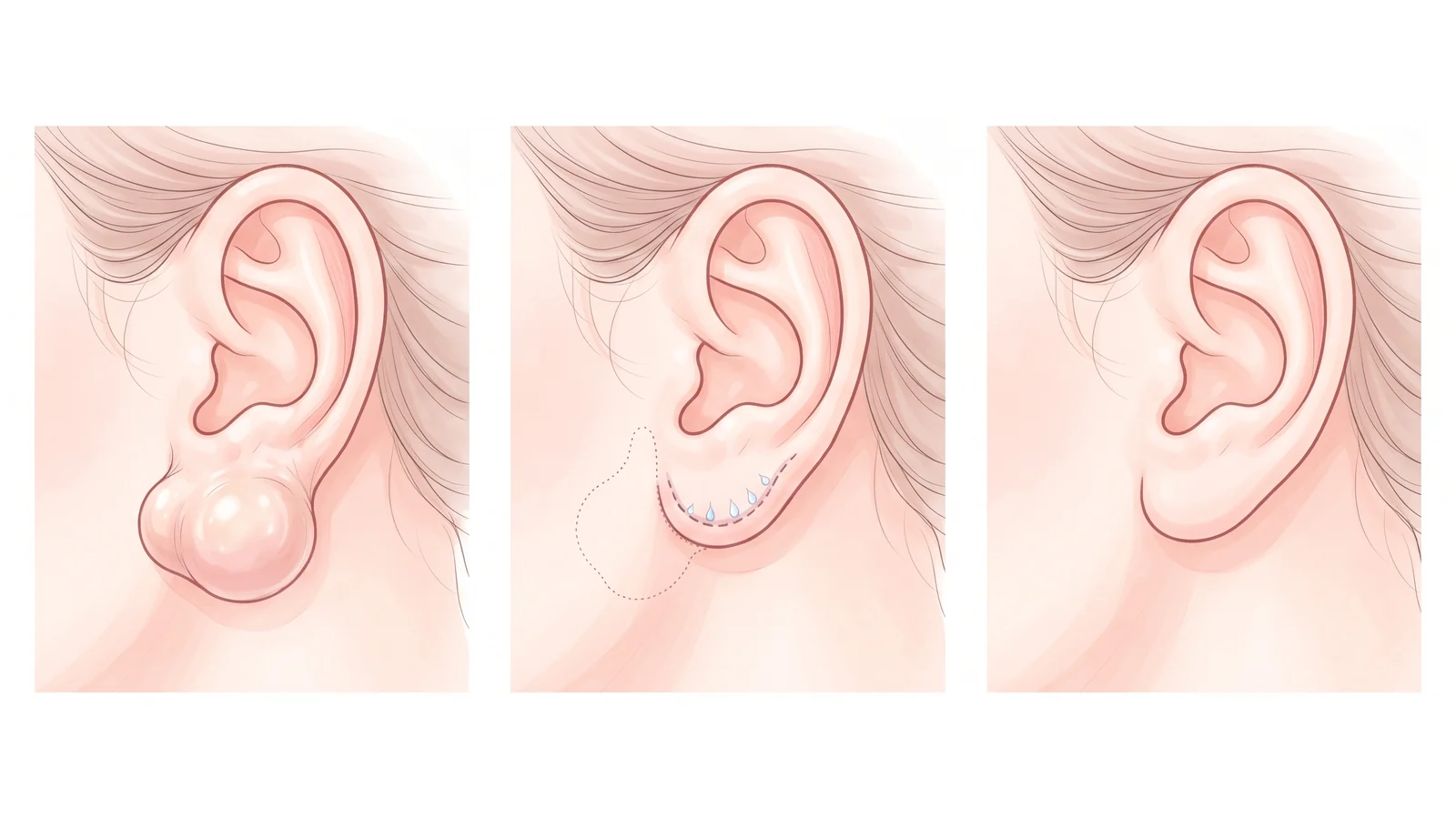
Keloid tissue is made of thick, disorganized bands of collagen laid down by overactive scar cells (fibroblasts). On the ear it grows as a rounded lump, at the front or back of the lobe or along the rim, and can reach several times the size of the original piercing. Excision removes this mass and closes the defect with fine stitches, shaping the lobe or rim as closely as the remaining tissue allows.
The excision on its own does not switch off the tendency to form keloids, so the stitched wound is then managed to keep new scar tissue from building up. The clinic's plan uses high-concentration triamcinolone acetonide (TA), a corticosteroid injected into the scar, at four to six week intervals for three to five sessions, with progress checked each time. A pressure earring and a silicone sheet over the healed wound are recommended alongside.
The research base for keloid care is uneven. A 2023 systematic review of 108 studies found that differences in design, size and outcome measures limit firm conclusions about steroids, cryotherapy, lasers, excision with radiation or pressure, and called for larger controlled trials (Walsh, 2023). A meta-analysis on raised scars reported better results when TA was combined with 5-fluorouracil than with either drug alone (Mavilakandy, 2023).
Assessing the keloid
At consultationDr. Jang Jin-woo examines the size and position of the mass, how firm it is and whether it has grown beyond the original wound, and plans the line of excision.
Local anesthesia and excision
20–40 minutesThe ear is numbed with local anesthesia and the keloid tissue is cut out, preserving as much of the lobe or rim as possible.
Closing the ear
The wound is closed with fine stitches that come out after seven to ten days; after you fly home, they can be removed by a local doctor.
Steroid injections
Triamcinolone is injected into the healing scar every four to six weeks, three to five times, to discourage new keloid tissue.
Pressure and silicone
A pressure earring and a silicone sheet are recommended over the healed area while the scar matures, and progress is checked at each injection.
Two scar options on the ENTER Plastic Surgery menu
| Point of comparison | Ear keloid excision | Scar laser set |
|---|---|---|
| Main target | A raised keloid mass on the ear | Surface texture and color of a scar |
| How it is done | Cut out, then stitched closed | Laser with Rejuran and a TA injection |
| Anesthesia | Local anesthesia | Numbing cream |
| Time per visit | 20–40 minutes | 20–40 minutes |
| Number of sessions | 1 surgery + 3–5 TA injections | 3–5 sessions, 4–6 weeks apart |
| Stitches | Removed at 7–10 days | None |
| Flying home (clinic guidance) | After 2–3 days | The next day |
The scar laser set is aimed at flatter scars; the clinic treats raised parts with TA injections and the surface with laser.
Your doctor
Chief Director · Korean board-certified plastic surgeon
“Natural, yet clearly visible change.”Eyelid and facelift surgery at ENTER is planned and performed by Dr. Jang himself.
- NowChief Director, ENTER Plastic Surgery
- TrainingPlastic surgery, Kyung Hee University Medical Center
- FormerChief Director, Jang Plastic Surgery
- FormerDirector, Secret Plastic Surgery
- MemberKSPRS · KSAPS · ISAPS · ESOPRS · ASPS
At a glance
Ear keloid excision at a glance
| Procedure time | 20–40 minutes |
|---|---|
| Anesthesia | Local anesthesia |
| Recovery | Swelling 3–5 days; daily routine the same day |
| Return to exercise | Generally, strenuous exercise is avoided for about 2 weeks, depending on where the wound is |
| Earliest flight home | After 2–3 days; stitches can be removed at home |
Prices
Ear keloid surgery cost in South Korea
The excision is charged as one surgery fee, shown in the card below before VAT, and 10% VAT is added at payment. The operation is done under local anesthesia; if IV sedation is added, it is billed as its own line, as it is for every surgery at the clinic.
The steroid injections that follow, the pressure earring and the silicone sheet are not described as part of the surgery line. Ask for each of them to appear as a separate item in your written quote, together with the number of injection sessions planned, so the full course is clear before you travel.
Prices exclude VAT (10% VAT is added at payment).
Recovery
After ear keloid excision: the first weeks
The ear is dressed and you can return to your daily routine the same day. Keep the area clean and dry and avoid pressure on that side when you lie down.
Washing your face and showering are allowed from the next day, with the surgical site kept waterproof.
The clinic's guidance is that you can fly home after two to three days. The stitches can stay in and be removed by a doctor at home.
Swelling around the ear settles over three to five days. Increasing redness, warmth, discharge or pain is a reason to contact the clinic.
The stitches come out after seven to ten days. After that, the pressure earring and silicone sheet are used over the closed wound.
Triamcinolone injections continue every four to six weeks for three to five sessions, and the scar is checked each time for any sign of regrowth.
Safety
Risks and limits of ear keloid surgery
Excision removes the mass you can see. It does not change the skin's tendency to over-scar, and that is the central limit of this operation.
- Recurrence of the keloid at the excision site, which can be larger than before; the steroid and pressure plan aims to lower this risk.
- A new keloid at stitch marks or at a later piercing on the same ear.
- Skin thinning, lighter skin color, small visible blood vessels or a dent where the steroid is injected.
- Wider effects of steroid injections on the body; a systematic review found Cushing's syndrome reported after injected triamcinolone, with children most at risk and low risk within adult dosing (Fredman, 2013).
- Bleeding, infection or the wound opening before it has healed.
- A change in the shape or size of the earlobe or rim compared with the other ear.
Lasers are another approach discussed for keloids, but a Cochrane review found the evidence for laser treatment of keloid and hypertrophic scars insufficient because of small, conflicting studies (Leszczynski, 2022).
Evidence
Research behind this page
- Keloid treatments: an evidence-based systematic review of recent advancesSystematic Reviews · 2023 · Walsh L et al. · doi:10.1186/s13643-023-02192-7
Systematic review of 108 studies on keloid treatment: heterogeneity, small samples and inconsistent designs limit conclusions, and larger controlled trials of each treatment are needed.
- Comparing Combination Triamcinolone Acetonide and 5-Fluorouracil with Monotherapy Triamcinolone Acetonide or 5-Fluorouracil in the Treatment of Hypertrophic Scars: A Systematic Review and Meta-AnalysisPlastic & Reconstructive Surgery · 2023 · Mavilakandy A et al. · doi:10.1097/prs.0000000000010867
Meta-analysis on hypertrophic scars: combined triamcinolone and 5-fluorouracil injections outperformed either drug used alone.
- Cushing's syndrome after intralesional triamcinolone acetonide: A systematic review of the literature and multinational surveyBurns · 2013 · Fredman R · doi:10.1016/j.burns.2012.09.020
Systematic review and survey: Cushing's syndrome has been reported after intralesional triamcinolone; risk appears low within adult dosing but highest in children, so monitoring and patient education are advised.
- Laser therapy for treating hypertrophic and keloid scarsCochrane Database of Systematic Reviews · 2022 · Leszczynski R et al. · doi:10.1002/14651858.cd011642.pub2
Cochrane review: evidence for laser treatment of hypertrophic and keloid scars is insufficient because of heterogeneous, small and conflicting studies, and long-term trials including recurrence are needed.
FAQ
Ear keloid removal FAQ
How long does swelling last after keloid excision on the ear?
Swelling around the ear settles over about three to five days. You can go back to your daily routine on the surgery day, and wash your face and shower from the next day with the site kept waterproof. Spreading redness, discharge or increasing pain should be reported to the clinic.
How many days should I stay in Seoul for ear keloid removal?
Plan on two to three days after surgery. The clinic's guidance is that you can fly home after that, and the stitches, which come out at seven to ten days, can be removed by a doctor in your home country. The later steroid injections are a separate schedule to plan.
Who performs the keloid surgery?
Dr. Jang Jin-woo, a Korean board-certified plastic surgeon, performs ear keloid removal at ENTER Plastic Surgery. Dr. Jang trained in plastic surgery at Kyung Hee University Medical Center and is a member of the Korean Society of Plastic and Reconstructive Surgeons and ESOPRS, the European society for eyelid and orbital plastic surgery.
Does the keloid surgery price include VAT and the injections?
No. The excision fee of ₩1,300,000 is listed before 10% VAT, and IV sedation, if added, is a separate ₩300,000 + VAT. The follow-up steroid injections, pressure earring and silicone sheet are not described as part of that fee, so request them as separate lines in your quote.
How do I contact the clinic from abroad?
Send the form on this page or message us on WhatsApp, and we will get back to you as soon as possible. English-speaking staff are available at the clinic. A clear photo of the front and back of the ear and how long the keloid has been growing help with the first reply.
Do I need to pay a deposit, and what if I cancel?
Deposit and cancellation terms are set for each booking, so ask for them in writing before you pay. Since the injection sessions continue for months after the operation, it also helps to agree on that schedule before you fix your surgery and flight dates.
What is done to stop the keloid from growing back?
Three measures follow the excision. Triamcinolone is injected into the healing scar every four to six weeks, three to five times; a pressure earring presses on the area; and a silicone sheet covers the closed wound. Together they aim to lower the chance of regrowth, though no plan can rule it out.
Are the triamcinolone steroid injections safe?
They carry known risks: skin thinning, lighter color or a dent at the injection site, and, in published reports, effects on the whole body. A systematic review found Cushing's syndrome reported after injected triamcinolone, with low risk within adult dosing and the highest risk in children (Fredman, 2013). Doses are checked at each session.
Is an ear keloid the same as a piercing bump or hypertrophic scar?
No. A keloid grows beyond the edges of the original wound and does not shrink on its own. A hypertrophic scar stays within the wound and can flatten over months, and a small piercing bump may be irritation or infection. Telling them apart at the consultation decides whether surgery is needed.
Can I have the follow-up injections after I go home?
The injection course runs for several months after you leave, so it has to be planned before surgery. The stitches can be removed by a local doctor, but how the triamcinolone sessions will be arranged in your case should be confirmed at your consultation, including who will give them.
Will I be awake during ear keloid removal?
Yes. The ear is numbed with local anesthesia (local anaesthetic, in UK spelling), so you are awake and can talk during the 20 to 40 minute operation. The numbing injection stings briefly; after that you feel pressure and movement around the ear rather than sharp pain.
Google reviews
Reviews on Google Maps
Great experience! Dr. is very sweet and kind. He listened to what I wanted to fix and correct. He explained everything very well. Wasn’t pushy and didn’t try to sell anything extra. This isn’t a clinic that comes out on instagram, which I…
 Jennifer LyuA month ago
I came to Enter Plastic Surgery on a friend’s recommendation for under-eye fat repositioning. I was pretty nervous going in, but the doctor took the time to explain what would work for my under-eyes, what the procedure involved, and what…
 Michael2 months ago
The staff are incredibly friendly, and the consultation was very thorough. I was very worried since it was my first procedure, but the director explained the aftercare in detail, so I felt completely confident trusting them!!
 ROOHEUI SHIN (RHS)2 months ago · Translated by Google