

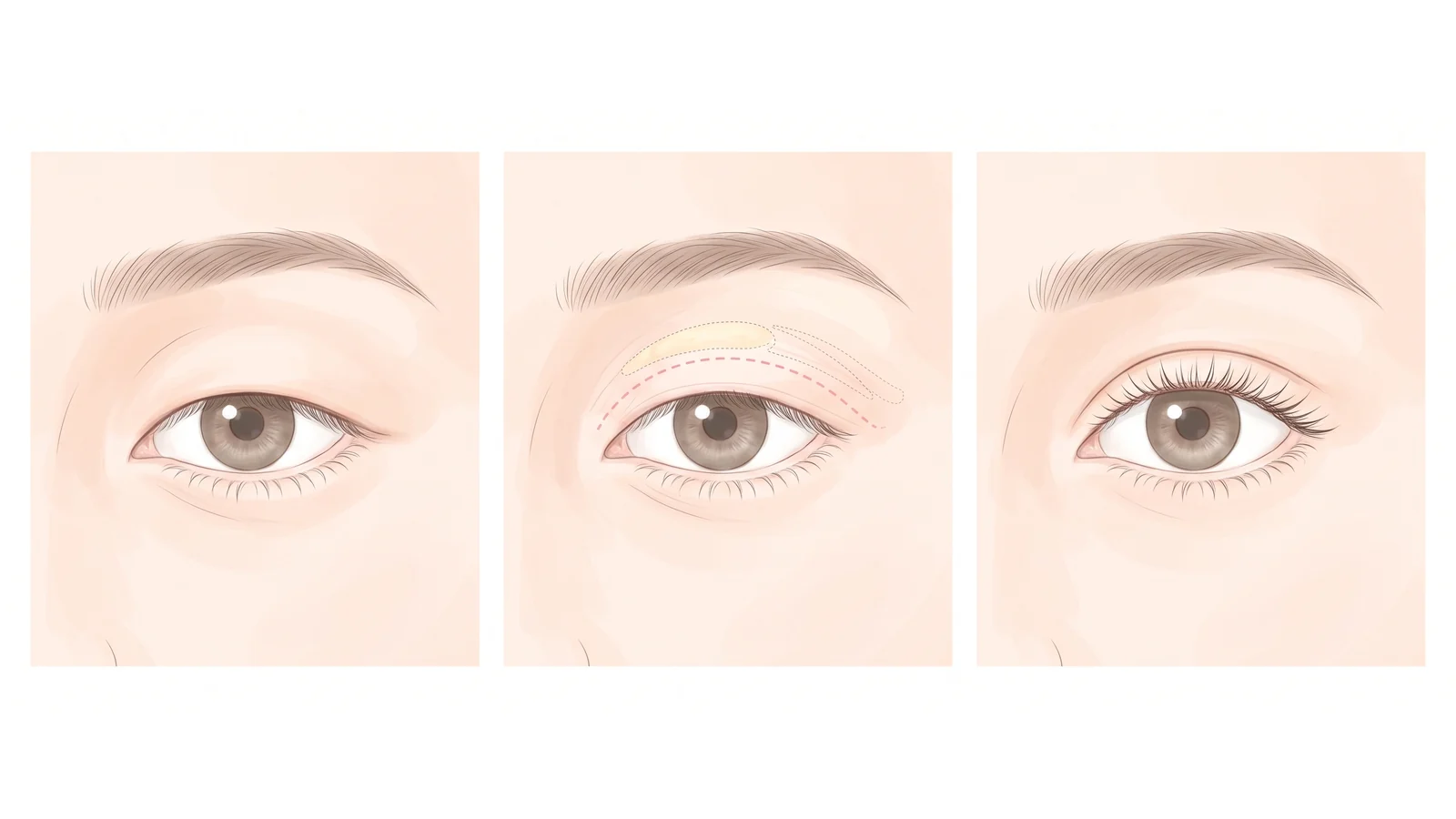
Incisional double eyelid surgery in Seoul, Korea forms an upper-eyelid crease (the supratarsal fold) through an incision along a line designed for each eye; the skin is attached to deeper lid tissue so it folds as the eye opens. Dr. Jang Jin-woo performs it in about 40 to 60 minutes under local anesthesia, and the stitches come out after five to seven days.
Is it for you?
Who incisional double eyelid surgery suits
The incisional method is chosen when a crease needs to hold against tissue that tends to push it down. Thick upper-lid skin, a full pad of fat above the lashes, or a little excess skin all work against a fold made with stitches alone. With an incision, the surgeon can see the layers directly, trim what is in the way and attach the skin where the new crease should sit. The same reasoning applies when a crease made earlier with buried sutures has loosened.
Two problems look similar to a missing crease but need a different plan. If heavy, hooding skin in an older eyelid is the main reason the eye looks tired, upper blepharoplasty, which removes that skin, is the operation discussed. If the lid sits low because the muscle that opens the eye is weak, ptosis correction is added to the surgery. A lid that droops suddenly or changes over the day can point to a medical condition and needs a diagnosis before any cosmetic surgery.
Usually a good fit
- Monolids, or a faint or uneven crease you want defined
- Thick upper-lid skin or puffy fat above the lashes
- A buried-suture crease that has loosened
- Mild excess skin together with a missing crease
- Able to stay in Seoul until the stitches come out
We may suggest waiting
- Heavy hooding skin as the main concern
- A lid that droops suddenly or varies during the day
- Untreated dry eye or an active eye infection
- Pregnancy or breastfeeding
- Wanting a crease with no incision at all
Before & after
Double eyelid surgery results at ENTER Plastic Surgery
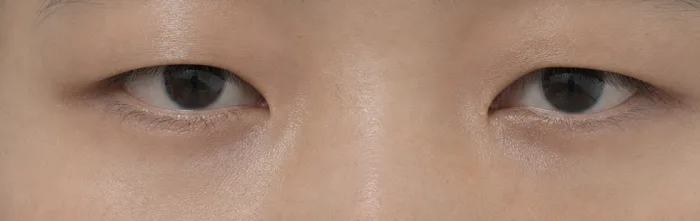 BEFORE
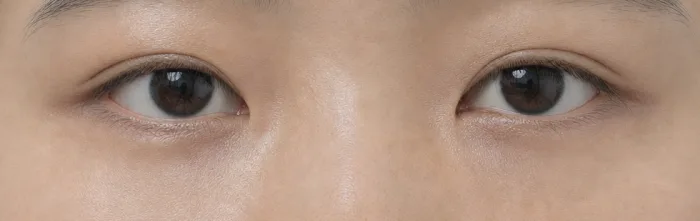 AFTER
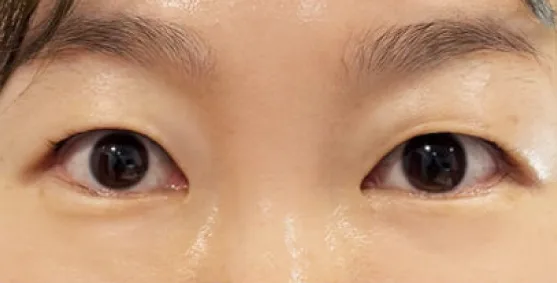 BEFORE
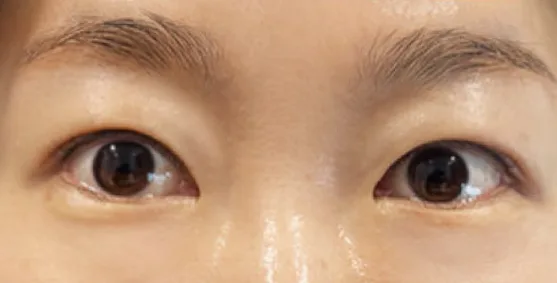 AFTER
How it works
How the crease is set in incisional double eyelid surgery
In an eyelid that already has a fold, fine strands from the tendon of the eye-opening muscle (the levator aponeurosis) reach the skin and pull it inward when the eye opens. In a monolid those connections are weak or absent, and fat and soft tissue sit lower, so the skin rolls down over the lashes as one smooth surface. The surgery recreates that connection at a chosen height.
The incision line is designed for each patient, taking into account the shape of the eye, the thickness of the skin and the crease height the person wants. Through the incision, a small amount of skin, a strip of the thin circular eyelid muscle or some fat can be trimmed if the lid is bulky, and the skin edge is then fixed to the deeper tissue so the fold forms along the line. Fine stitches close the skin and are removed after about five to seven days.
Shorter-incision variations also exist. A systematic review of 13 studies and 4,177 patients found small-incision techniques recovered faster with firm fixation, and loss of the crease and other complications occurred at rates comparable with non-incisional and full-incision methods (Yu, 2022). The method used for your eyelids is planned from their anatomy.
Assessing the single eyelid
At consultationDr. Jang Jin-woo looks at the lid with the eye open and closed, the thickness of skin and fat, and how strongly the eye opens.
Designing the crease line
The crease height and shape are marked on each upper lid while you sit up, and the line is adjusted until both sides match the planned look.
Incision along the marked line
About 40–60 minutesUnder local anesthesia, with IV sedation if needed, the lid is opened along the dotted line, excess tissue is trimmed and the skin is fixed to the deeper layer.
Crease formed and stitched
The skin is closed with fine stitches, the new fold appears when the eye opens, and the stitches come out after about five to seven days.
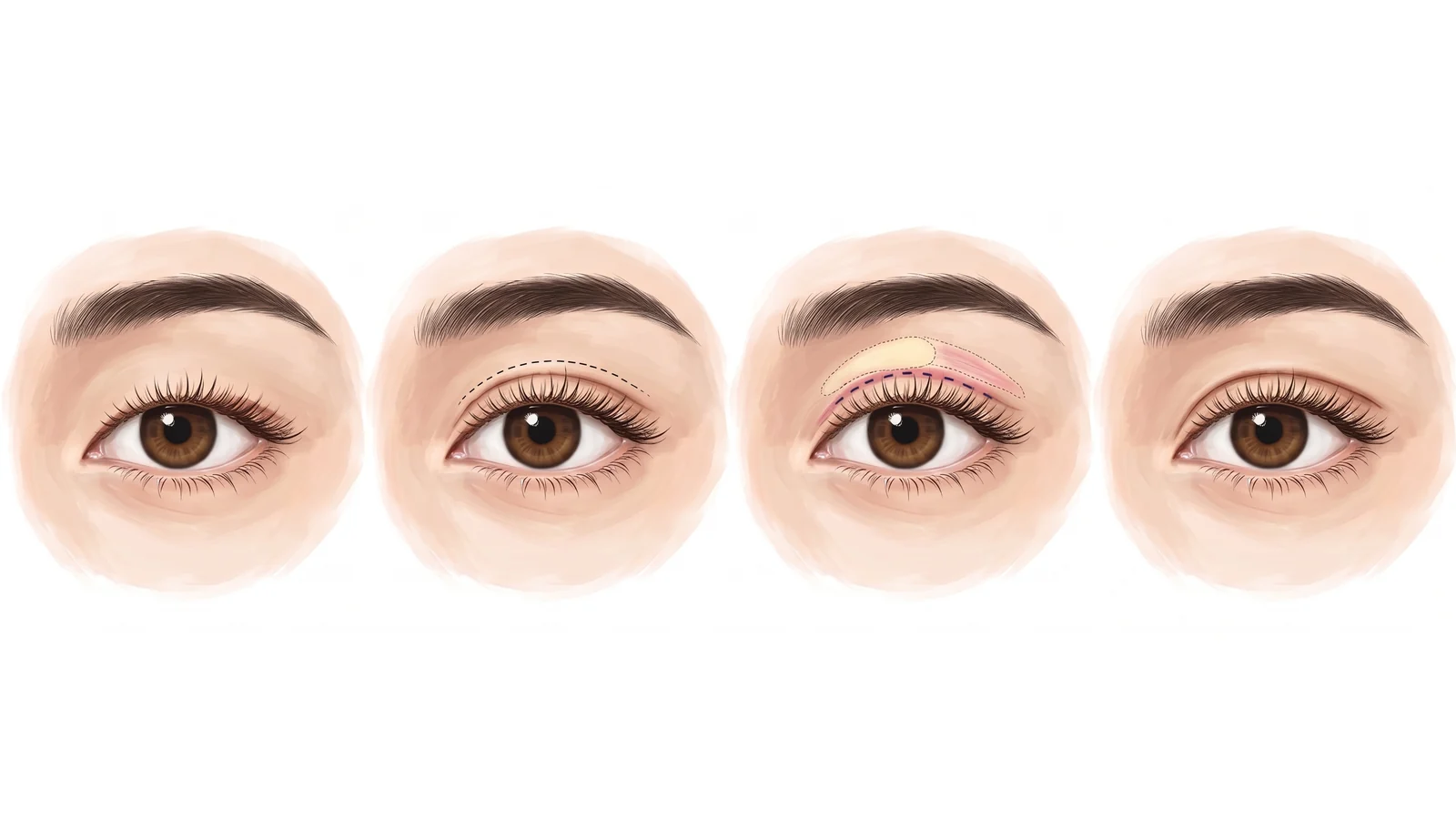
Three ways to change the upper eyelid at the clinic
| Point of comparison | Incisional double eyelid | Non-incisional (buried suture) | Upper blepharoplasty |
|---|---|---|---|
| Main goal | Create or redefine a crease | Create a crease without an incision | Remove excess, hooding upper-lid skin |
| How it is done | Incision along the planned crease | Buried stitches through tiny punctures | Excess skin removed along the crease |
| Procedure time | About 40–60 minutes | About 20–30 minutes | 30–60 minutes |
| Anesthesia | Local; IV sedation if needed | Local anesthesia | Local; IV sedation if needed |
| Stitches | Removed after about 5–7 days | None to remove | Removed after about 5–7 days |
| Swelling and bruising | 2–3 weeks | 3–7 days | 1–2 weeks |
| Earliest flight home | After stitch removal, 5–7 days | After 2–3 days | After about 7 days |
Timings are the clinic's own guidance; healing differs from person to person, and IV sedation is a separate charge.

Your doctor
Chief Director · Korean board-certified plastic surgeon
“Natural, yet clearly visible change.”Eyelid and facelift surgery at ENTER is planned and performed by Dr. Jang himself.
- NowChief Director, ENTER Plastic Surgery
- TrainingPlastic surgery, Kyung Hee University Medical Center
- FormerChief Director, Jang Plastic Surgery
- FormerDirector, Secret Plastic Surgery
- MemberKSPRS · KSAPS · ISAPS · ESOPRS · ASPS
At a glance
Facts for planning incisional double eyelid surgery
| Procedure time | About 40–60 minutes |
|---|---|
| Anesthesia | Local anesthesia, with IV sedation if needed |
| Recovery | Swelling and bruising 2–3 weeks; crease settles in 3–6 months |
| Follow-up visits | 1–2 visits for dressing and checks |
| Stitches | Removed about 5–7 days after surgery |
| Return to exercise | Generally, light walking is encouraged from surgery day; jogging, aerobics, weight training and heavy lifting are avoided for about 2 weeks (published guidance 10–14 days, some 2–3 weeks) |
| Earliest flight home | After stitch removal, about 5–7 days |
Prices
What incisional double eyelid surgery costs in South Korea
The surgery fee is a single line for both eyelids' operation and is listed before VAT, with 10% VAT added at payment. The operation is done under local anesthesia. When IV sedation is added for comfort, it appears as its own line on the bill, the same arrangement the clinic uses for every surgery.
Ptosis correction, for a lid that sits low because of a weak opening muscle, is offered as an add-on during incisional double eyelid surgery or upper blepharoplasty, and a quote that includes it shows it as an extra line. Medication and aftercare products are worth asking about when you request your written quote, so you know whether anything beyond these lines applies.
Prices exclude VAT (10% VAT is added at payment).
Recovery
Healing timeline after incisional double eyelid surgery
Cold compresses start right away. A small amount of blood on the dressing or tissues during the first one to two days is expected.
Keep using cold compresses for the first three days. Do not blow your nose for two weeks, and sneeze gently, because the pressure reaches the healing lids.
Change to warm compresses: about 30 seconds of warmth followed by 5 minutes of rest, repeated.
The stitches come out after about five to seven days. Once they are out, the clinic's guidance is that you can fly home; follow-up is one to two visits in all.
Swelling and bruising fade over two to three weeks. In this period the crease can still look higher and fuller than it will finally be.
The crease line keeps settling over about three to six months, and the final height and softness are judged at the end of that window.
Safety
What can go wrong after incisional double eyelid surgery
A 2020 review sorts the problems seen after Asian double eyelid surgery into dissatisfaction with the look, crease problems, lid height problems, stitch-related problems and the general complications of any eyelid operation (Young, 2020). In practical terms, these are the ones to weigh:
- Swelling and bruising, with a crease that looks higher or thicker than planned while it settles.
- Asymmetry between the two creases in height or shape.
- A crease that loosens, fades or splits into more than one fold, which can need revision.
- A scar along the incision that stays red, raised or more visible than expected.
- Lid height problems, such as a lid that sits lower after surgery, or difficulty closing the eye fully for a period.
- Bleeding, a collection of blood under the skin (hematoma) or infection.
- Dry, irritated or watery eyes while the lids heal.
Symmetry is harder to achieve when the eye-opening muscle is also weak. In Asian patients with congenital ptosis who had crease surgery at the same time, 30% were fully symmetrical, and in 70% the eyes looked even right after surgery but asymmetry appeared by six months (Park, 2007). Swelling that grows on one side, severe pain or any change in vision should be reported to the clinic straight away.
Evidence
Research behind this page
- Strategies for Simultaneous Double Eyelid Blepharoplasty in Asian Patients With Congenital BlepharoptosisAesthetic Plastic Surgery · 2007 · Park D et al. · doi:10.1007/s00266-007-9050-5
Cohort of Asian patients with congenital ptosis having double eyelid surgery at the same time: 30% were fully symmetrical, and in 70% asymmetry appeared by six months, showing how hard symmetry is when ptosis is corrected.
- Simultaneous Double Eyelid Blepharoplasty and Blepharoptosis Correction With Levator Aponeurosis Plication TechniqueAnnals of Plastic Surgery · 2022 · Hao D et al. · doi:10.1097/sap.0000000000003111
Uncontrolled series of 108 patients (155 eyes): crease surgery combined with levator aponeurosis plication improved lid opening (MRD1) by a mean of 1.28 mm, with satisfactory results at about 12 months.
- Small-Incisional Techniques for Double-Eyelid Blepharoplasty: A Systematic ReviewAesthetic Plastic Surgery · 2022 · Yu P et al. · doi:10.1007/s00266-022-03154-5
Systematic review of 13 studies and 4,177 patients: small-incision double eyelid techniques recovered faster with firm fixation, and complication rates were acceptable compared with non-incisional and full-incision methods.
- Complications of Asian Double Eyelid Surgery: Prevention and ManagementFacial Plastic Surgery · 2020 · Young S · doi:10.1055/s-0040-1717147
Review that classifies complications of Asian double eyelid surgery (dissatisfaction, crease, lid height, suture-related and general eyelid problems) and sets out prevention and revision principles.
FAQ
Incisional double eyelid surgery FAQ
How long do swelling and bruising last after incisional double eyelid surgery?
Swelling and bruising fade over about two to three weeks, and the crease keeps settling toward its final height for roughly three to six months. Cold compresses for the first three days and warm ones from day four help. Swelling that keeps growing on one side should be reported.
When do the stitches come out, and when can I fly home?
The stitches are removed after about five to seven days, and the clinic's guidance is that you can fly once they are out. That makes the stitch removal visit the fixed point of your trip. Follow-up is one to two visits in total, for dressing and a check.
Which surgeon will operate on my eyelids?
Dr. Jang Jin-woo, a Korean board-certified plastic surgeon, performs incisional double eyelid surgery at ENTER Plastic Surgery and designs the crease line at consultation. Dr. Jang is a member of seven professional societies, among them the Korean Society for Aesthetic Plastic Surgery, ISAPS and ESOPRS.
Is IV sedation charged separately for double eyelid surgery?
Yes, when it is used. The surgery is done under local anesthesia, and IV sedation added for comfort is billed at ₩300,000 + VAT on top of the surgery fee of ₩2,000,000 + VAT. Both figures are listed before Korea's 10% VAT.
Can ptosis correction be done at the same time?
Yes, as an add-on. When a weak eye-opening muscle makes the lid sit low, ptosis correction can be combined with incisional double eyelid surgery and is quoted as an extra line. In one series combining the two, lid opening improved by a mean of 1.28 mm (Hao, 2022).
Where is the scar, and will people see it?
The incision follows the new crease, so with the eyes open the line sits inside the fold. With the eyes closed, a fine line can be visible while it matures, and redness fades over several months. How a scar heals differs from person to person, and some scars thicken.
Does incisional double eyelid surgery work for non-Asian eyes?
It can. What matters is the lid's anatomy: skin thickness, fat, crease position and how the eye opens. For eyelids that already have a fold, the aim may be to raise, redefine or even out an existing crease, and that is planned from your own lids during the assessment.
Can men have double eyelid surgery in Korea?
Yes. The surgery, stitches and recovery timeline are the same; what changes is the design. Men can ask for a lower, straighter or subtler crease, and the line is drawn to match the look they want rather than a set template.
What if the crease fades or the two sides look different?
Wait for the crease to settle first, since it changes for three to six months after surgery. If a fold loosens, splits or stays uneven after that, revision surgery is assessed on the healed lids. Both crease problems and asymmetry are recognized complications of this operation.
How do I start planning double eyelid surgery from abroad?
Send the form on this page or message us on WhatsApp with your preferred dates, and we will get back to you as soon as possible. English-speaking staff are available at the clinic. Build your dates around the stitch removal at about five to seven days.
Is a deposit required, and can I change my surgery date?
Deposit and cancellation terms are set when you book, and this page does not publish them. Get them in writing before paying, and remember that moving the surgery date also moves the stitch removal, which decides when you can fly home.
Google reviews
Reviews on Google Maps
Great experience! Dr. is very sweet and kind. He listened to what I wanted to fix and correct. He explained everything very well. Wasn’t pushy and didn’t try to sell anything extra. This isn’t a clinic that comes out on instagram, which I…
 Jennifer LyuA month ago
I came to Enter Plastic Surgery on a friend’s recommendation for under-eye fat repositioning. I was pretty nervous going in, but the doctor took the time to explain what would work for my under-eyes, what the procedure involved, and what…
 Michael2 months ago
The staff are incredibly friendly, and the consultation was very thorough. I was very worried since it was my first procedure, but the director explained the aftercare in detail, so I felt completely confident trusting them!!
 ROOHEUI SHIN (RHS)2 months ago · Translated by Google