

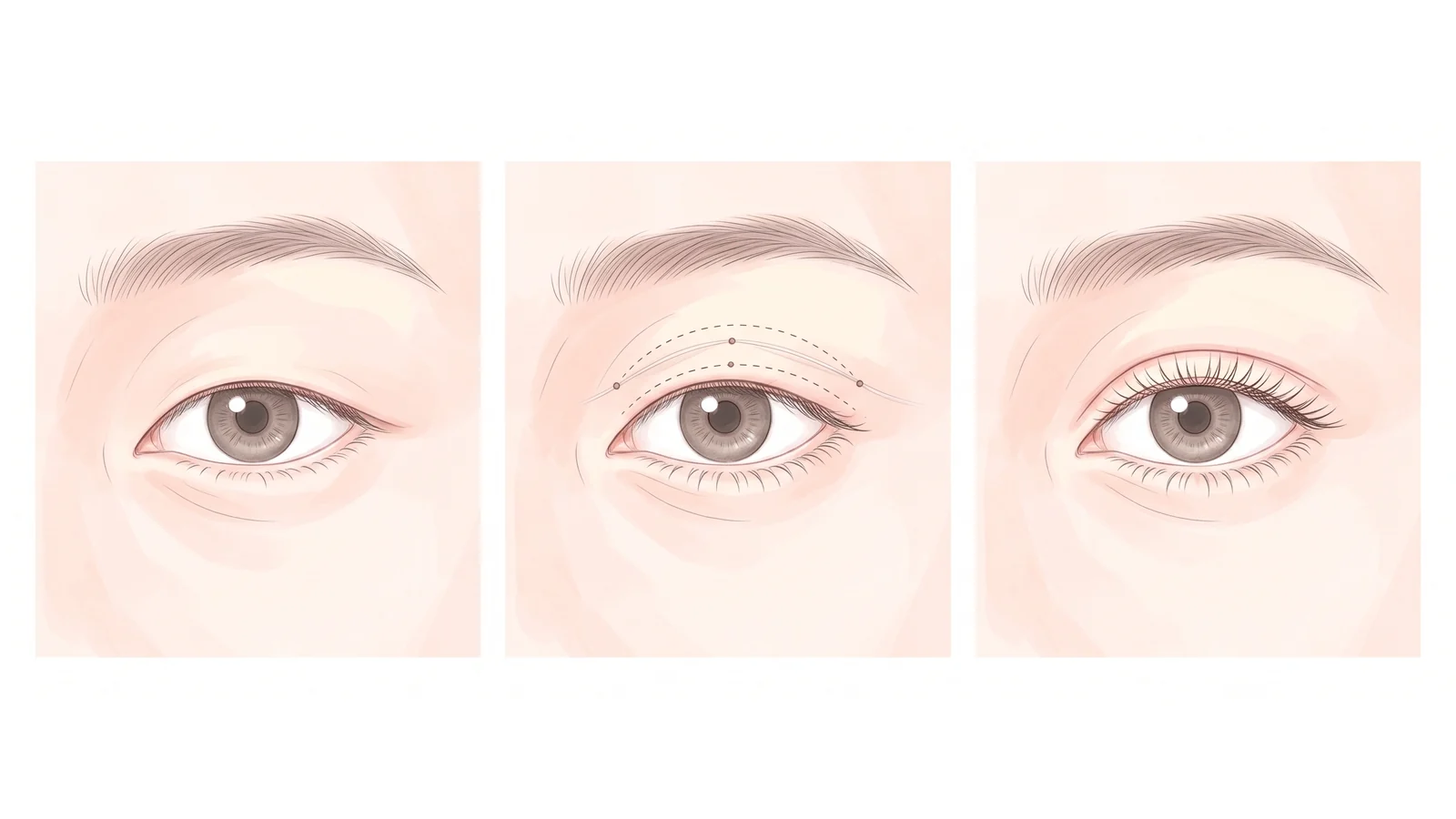
A few needle-sized punctures on the upper lid are all the skin opening that non-incisional double eyelid surgery in Korea needs: fine stitches pass through them and are buried under the skin, tying it to the deeper lid so a crease folds in as the eye opens. Dr. Jang Jin-woo performs it under local anesthesia in about 20 to 30 minutes, with no stitches to remove.
Is it for you?
Which eyelids suit the buried suture method
A stitched crease lasts longer when little tissue is pushing against it. Thin upper-lid skin with a modest layer of fat lets the buried thread pull the skin inward each time the eye opens, so the fold forms with very little resistance. The thicker and fuller the lid, the more weight sits on a few loops of thread, and the more likely the line is to soften over time.
Because nothing is cut away, the method changes only where the lid folds. It does not take off hooding skin, reduce a heavy fat pad or strengthen a weak eye-opening muscle. When one of those is the main concern, a different operation is planned from the start, which avoids a second procedure later. The method also leaves the lid easy to revise if the first crease height is not quite right.
Usually a good fit
- Monolids or a faint crease in thin upper-lid skin
- Little puffiness from fat above the lashes
- Uneven creases, one side defined and one faint
- Wanting a crease without an incision on the skin
- Able to stay in Seoul two to three days after surgery
We may suggest waiting
- Hooding or excess upper-lid skin as the main issue
- Thick skin or a full fat pad that weighs the lid down
- An eyelid that sits low because the opening muscle is weak
- Active eye infection, stye or untreated dry eye
- Pregnancy or breastfeeding
Before & after
Buried suture crease results at ENTER Plastic Surgery
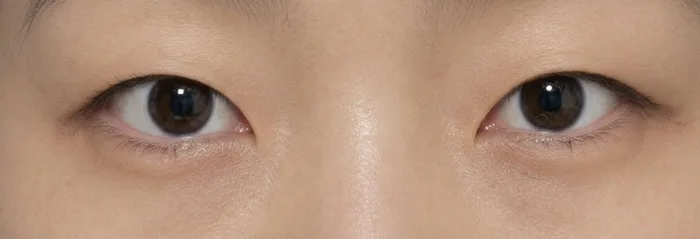 BEFORE
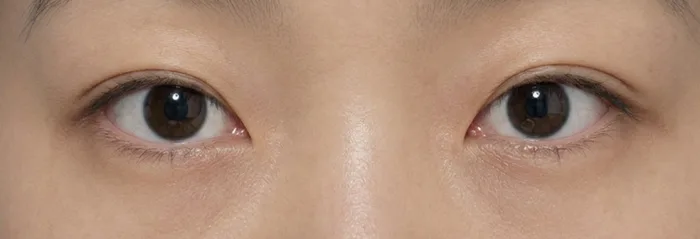 AFTER
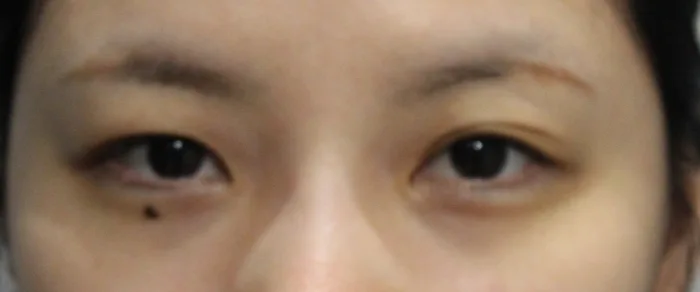 BEFORE
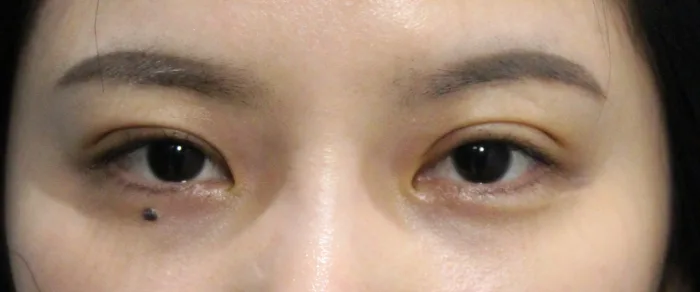 AFTER
How it works
How non-incisional double eyelid surgery forms a crease
In an eyelid that already folds, small strands from the tendon of the eye-opening muscle reach up into the skin. When the eye opens, they tug the skin inward along one line, and the skin above that line drapes over it as a crease. A monolid lacks those links, so the skin lifts as one flat sheet. Non-incisional surgery adds a substitute link: a fine thread looped between the skin and the firm plate of the upper lid (the tarsus) or the tendon above it.
The crease line is drawn for each patient, with the eye closed and open, so its height and shape suit the eye rather than a set template. The thread enters and exits through tiny punctures along that line, and the knot is buried beneath the skin, where it stays. Because the skin is not opened and no tissue is removed, swelling is shorter than after the incisional method, and the crease can later be loosened or redone if needed.
How the thread is anchored matters for how long the fold lasts. In a long-term analysis of 423 eyelids, fixing the thread on the inner, conjunctival side of the lid carried a significantly lower risk of losing the crease than fixing it on the skin side (Inoguchi, 2026). Single-center reports of continuous buried-thread techniques describe few complications over years of follow-up, though that evidence comes from case series without comparison groups (Hu, 2015).
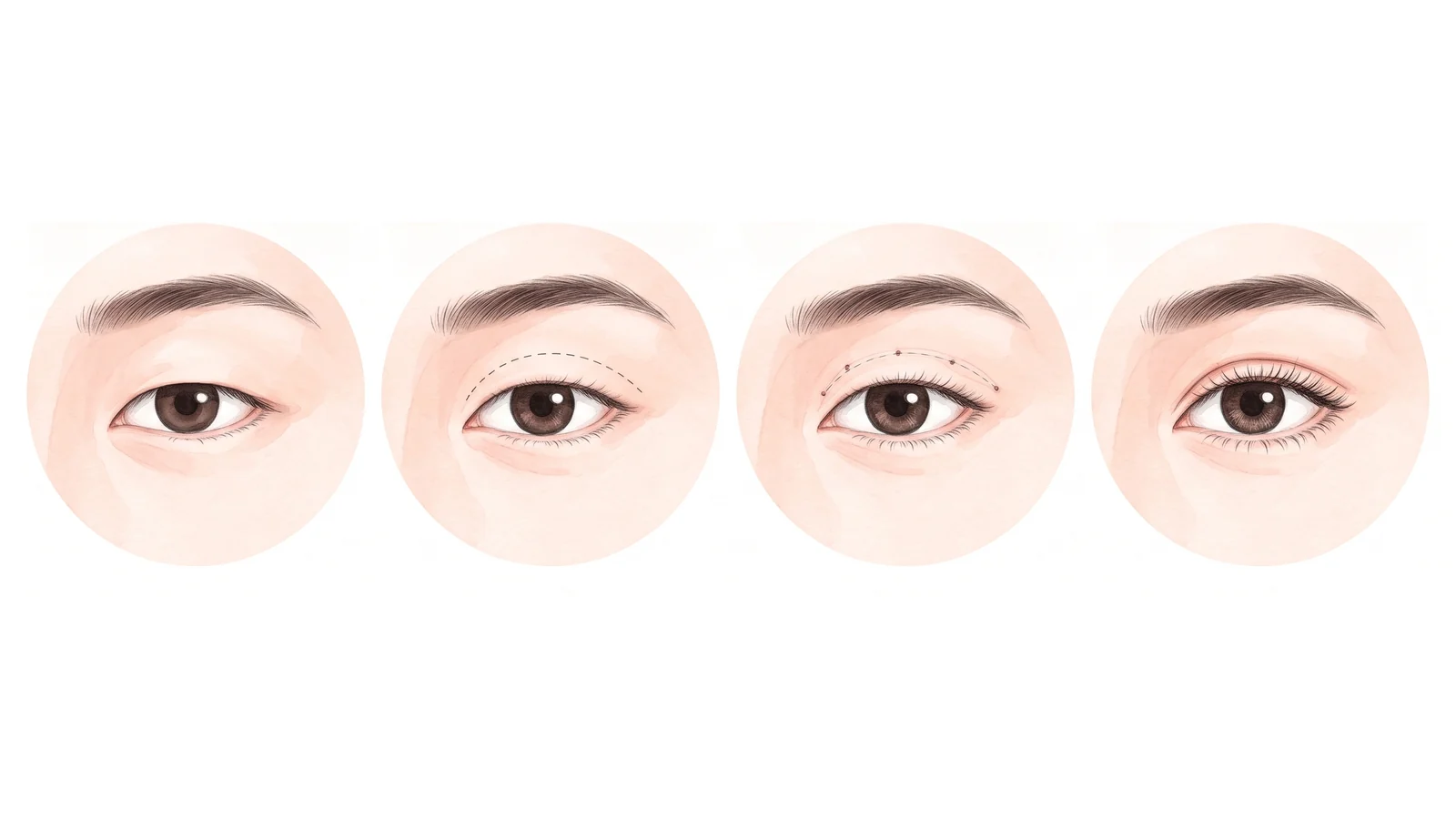
Reading the single eyelid
At consultationDr. Jang Jin-woo checks skin thickness, the fat above the lashes and how strongly the lid opens, which decides whether buried sutures can hold a crease on this lid.
Drawing the crease line
The planned fold is marked on each upper lid at the height you agree on, and both sides are compared with the eyes open before anything is done.
Stitches through needle points
About 20–30 minutesAfter local anesthesia, a fine thread is passed through a few small punctures along the line, looped to the deeper lid and knotted under the skin.
Crease in place
The fold appears as soon as the eye opens. The punctures need no stitches, cold compresses start, and the line settles over the following weeks.
Upper-eyelid choices on the ENTER Plastic Surgery menu
| Point of comparison | Non-incisional (buried suture) | Incisional double eyelid | Upper blepharoplasty |
|---|---|---|---|
| Skin opening | A few needle-sized punctures | Incision along the crease line | Strip of excess skin removed |
| Tissue taken out | None | Fat or soft tissue, if needed | Excess skin, sometimes fat |
| Lids it suits | Thin skin, little fat | Thicker skin or fuller fat | Hooding, loose upper-lid skin |
| Operation length | About 20–30 minutes | About 40–60 minutes | 30–60 minutes |
| Stitch removal visit | Not needed | At about 5–7 days | At about 1 week |
| Visible swelling | 3–7 days | Swelling and bruising 2–3 weeks | 1–2 weeks |
| Flying home (clinic guidance) | After 2–3 days | After stitch removal | After about 7 days |
| Lasting (clinic guidance) | Several years; can loosen | Long-term | 5–10 years or more |
Timings and durations are the clinic's own guidance; eyelids keep aging and individual results vary.

Your doctor
Chief Director · Korean board-certified plastic surgeon
“Natural, yet clearly visible change.”Eyelid and facelift surgery at ENTER is planned and performed by Dr. Jang himself.
- NowChief Director, ENTER Plastic Surgery
- TrainingPlastic surgery, Kyung Hee University Medical Center
- FormerChief Director, Jang Plastic Surgery
- FormerDirector, Secret Plastic Surgery
- MemberKSPRS · KSAPS · ISAPS · ESOPRS · ASPS
At a glance
Buried suture double eyelid: the numbers
| Procedure time | About 20–30 minutes |
|---|---|
| Anesthesia | Local anesthesia |
| Recovery | Swelling 3–7 days; crease settles in about 1–3 months |
| Follow-up visits | 1–2 visits for dressing and a check |
| Stitches | None to remove (buried sutures) |
| Earliest flight home | After 2–3 days |
Prices
How much non-incisional double eyelid surgery costs in South Korea
The buried suture operation is priced as one fee covering both upper lids, shown in the card below without VAT; 10% VAT is added at payment. Local anesthesia is part of the operation itself. Should IV sedation be added on request, it becomes a second line on the bill, which is how the clinic charges sedation for every surgery it performs.
Because there are no stitches to take out, the bill has no separate removal visit, and the one or two follow-up checks fall within the few days you are already in Seoul. Any medication or aftercare products would appear as their own items, so ask for an itemized written quote before you book travel.
Prices exclude VAT (10% VAT is added at payment).
Recovery
Healing after non-incisional double eyelid surgery
You walk out the same day with a visible but swollen crease. Hold cold compresses on the lids; a little blood on tissues during the first one to two days is normal.
Keep up the cold compresses for three days. Avoid blowing your nose for two weeks and sneeze with your mouth open, because the pressure reaches the lids.
With no stitch removal visit, the clinic's guidance is that you can fly home after two to three days, once the one or two checks are done.
Change to warm compresses, about 30 seconds of warmth followed by 5 minutes of rest, repeated a few times through the day.
Visible swelling settles within three to seven days. The crease can still look slightly higher or deeper than planned at this point.
The line keeps softening into its final height over about one to three months; judge symmetry at the end of that window.
Safety
Risks of the buried suture method
A 2020 review groups the problems seen after Asian double eyelid surgery into dissatisfaction with the look, crease problems, lid height problems, suture-related problems and the general complications of eyelid surgery (Young, 2020). For the non-incisional method, these are the specific ones to know:
- The crease loosening, fading or disappearing over time, which is the main limit of a thread-held fold.
- Asymmetry in crease height or depth between the two eyes, or more than one fold forming.
- A knot or thread that can be felt or seen under the skin, or a small cyst or inflamed bump around it.
- Irritation of the eye surface if a thread is exposed on the inner side of the lid.
- Swelling, bruising, bleeding or infection at the puncture points.
- A revision, either releasing the thread or redoing the crease, sometimes with the incisional method.
Swelling that keeps increasing, severe pain or any change in vision after surgery needs a call to the clinic straight away.
Evidence
Research behind this page
- Transcutaneous versus Transconjunctival Fixation in Non-Incisional Double Eyelid Surgery: A Long-Term Survival Analysis of Crease RetentionAesthetic Plastic Surgery · 2026 · Inoguchi K et al. · doi:10.1007/s00266-026-06230-2
Retrospective analysis of 423 eyelids: fixing the buried thread on the conjunctival side carried a significantly lower risk of crease loss than skin-side fixation, showing that loosening risk depends on the fixation method.
- Simultaneous Double Eyelid Blepharoplasty and Ptosis Correction with a Single-Knot, Continuous, Nonincisional Technique: A Five-Year ReviewAesthetic Surgery Journal · 2015 · Hu J et al. · doi:10.1093/asj/sjv201
Single-center five-year review of a single-knot continuous non-incisional technique used for a double eyelid together with mild-to-moderate ptosis; few complications were reported, at level 4 evidence.
- Transconjunctival Müller’s muscle Tucking Method for Non-incisional Correction of Mild Ptosis: The Effectiveness and MaintenanceAesthetic Plastic Surgery · 2019 · Han H · doi:10.1007/s00266-019-01379-5
Series of 34 patients with mild ptosis treated by tucking Müller's muscle through the inner lid without an incision; improvement held at six months, with some crease loss, asymmetry and recurrence.
- Complications of Asian Double Eyelid Surgery: Prevention and ManagementFacial Plastic Surgery · 2020 · Young S · doi:10.1055/s-0040-1717147
Review that classifies complications of Asian double eyelid surgery (appearance, crease, lid height, suture-related and general) and sets out principles for preventing and revising them.
FAQ
Non-incisional double eyelid surgery FAQ
When will my new crease look settled?
Visible swelling goes down within three to seven days, and the crease keeps softening into its final height over about one to three months. Early on it can look higher or deeper than planned. Swelling that keeps increasing, strong pain or blurred vision should be reported to the clinic right away.
How many days should I stay in Seoul for non-incisional double eyelid surgery?
Plan on two to three days after the surgery day. There are no stitches to remove, the follow-up is one to two short visits, and the clinic's guidance is that you can fly after two to three days. Adding a spare day leaves room if a check needs to move.
Who performs the operation?
Dr. Jang Jin-woo, a Korean board-certified plastic surgeon, designs the crease and performs non-incisional double eyelid surgery at ENTER Plastic Surgery. Dr. Jang trained in plastic surgery at Kyung Hee University Medical Center and is a member of the Korean Society for Aesthetic Plastic Surgery and ISAPS.
Is VAT or sedation added to the non-incisional double eyelid price?
VAT is added: the fee of ₩1,600,000 is listed before 10% VAT. The operation uses local anesthesia, so sedation is not part of the standard fee; if IV sedation is added, it is billed separately at ₩300,000 + VAT. Ask for medication or aftercare items as separate lines.
How do I contact the clinic from abroad?
Send the form on this page or message us on WhatsApp, and we will get back to you as soon as possible. English-speaking staff are available at the clinic. Mention your travel dates and, if you can, attach a straight-on photo of your open eyes to help with the first reply.
Is a deposit needed, and can I change my surgery date?
Deposit and change or cancellation terms are set for each booking, so ask for them in writing before paying anything. Because your earliest flight is two to three days after the operation, moving the surgery date also moves your return, so check both together.
Is the buried suture method the same as non-incisional double eyelid surgery?
Yes. Buried suture is the technical name for the same operation: the crease is held by thread buried under the skin and passed through small punctures, without an incision along the lid. Clinics and articles use either term, and some add the number of knots or stitch points to the name.
How long does non-incisional double eyelid surgery last?
The clinic's guidance is several years, with individual differences and a real chance of the crease loosening. Thicker lids, rubbing the eyes and the way the thread is anchored all affect how long it holds. A study of 423 eyelids found the fixation method changed the risk of losing the crease (Inoguchi, 2026).
What happens if the crease loosens or the two sides differ?
The thread can be released or the crease redone. A faint or uneven fold is assessed first for the cause, such as a loosened loop or thicker tissue on one side. If the lid has proved too heavy for buried sutures, the incisional method is the option discussed for the revision.
Will I be awake, and does it hurt?
Yes, you stay awake. Local anesthesia (local anaesthetic, in UK spelling) is injected into the upper lids, and the injection itself stings briefly. After that, what you notice is mainly pressure and the feeling of your eyes being opened and closed while the crease is checked.
Does the thread stay in my eyelid?
Yes. The thread is meant to stay under the skin, because it is what holds the crease. It is very fine and the knot sits beneath the surface, though it can occasionally be felt or show as a small bump. If that happens, the thread can be removed or replaced at a revision.
Google reviews
Reviews on Google Maps
Great experience! Dr. is very sweet and kind. He listened to what I wanted to fix and correct. He explained everything very well. Wasn’t pushy and didn’t try to sell anything extra. This isn’t a clinic that comes out on instagram, which I…
 Jennifer LyuA month ago
I came to Enter Plastic Surgery on a friend’s recommendation for under-eye fat repositioning. I was pretty nervous going in, but the doctor took the time to explain what would work for my under-eyes, what the procedure involved, and what…
 Michael2 months ago
The staff are incredibly friendly, and the consultation was very thorough. I was very worried since it was my first procedure, but the director explained the aftercare in detail, so I felt completely confident trusting them!!
 ROOHEUI SHIN (RHS)2 months ago · Translated by Google