

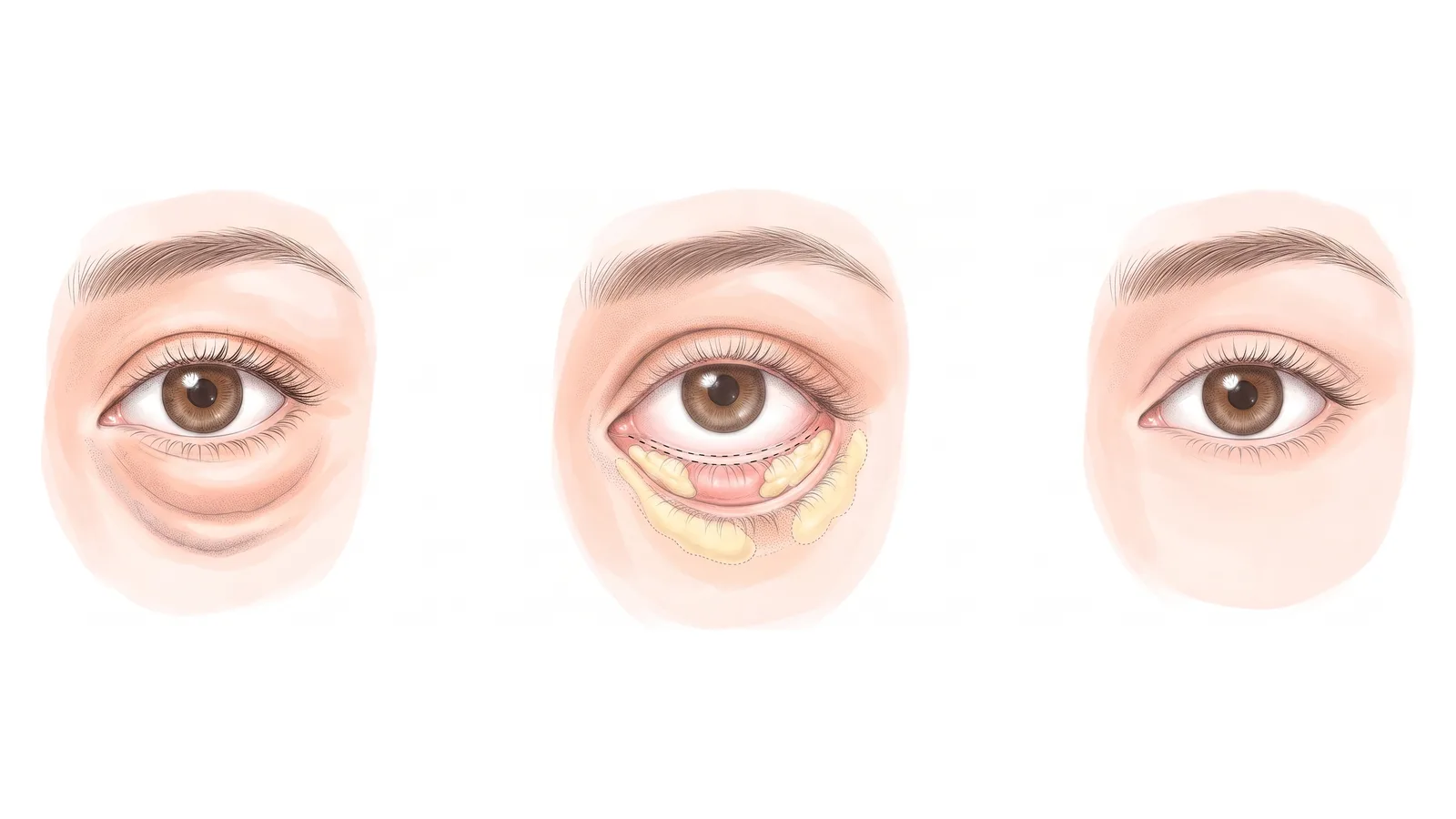
Under eye fat repositioning in Seoul, Korea treats a bulging lower-lid fat pad that sits above a sunken tear trough. Working through a small opening inside the lower eyelid (the transconjunctival route), Dr. Jang Jin-woo moves that fat down into the groove under IV sedation, and absorbable stitches close the inner incision.
Is it for you?
Who is a candidate for under-eye fat repositioning
A tired look under the eyes can have several causes, and they call for different treatments. The pattern this surgery addresses is a contour problem: a rounded bag catches light while the groove just below it falls into shadow, so the lid looks puffy and hollow at the same time. Moving the fat works on both parts of that contour in one step.
The deciding question is how much the lower-lid skin has loosened. Fat that has been moved does not tighten skin, so when crepey, excess skin is what makes the area look aged, lower blepharoplasty, which trims skin through an incision below the lashes, is the operation discussed instead. Dark circles that come from pigment or thin, translucent skin without a bulge also fall outside what this surgery changes.
Usually a good fit
- Lower-lid bags with a visible groove or hollow just beneath them
- Lower-lid skin that still has reasonable elasticity
- Shadowing that comes from the bulge-and-groove shape
- Inherited eye bags, including in younger adults
- Able to stay in Korea about one week for the follow-up check
We may suggest waiting
- Loose, wrinkled lower-lid skin as the main concern
- Brown or bluish dark circles without any bulge
- Active eye infection or untreated dry eye
- Pregnancy or breastfeeding
- Wanting a change without surgery or sedation
Before & after
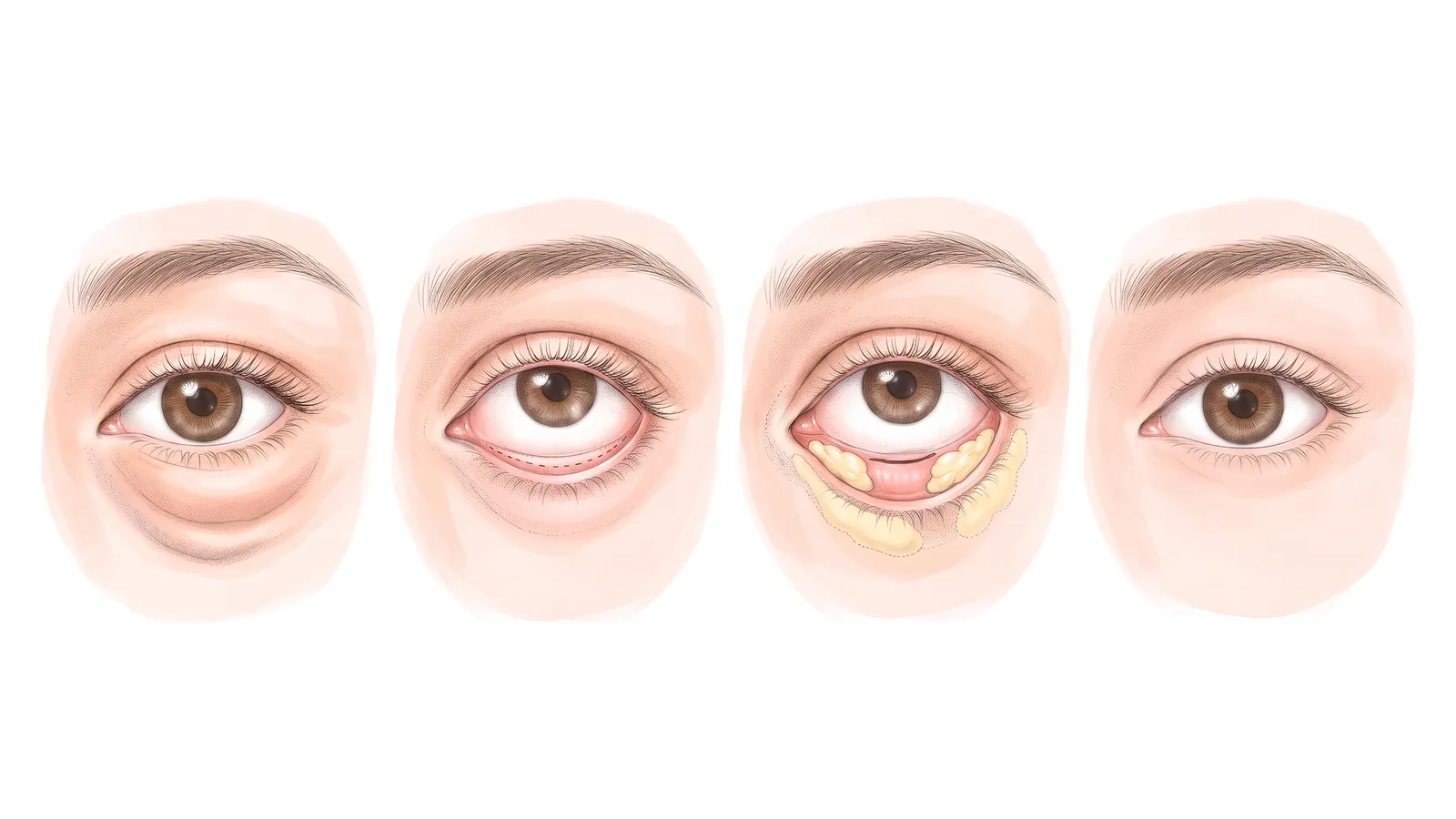
Under-eye fat repositioning before and after
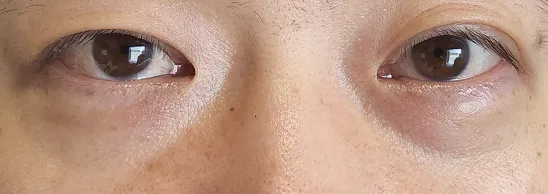 BEFORE
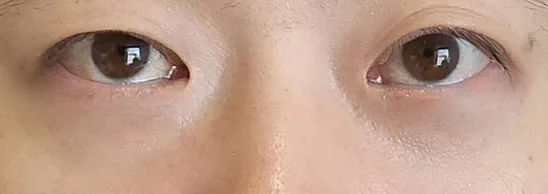 AFTER
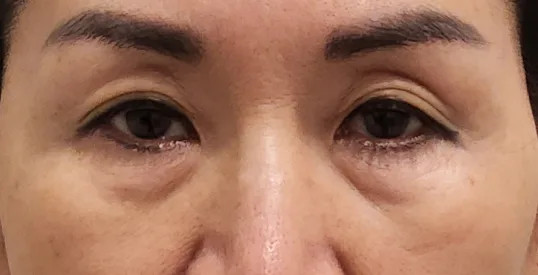 BEFORE
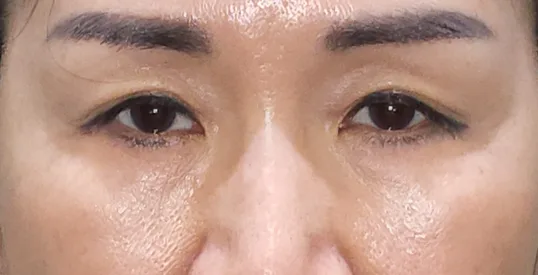 AFTER
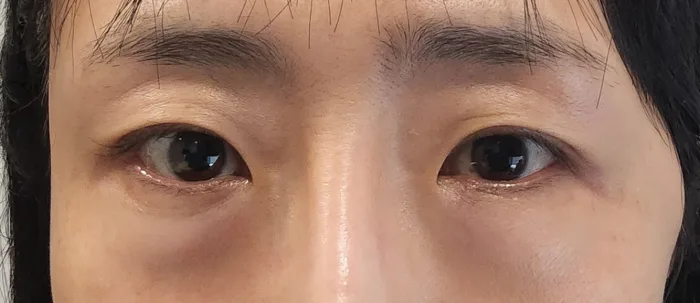 BEFORE
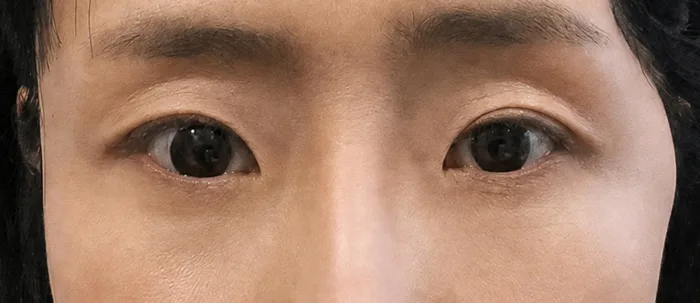 AFTER
How it works
How under-eye fat repositioning works inside the lid
Behind the lower eyelid, three small pads of orbital fat cushion the eye. They sit behind a thin membrane called the orbital septum, and as that membrane relaxes with age or genetics, the fat pushes forward into a visible bag. Directly below the bag, a band of tissue tethers the skin to the bone of the eye socket rim and creates the tear trough.
Fat repositioning is a form of transconjunctival lower blepharoplasty (also called fat transposition). The approach is through the conjunctiva, the pink inner lining of the lower lid, so there is no incision on the outer skin. Nothing is taken out of the face: the same fat that formed the bag is laid down over the rim into the groove that cast the shadow, and it is secured there. In a comparison of the two techniques, removing fat shortened the lower eyelid, while moving it gave a smoother junction between lid and cheek over an average follow-up of 5.6 months (Ramesh, 2019).
A 2025 review of 24 studies found that fat-preserving lower-lid surgery can be done through the inside of the lid or through the skin, with outcome reporting too inconsistent to name one route as superior (Atiyeh, 2025). In practice, the inner approach suits lids where the skin itself is in reasonable condition.
Mapping the bulge and groove
At consultationDr. Jang Jin-woo looks at where the fat bulges, how deep the tear trough runs and how much the lower-lid skin has loosened, and plans the fat movement for each side.
Opening inside the lower lid
With IV sedation and local anesthesia, a small opening is made in the conjunctiva on the inner surface of the eyelid. The outer skin is left uncut.
Fat moved into the groove
The bulging fat pads are freed, brought down over the bony rim and fixed in the hollow, so the bag flattens as the groove fills.
Dissolving stitches
30–60 minutes in totalThe inner opening is closed with absorbable stitches that dissolve without a removal appointment, and cold compresses begin.
Under-eye choices on the ENTER Plastic Surgery menu
| Point of comparison | Fat repositioning | Lower blepharoplasty | HA filler |
|---|---|---|---|
| Where the work is done | Opening inside the lower lid | Below the lash line, or inside the lid | Injection, no incision |
| What happens to the fat | Moved into the groove | Removed or redistributed | Left in place; groove filled with gel |
| Loose lower-lid skin | Not treated | Excess skin trimmed | Not treated |
| Anesthesia | IV sedation, local if needed | IV sedation, local if needed | Numbing cream |
| Procedure time | 30–60 minutes | 30–90 minutes | 15–30 minutes |
| Stitches | Dissolve on their own | Removed at about 1 week (skin incision) | None |
| How long it lasts (clinic guidance) | About 7–8 years or more | About 7–8 years or more | 6–18 months, by area and product |
Durations are the clinic's own guidance; aging continues and individual results vary.

Your doctor
Chief Director · Korean board-certified plastic surgeon
“Natural, yet clearly visible change.”Eyelid and facelift surgery at ENTER is planned and performed by Dr. Jang himself.
- NowChief Director, ENTER Plastic Surgery
- TrainingPlastic surgery, Kyung Hee University Medical Center
- FormerChief Director, Jang Plastic Surgery
- FormerDirector, Secret Plastic Surgery
- MemberKSPRS · KSAPS · ISAPS · ESOPRS · ASPS
At a glance
Under-eye fat repositioning: surgical facts
| Procedure time | 30–60 minutes |
|---|---|
| Anesthesia | IV sedation, with local anesthesia added if needed |
| Recovery | Swelling and bruising 1–2 weeks; settles over about 1–3 months |
| Follow-up visits | 1–2 follow-up visits |
| Stitches | Inner-lid incision; stitches dissolve on their own, nothing to remove |
| Return to exercise | Generally, light walking is encouraged from surgery day; jogging, aerobics, weight training and heavy lifting are avoided for about 2 weeks (published guidance 10–14 days, some 2–3 weeks) |
| Earliest flight home | About 1 week, after the one-week check |
Prices
Under-eye fat repositioning cost in South Korea
Two lines make up the bill for this operation: the surgery fee and IV sedation, which the clinic charges as a separate item for every surgery it performs. Both exclude VAT (10% VAT is added at payment). Put together, the operation comes to ₩2,000,000 plus ₩300,000 for sedation before VAT.
Medication, aftercare items or a combination with another procedure are not part of these two lines; ask for them to be itemized in your written quote before you book flights.
Prices exclude VAT (10% VAT is added at payment).
Recovery
Recovery after under-eye fat repositioning
Swelling starts within hours. A little blood on tissues or tears for the first one to two days is expected and is not a sign that something has gone wrong.
Use cold compresses for the first three days. Do not blow your nose for two weeks, and take care when sneezing, because pressure travels to the healing lid.
Switch to warm compresses: 30 seconds of warmth, then 5 minutes of rest, repeated. Bruising begins to fade from purple to yellow.
Recovery reaches roughly one week and you return for a check. There are no stitches to take out. After this visit, the clinic's guidance is that you can fly home.
Swelling and bruising settle over one to two weeks, and facial expression looks fairly natural again. The clinic suggests waiting two to three weeks before photos or an event.
The repositioned fat and the lower-lid contour keep settling over about one to three months, so judge the final shape at the end of that window.
Safety
Risks of under-eye fat repositioning
The inner approach avoids cutting the outer skin and lid muscle, yet it is still eyelid surgery with real risks. Signs that need a call to the clinic straight away are swelling that spreads or keeps increasing, severe pain, or any change in vision.
- Bruising and swelling, which can be uneven between the two sides while they settle.
- Asymmetry or contour irregularity, including a small lump where fat was fixed or a groove that remains partly visible.
- Lower-lid malposition, such as the lid pulling down (retraction) or turning outward (ectropion).
- Dry, gritty or watery eyes, and swelling of the inner lining of the lid (chemosis) for a period.
- Bleeding behind the eyelid or infection, which needs prompt treatment.
- Revision surgery if a bag or hollow returns or the result is uneven.
Fat repositioning is not the strongest option for every groove. In a study of young Chinese patients with eye bags and tear trough deformity, grafting minced orbital fat into the trough scored better than repositioning on groove measures and satisfaction at about 11 months (Liu, 2025). Another surgeon's series of extended transconjunctival surgery reported a 2% reoperation rate and no lower-lid retraction over an average of 10 months (Wong, 2017); those are published figures from one practice and do not predict an individual result.
Evidence
Research behind this page
- Transconjunctival or Transcutaneous Approach for Fat-preserving Lower Lid Blepharoplasty?Plastic and Reconstructive Surgery - Global Open · 2025 · Atiyeh B et al. · doi:10.1097/gox.0000000000007345
A 2025 review of 24 studies: fat-preserving lower-lid surgery is feasible through the inner lid or the skin, fat movement is possible either way, and inconsistent outcome reporting prevents naming one approach as superior; fat grafting may suit some tear troughs better.
- Objective Comparison of Nasojugal Fold Depth and Lower Eyelid Length After Fat Excision Versus Fat Transpositional Lower BlepharoplastyAesthetic Surgery Journal · 2019 · Ramesh S et al. · doi:10.1093/asj/sjz082
Cohort comparison: fat excision shortened the lower eyelid, while fat transposition produced a smoother lid-cheek junction (mean follow-up 5.6 months); the authors suggest combining techniques per patient.
- Treatment of Tear Trough Deformity: Fat Repositioning versus Autologous Fat GraftingAesthetic Plastic Surgery · 2016 · Chiu C et al. · doi:10.1007/s00266-016-0692-z
Non-randomized comparison: in tear troughs without marked skin or muscle laxity, both repositioning and fat grafting were acceptable for mild cases, and repositioning improved moderate-to-severe cases more.
- Transconjunctival Orbital Fat Repositioning for Tear Trough Deformity in Young AsiansAesthetic Surgery Journal · 2008 · MOMOSAWA A et al. · doi:10.1016/j.asj.2008.02.002
Small series of 20 young Asian patients: transconjunctival orbital fat repositioning rated excellent in 90%, with no major complications such as lid retraction, ectropion or double vision.
- Extended Transconjunctival Lower Eyelid Blepharoplasty with Release of the Tear Trough Ligament and Fat RedistributionPlastic & Reconstructive Surgery · 2017 · Wong C · doi:10.1097/prs.0000000000003561
One surgeon's series of extended transconjunctival surgery with tear trough ligament release and fat redistribution: high satisfaction at a mean of 10 months, 2% reoperation, no lower-lid retraction or ectropion observed.
- Minced Orbital Fat Grafting Versus Orbital Fat Repositioning in TCLB for a Young Chinese Population with Eyelid Bags and Tear Trough DeformitiesAesthetic Plastic Surgery · 2025 · Liu J et al. · doi:10.1007/s00266-025-05289-7
Comparative study in young Chinese patients: minced orbital fat grafting outperformed fat repositioning on tear trough measures and satisfaction at about 11 months, evidence that repositioning is not always the stronger choice.
FAQ
Under-eye fat repositioning FAQ
How long does swelling last after under eye fat repositioning?
Swelling and bruising settle over about one to two weeks, and the under-eye contour keeps refining for roughly one to three months. The clinic suggests allowing two to three weeks before photos or an event. Swelling that spreads, severe pain or any change in vision should be reported right away.
How many days should I stay in Korea for under-eye fat repositioning?
Plan on about one week. The clinic's guidance is that you can fly home after the check at one week, and there are no stitches to remove because the inner incision closes with dissolving stitches. Follow-up is one to two visits in total, so a spare day helps if your schedule allows.
Who performs the surgery?
Dr. Jang Jin-woo, a Korean board-certified plastic surgeon, performs under-eye fat repositioning at ENTER Plastic Surgery. Dr. Jang trained in plastic surgery at Kyung Hee University Medical Center and is a member of the Korean Society of Plastic and Reconstructive Surgeons and the American Society of Plastic Surgeons.
Is IV sedation included in the under-eye fat repositioning price?
No. IV sedation (the anaesthesia line, in UK spelling) is billed separately at ₩300,000 + VAT for every operation, on top of the surgery fee. Both amounts are listed before Korea's 10% VAT. If you expect medication or aftercare items, ask for them as itemized lines in your quote.
How do I contact the clinic from abroad?
Send the form on this page or message us on WhatsApp, and we will get back to you as soon as possible. English-speaking staff are available at the clinic. Sharing your preferred travel dates in the first message makes it easier to plan the surgery and the one-week check together.
Do I need a deposit, and what happens if I cancel?
Deposit and cancellation terms are set per booking, so ask for them in writing before you pay anything. Read them alongside your flight plan, because the one-week check after surgery decides the earliest date you can travel home, and changing the surgery date moves that check too.
Is fat repositioning the same as under eye fat transfer?
No. Repositioning shifts the fat that already forms your lower-lid bag a short distance down into the groove beneath it. Under eye fat transfer, also called fat grafting, harvests fat from another part of the body, such as the abdomen or thigh, and injects it under the eye. They are separate operations.
Where is the incision for under-eye fat repositioning?
The incision is on the inner surface of the lower eyelid, so there is no incision on the outer skin. It is closed with stitches that dissolve by themselves. Bruising can still show on the skin while it heals, which is why the clinic suggests two to three weeks before photos.
Is transconjunctival blepharoplasty safe?
It carries the standard risks of eyelid surgery, including swelling, asymmetry, dry eye and a change in lower-lid position, all listed in the risks section above. In a small series of young Asian patients treated through the inner lid, no major complications such as lid pulling or double vision were reported (Momosawa, 2008).
How long do the results of under-eye fat repositioning last?
The clinic's guidance is about seven to eight years or longer with good care. The moved fat stays where it was placed, but the skin, ligaments and bone around the eye keep aging, so the area changes gradually. Some people have a second procedure later in life.
Am I too young or too old for under-eye fat repositioning?
There is no fixed age; anatomy decides. Adults with inherited bags and a groove beneath them fit the pattern well even in their twenties. In older adults, the amount of loose lower-lid skin decides between repositioning alone and lower blepharoplasty, which also trims skin.
Will my health insurance cover surgery in Korea?
We cannot say whether your insurer will cover treatment abroad; check with your provider before you travel and get the answer in writing. If you need paperwork for a claim, ask the clinic for an itemized quote that lists the surgery and sedation lines separately.
Google reviews
Reviews on Google Maps
Great experience! Dr. is very sweet and kind. He listened to what I wanted to fix and correct. He explained everything very well. Wasn’t pushy and didn’t try to sell anything extra. This isn’t a clinic that comes out on instagram, which I…
 Jennifer LyuA month ago
I came to Enter Plastic Surgery on a friend’s recommendation for under-eye fat repositioning. I was pretty nervous going in, but the doctor took the time to explain what would work for my under-eyes, what the procedure involved, and what…
 Michael2 months ago
The staff are incredibly friendly, and the consultation was very thorough. I was very worried since it was my first procedure, but the director explained the aftercare in detail, so I felt completely confident trusting them!!
 ROOHEUI SHIN (RHS)2 months ago · Translated by Google