

When a fold of loose skin settles over the upper lashes and hides the eyelid crease, upper blepharoplasty in Seoul, Korea removes that excess skin through an incision drawn along the crease line. Dr. Jang Jin-woo performs the operation in 30–60 minutes under local anesthesia, adding IV sedation if you prefer, and the fine skin stitches come out at about 5–7 days.
Is it for you?
When extra upper-lid skin calls for upper blepharoplasty
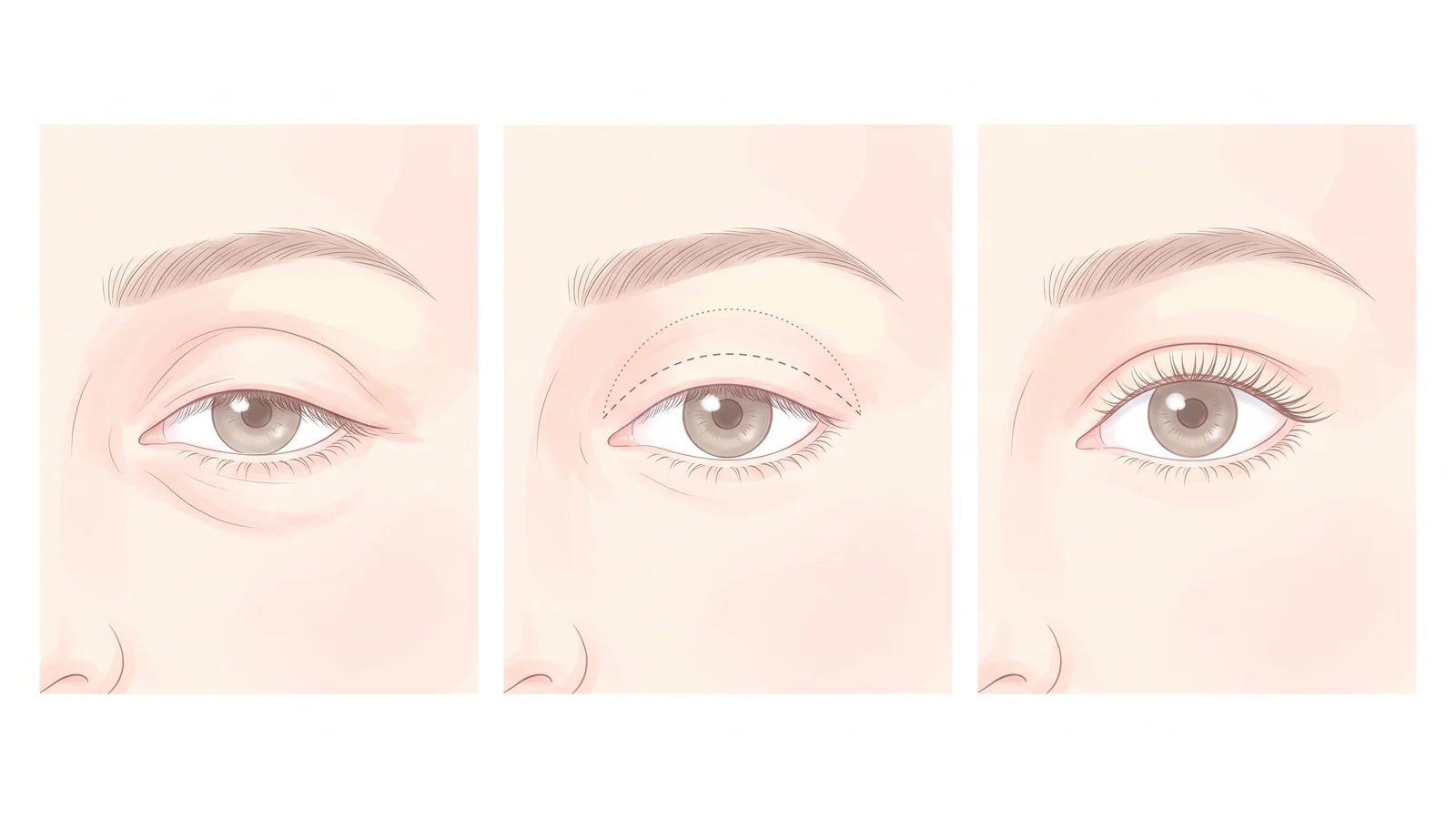
Upper-lid skin loosens with age, and in some families it is heavy from early adulthood. The medical name for that surplus is dermatochalasis. Once the fold reaches the lashes, the lid can feel heavy by evening, eyeliner prints onto the fold, and some people catch themselves raising their eyebrows to see clearly at the outer edges of their vision. Upper blepharoplasty treats the surplus directly: the extra skin is taken away and the remaining skin is closed inside the crease, so the scar line sits where the lid folds.
A droopy upper eyelid has more than one possible cause, and telling them apart decides the operation. Surplus skin is the job of upper blepharoplasty. A weak levator, the muscle that raises the lid, lets the lid margin itself sit low over the iris; that is ptosis, and ptosis correction is added to the upper-lid operation to tighten the muscle. A low, heavy eyebrow is a third pattern, for which the sub-brow lift or a brow procedure comes into the discussion. A single lid can show two of these at once, so the examination looks at the skin, the lid margin and the brow one by one.
Usually a good fit
- A fold of upper-lid skin resting on or near the lashes
- A crease hidden by hooding, most visible at the outer corner
- Upper lids that feel heavy or tired by the end of the day
- A hollow upper lid that may also suit the fat graft add-on
- Able to stay in Korea about 7 days for stitch removal
We may suggest waiting
- The lid margin itself sits low over the iris (ptosis)
- Heaviness that comes mainly from a low eyebrow
- Severe dry eye or an eye infection not yet treated
- Pregnancy or breastfeeding
- Wanting a change with no incision at all
Before & after
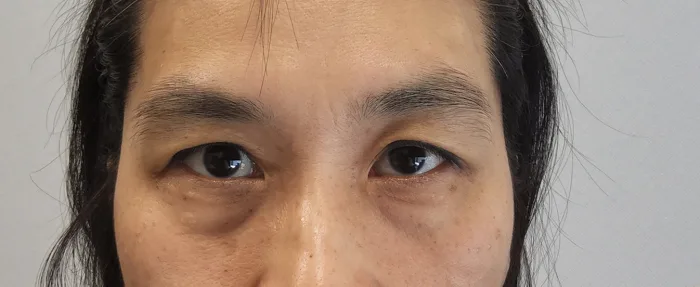
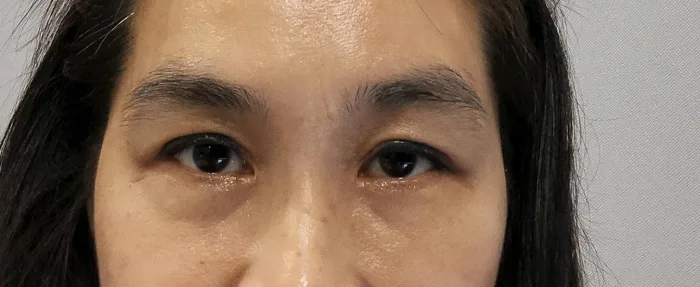
Upper blepharoplasty before and after
 BEFORE
 AFTER
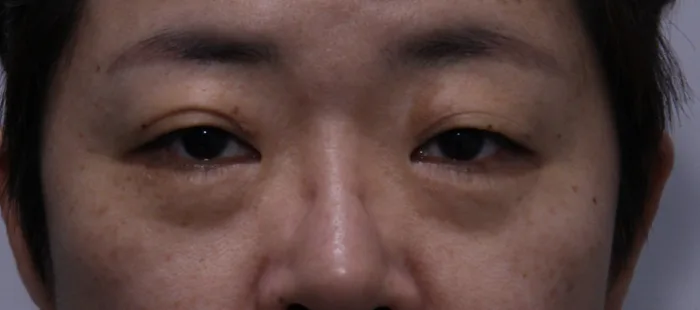 BEFORE
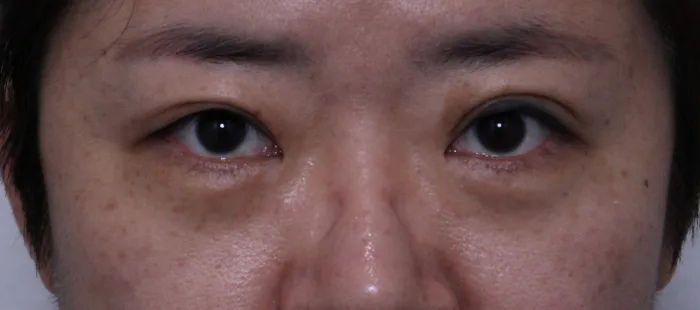 AFTER
How it works
How upper blepharoplasty removes hooded skin
The upper eyelid is built in thin layers: skin on the surface, the orbicularis oculi muscle that closes the eye beneath it, a membrane called the orbital septum, and behind that small pads of fat. Hooding is mostly a skin problem, though fat pressing forward near the inner corner can add fullness. Upper blepharoplasty reaches these layers from the front through one line drawn in the crease, and when the eye is open that line folds out of view.
How much tissue comes out is the central judgment. Too little, and the hood drops back onto the lashes; too much, and the lid can struggle to close. The amount is marked with you sitting upright, because gravity changes how the fold hangs. Whether a strip of muscle is removed along with the skin is decided for each eyelid. A 2021 systematic review of six small studies found no long-term difference in appearance between removing skin alone and removing skin with muscle, while muscle removal brought more eye discomfort in the early weeks (Samargandi, 2021).
An upper lid that looks hollow instead of full is a different issue from hooding. The clinic menu lists an upper-eyelid fat graft that is performed in the same session as upper blepharoplasty or incisional double eyelid surgery, priced as an add-on in the section below.
Measuring the hood
At consultationDr. Jang Jin-woo checks how far the skin fold drops, where the brow sits and whether the lid margin itself is low, then marks the skin to be removed while you sit upright.
Incision in the crease
Under local anesthesia, with IV sedation if you chose it, the lower edge of the marking follows the crease so the future scar lies inside the fold.
Removing the surplus
30–60 minutes in totalAn ellipse of excess skin is lifted away, with a strip of muscle or a little fat when that lid needs it, and the edges are drawn together.
Fine skin stitches
The incision is closed with fine stitches that are taken out at about 5–7 days, and cool compresses begin the same day.
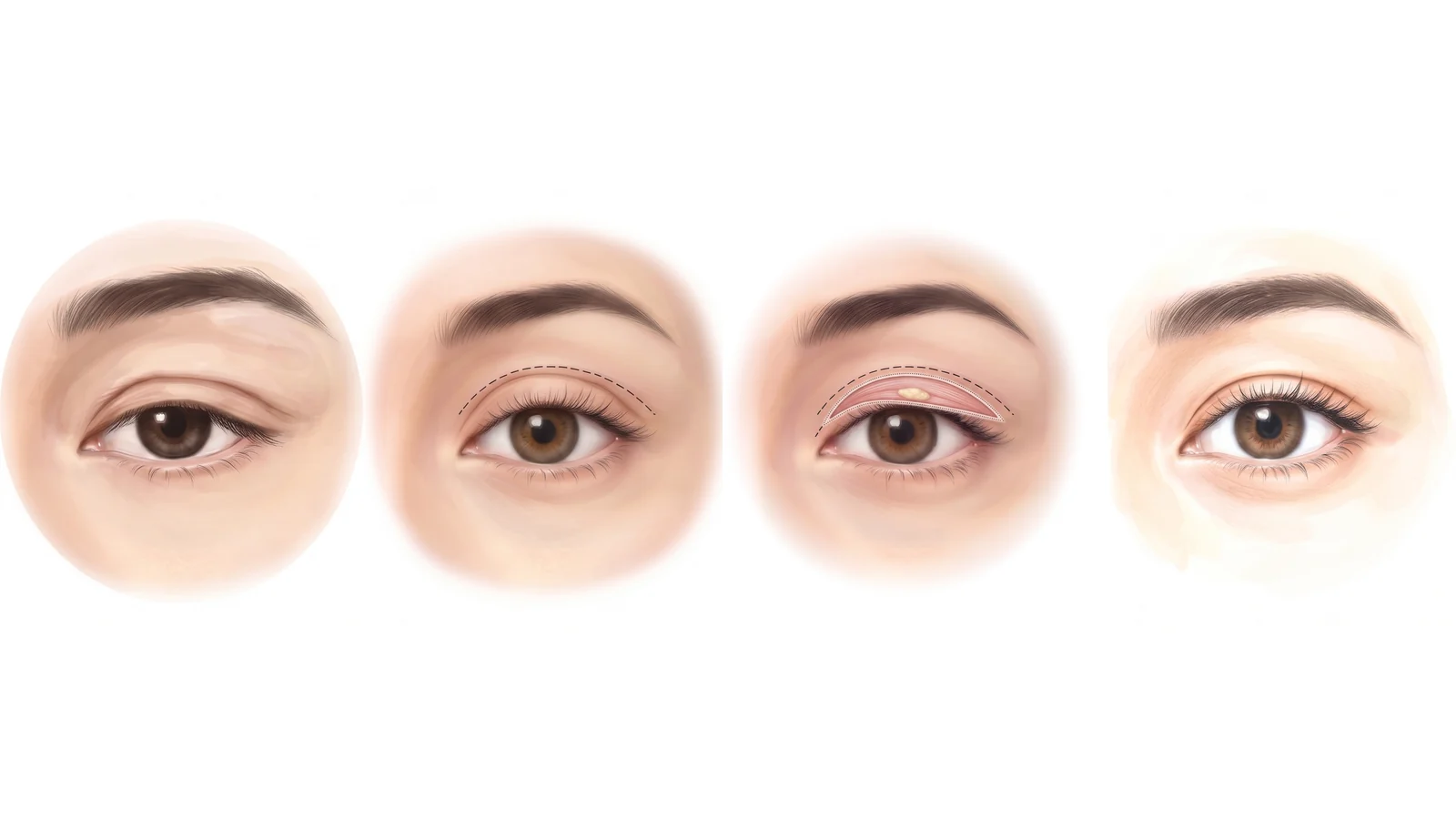
Upper-eyelid operations on the ENTER Plastic Surgery menu
| Point of comparison | Upper blepharoplasty | Sub-brow lift | Incisional double eyelid | Ptosis correction |
|---|---|---|---|---|
| Main concern | Surplus skin over the lashes | Hooding with a heavy outer brow area | A crease that is absent or faint | Lid margin sitting low over the iris |
| Incision line | In the eyelid crease | Along the lower edge of the brow | Along a newly designed crease | Through the crease, or non-incisional |
| Skin removed | Yes, the main step | Yes, just below the brow | A small amount if needed | Not the aim |
| Procedure time | 30–60 minutes | 30–60 minutes | 40–60 minutes | 40–60 minutes |
| How it is booked | Its own operation | Its own operation | Its own operation | Add-on to upper-lid surgery |
Times are the clinic's own figures; ptosis correction is booked together with upper blepharoplasty or incisional double eyelid surgery.

Your doctor
Chief Director · Korean board-certified plastic surgeon
“Natural, yet clearly visible change.”Eyelid and facelift surgery at ENTER is planned and performed by Dr. Jang himself.
- NowChief Director, ENTER Plastic Surgery
- TrainingPlastic surgery, Kyung Hee University Medical Center
- FormerChief Director, Jang Plastic Surgery
- FormerDirector, Secret Plastic Surgery
- MemberKSPRS · KSAPS · ISAPS · ESOPRS · ASPS
At a glance
Upper blepharoplasty: time, anesthesia and stay
| Procedure time | 30–60 minutes |
|---|---|
| Anesthesia | Local anesthesia, with IV sedation if needed |
| Recovery | Swelling and bruising 1–2 weeks; crease settles in about 1–3 months |
| Follow-up visits | 1–2 clinic visits, including stitch removal |
| Stitches | Removed about 5–7 days after surgery |
| Return to exercise | Generally, light walking is encouraged from surgery day; jogging, aerobics, weight training and heavy lifting are avoided for about 2 weeks (published guidance 10–14 days, some 2–3 weeks) |
| Earliest flight home | 7 days, once the stitches are out |
Prices
What upper blepharoplasty costs at ENTER Plastic Surgery
The operation itself is ₩2,600,000 per surgery, a pre-tax figure; Korea's 10% VAT is added to the bill when you pay. Local anesthesia belongs to the operation and has no line of its own.
IV sedation is optional for this surgery. If you would like it, the clinic lists it as a separate charge, the same sedation fee it applies to every surgery on its menu, also before VAT. The upper-eyelid fat graft for a hollow lid is an add-on: it is performed during upper blepharoplasty or incisional double eyelid surgery and has no price outside those operations.
Before you fix flights, ask for a written quote that names every line you expect to pay, including any medicine to take home, so the total is clear in advance.
Prices exclude VAT (10% VAT is added at payment).
Recovery
Healing after upper blepharoplasty, stage by stage
You leave with the stitches in place along the crease. A little blood on the gauze during the first one to two days is part of normal healing after this operation.
Cool compresses keep the lids comfortable for three days. Nose blowing stays off the list for two weeks, and any sneeze should be gentle, because the pressure reaches the fresh incision.
Compresses turn warm, in a cycle of 30 seconds on and 5 minutes off. Bruising can be hidden behind glasses if you want to go out in Seoul.
The skin stitches are removed at about 5–7 days and recovery reaches roughly one week. On the clinic's guidance, the flight home follows at 7 days, after the stitches are out.
Across the first one to two weeks the bruises yellow and the puffiness eases. While some swelling remains, the crease can look higher and the line pinker than it will finally be.
The crease line settles over about one to three months and the scar inside the fold softens, so the final shape is judged at the end of that period.
Safety
Upper blepharoplasty risks to weigh before booking
Each risk below has a name surgeons use, so you can ask about it directly. Bleeding that soaks through gauze, pain that keeps building or any loss of vision needs a call to the clinic at once.
- Asymmetry between the two creases or folds, during healing and sometimes after it.
- A visible or thickened scar, as the crease incision heals differently in each person.
- Trouble closing the eye fully (lagophthalmos) or dry, gritty eyes, a risk that rises when a large amount of skin is removed.
- Bleeding under the skin (hematoma) or infection, both of which need prompt treatment.
- A slight drop in eyebrow height once the hood is gone.
- Remaining hooding, or a further operation if the fold returns or the two sides differ.
The research on this surgery is broad but rated low in quality. Pooled reviews report good satisfaction and scar ratings, alongside a small downward shift of the brow (Hollander, 2020), while results on dry eye after surgery conflict from one study to the next. These are averages across studies and do not predict an individual result.
Evidence
Research behind this page
- Is Orbicularis Oculi Muscle Resection Necessary in Upper Blepharoplasty? A Systematic ReviewAesthetic Plastic Surgery · 2021 · Samargandi O et al. · doi:10.1007/s00266-021-02131-8
Systematic review of six small studies: removing orbicularis muscle with the skin gave no long-term cosmetic advantage over skin-only removal and caused more early eye discomfort, supporting muscle preservation in standard cases.
- Functional outcomes of upper eyelid blepharoplasty: A systematic reviewJournal of Plastic, Reconstructive & Aesthetic Surgery · 2019 · Hollander M et al. · doi:10.1016/j.bjps.2018.11.010
Review of 28 studies on function: wider upper visual fields and fewer headaches after surgery, with conflicting results on dry eye and eyebrow position that need further research.
- Aesthetic outcomes of upper eyelid blepharoplasty: a systematic reviewInternational Journal of Oral and Maxillofacial Surgery · 2020 · Hollander M et al. · doi:10.1016/j.ijom.2019.10.014
Review of 26 studies on appearance: satisfaction and scar ratings were generally good and more upper-lid platform showed, but the brow tended to sit slightly lower; meta-analysis was not possible.
- Upper Eyelid Blepharoplasty: Surgical Techniques and Results—Systematic Review and Meta-analysisAesthetic Plastic Surgery · 2023 · Rodrigues C et al. · doi:10.1007/s00266-023-03436-6
Meta-analysis of 20 studies: no significant change in eye pressure, corneal or tear measures after upper blepharoplasty, few complications and high reported satisfaction, from low-quality evidence.
FAQ
Upper blepharoplasty questions from overseas patients
How long does swelling last after upper blepharoplasty?
Swelling and bruising settle over about one to two weeks, and the crease keeps refining for about one to three months. Bruising can be covered with glasses during the first week. Swelling that grows after the first days, strong pain or blurred vision should be reported to the clinic straight away.
How many days should I stay in Korea for upper blepharoplasty?
Plan on 7 days. The skin stitches come out at about 5–7 days, and the clinic's guidance is that the flight home comes after that removal. Follow-up is one to two visits in all, so leaving a spare day before your flight gives room if the stitch appointment shifts.
Who will operate on my upper eyelids?
Every upper blepharoplasty at ENTER Plastic Surgery is performed by Dr. Jang Jin-woo, who is a Korean board-certified plastic surgeon. Dr. Jang's training in plastic surgery took place at Kyung Hee University Medical Center, and professional memberships include ISAPS, ESOPRS and the Korean Society for Aesthetic Plastic Surgery.
Can I stay awake for upper blepharoplasty?
Yes. The operation is done under local anesthesia, which numbs the eyelids while you stay awake. IV sedation can be added if you would feel calmer sleeping through it. Tell the clinic which you prefer before the surgery day, because sedation is billed as its own line and changes how you plan that afternoon.
Is IV sedation an extra charge on top of the surgery fee?
Yes. IV sedation, the sedation anaesthesia line as it is spelled in the UK, is ₩300,000 + VAT per surgery and is charged when you choose it. The surgery fee and the sedation line are both pre-tax amounts, and 10% VAT is added at payment.
Can I arrange upper blepharoplasty by message before I fly to Seoul?
Yes. Use the form on this page or message us on WhatsApp, and we will get back to you as soon as possible. English-speaking staff are available at the clinic. Include your travel dates, so the operation and the stitch-removal visit can fit inside one trip.
What should I check about the deposit and changing my surgery date?
Ask for the deposit amount and the cancellation and rescheduling terms in writing before you pay. Then compare them with your flights: stitch removal at about 5–7 days sets the earliest day you can leave, so moving the surgery date also moves your return.
Is upper blepharoplasty worth it?
It depends on what the hood is doing for you. In pooled studies, people whose skin fold blocked their upper vision gained a wider visual field and had fewer headaches after surgery (Hollander, 2019). The operation changes surplus skin; it does not raise a low brow or strengthen a weak lid muscle.
How long does upper blepharoplasty last?
The clinic's guidance is about 5 to 10 years or longer. The skin, the brow and the tissue around the eye keep aging after surgery, so some hooding can return gradually over the years, and a second operation later in life is possible if it does.
My eyelids look droopy. Is that extra skin or ptosis?
It can be either, or both. Extra skin folds down over the lashes while the lid margin stays at its normal height. In ptosis, the lid margin itself sits low over the iris because the levator muscle is weak. When both are present, ptosis correction is added to upper blepharoplasty.
Can upper blepharoplasty affect my eyesight or tears?
Pooled studies are reassuring about the eye itself: a 2023 meta-analysis found no significant change in eye pressure, corneal measures or tear tests after surgery (Rodrigues, 2023). Dry or gritty eyes in the first weeks remain a listed risk, and existing dry eye should be treated before the operation.
What does 'Korean technique' mean for upper blepharoplasty?
It is a search phrase, not a defined operation. What shapes the result is where the crease incision is placed, how much skin is removed and whether a strip of muscle or fat is taken, and Dr. Jang plans those points for each eyelid when examining you in person.
Google reviews
Reviews on Google Maps
Great experience! Dr. is very sweet and kind. He listened to what I wanted to fix and correct. He explained everything very well. Wasn’t pushy and didn’t try to sell anything extra. This isn’t a clinic that comes out on instagram, which I…
 Jennifer LyuA month ago
I came to Enter Plastic Surgery on a friend’s recommendation for under-eye fat repositioning. I was pretty nervous going in, but the doctor took the time to explain what would work for my under-eyes, what the procedure involved, and what…
 Michael2 months ago
The staff are incredibly friendly, and the consultation was very thorough. I was very worried since it was my first procedure, but the director explained the aftercare in detail, so I felt completely confident trusting them!!
 ROOHEUI SHIN (RHS)2 months ago · Translated by Google