

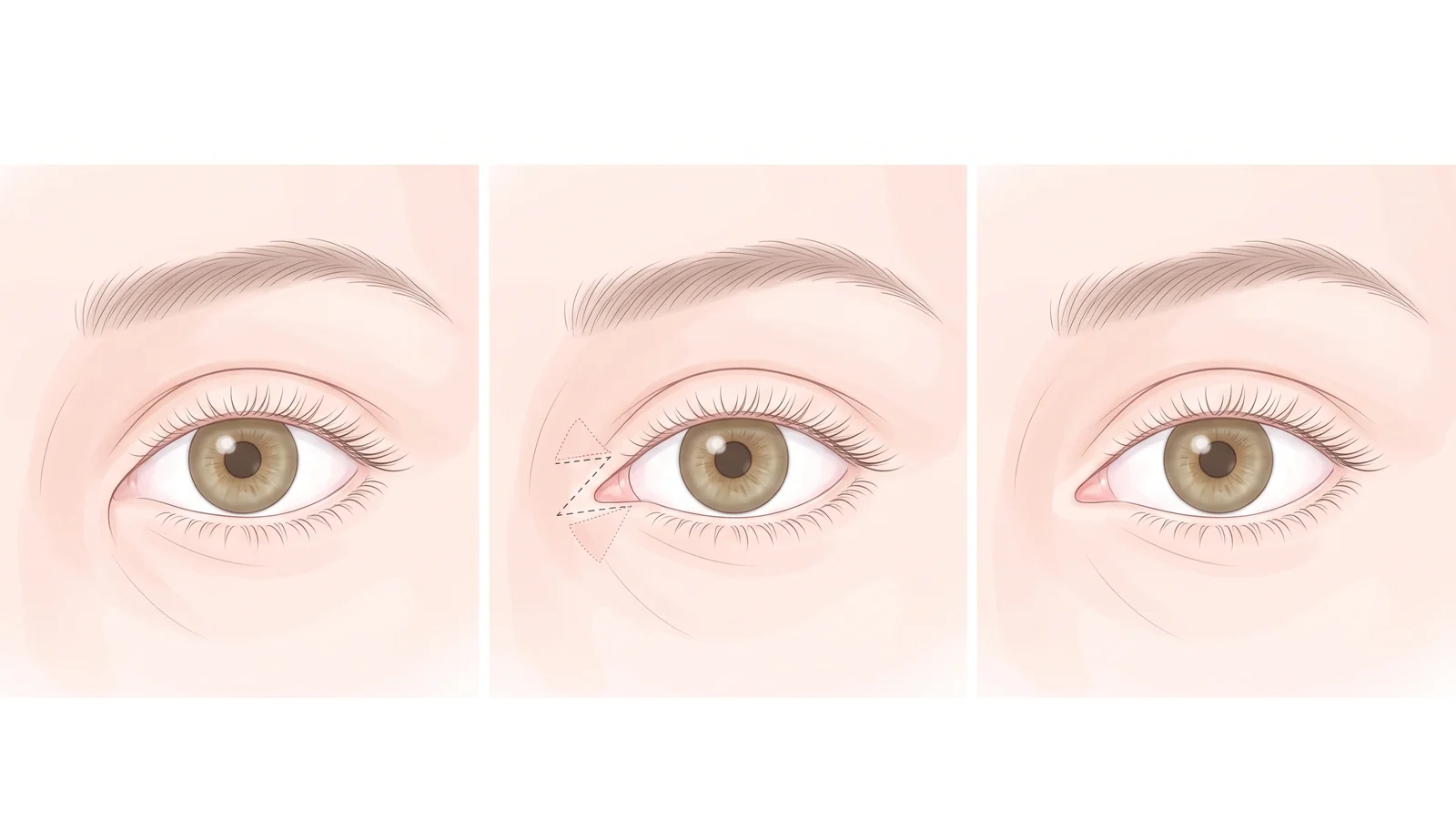
The epicanthal fold is the small web of upper-eyelid skin that curves down over the inner corner of the eye and can hide the pink caruncle, so the eyes read as set wider apart. Epicanthoplasty in Korea releases and resets that fold. At ENTER Plastic Surgery, Dr. Jang Jin-woo performs it in about 30–60 minutes under local anesthesia, with IV sedation as an option.
Is it for you?
Who medial epicanthoplasty suits
An epicanthal fold is a normal anatomical feature and does not need correcting for health reasons. People ask about surgery when the fold changes how they want their eyes to look: the inner corner looks rounded and covered, the space between the eyes looks wide, or the double-eyelid crease disappears into the fold before it reaches the corner.
The deciding measurement is the gap between the two inner corners compared with the width of each eye. When that gap is already narrow, opening the corner further can make the eyes look crowded toward the nose, and the change is hard to undo. Skin that scars thickly is another reason to pause, because the incision sits on visible skin right at the corner of the eye.
Usually a good fit
- A fold that covers part of the inner corner and the caruncle
- Eyes that look set far apart because of the fold
- A double-eyelid crease that vanishes into the fold
- Eyelid skin with no history of thick or raised scars
- Able to stay in Korea for about one week
We may suggest waiting
- Inner corners that already sit close together
- Little or no fold over the inner corner
- A history of keloids or thick, raised scars
- Active eye infection, allergy flare or irritation
- Pregnancy or breastfeeding
Before & after
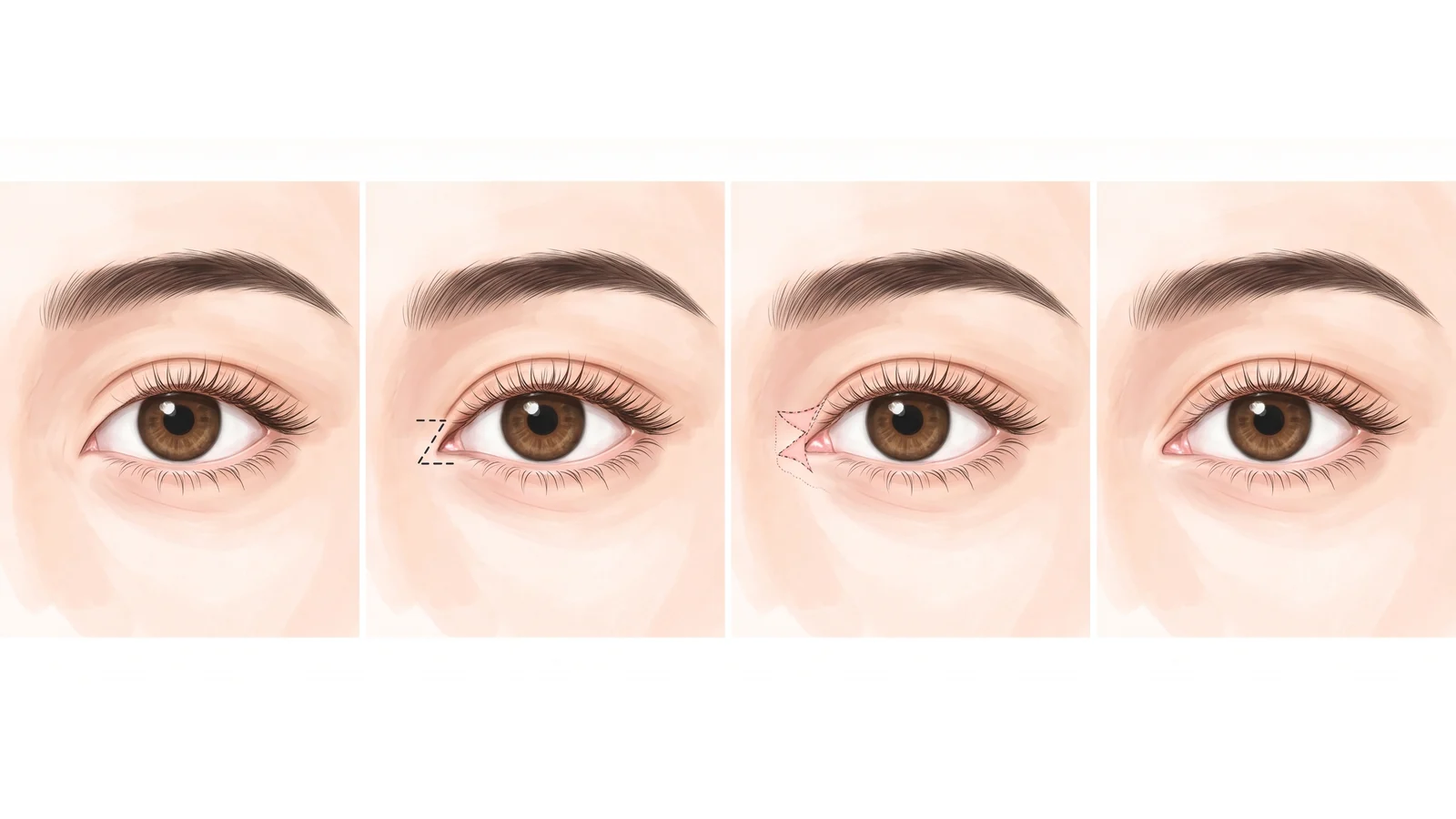
Epicanthoplasty before and after
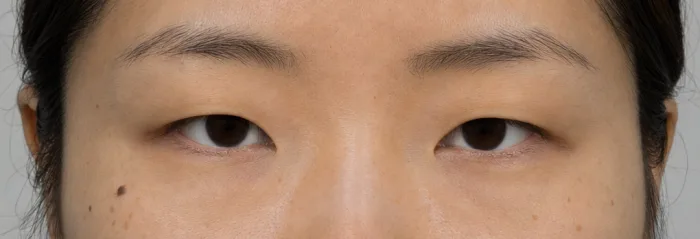 BEFORE
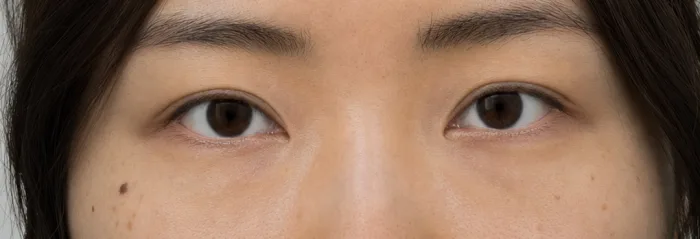 AFTER
How it works
How epicanthoplasty reshapes the fold
The fold forms where skin of the upper eyelid sweeps down across the medial canthus, the point where the upper and lower lids meet near the nose. Underneath it, a band of muscle and skin tension holds the fold in place. Medial epicanthoplasty (the inner-corner procedure) works on that tension: a small, precisely shaped flap of skin is cut, the tight band is released, and the skin is moved so that more of the corner shows.
Many patterns for designing this flap are described in the medical literature, and a review of the field concluded that no single technique is standard; the design is chosen for the shape of each patient's fold, and fine planning, magnification and tension-free closure are what keep the scar small (Baek, 2020). At ENTER Plastic Surgery the incision line is designed for each patient at consultation.
Upper epicanthoplasty
Upper (superior) epicanthoplasty addresses the top section of the fold, where it meets the beginning of the double-eyelid crease. Its aim is to let the crease start closer to the inner corner instead of being swallowed by the fold. Because it changes how the crease begins, it is planned with the double-eyelid line in mind, and the clinic prices it separately from the medial procedure.
Measuring the fold
At consultationDr. Jang Jin-woo looks at how much of the caruncle the fold covers, the distance between the inner corners and where the crease begins, then decides between medial, upper or both.
Designing the incision
A small incision line is marked around the fold. Its shape and length are set for that eye, so the two sides can differ slightly.
Moving the skin flap
Under local anesthesia, with IV sedation if chosen, the tight band under the fold is released and the small flap is shifted so the inner corner opens.
Fine stitches
30–60 minutes in totalThe skin is closed with fine stitches that come out at about 5–7 days, at the one follow-up visit.
Eye-corner procedures at ENTER Plastic Surgery
| Point of comparison | Medial epicanthoplasty | Upper epicanthoplasty | Lateral & lower canthoplasty |
|---|---|---|---|
| Part of the eye | Inner corner, lower part of the fold | Inner corner, where fold meets crease | Outer corner and lower lid |
| Main aim | Show more of the inner corner | Let the crease start at the corner | Lengthen the eye outward and down |
| Anesthesia (clinic guidance) | Local, IV sedation optional | Local, IV sedation optional | Local, IV sedation optional |
| Procedure time | About 30–60 minutes | About 30–60 minutes | About 30–60 minutes |
| Stitches out | About 5–7 days | About 5–7 days | About 5–7 days |
| Earliest flight home | 5–7 days, after stitches | 5–7 days, after stitches | 5–7 days, after stitches |
Times are the clinic's guidance for each procedure on its own; combining procedures in one session is planned at consultation.

Your doctor
Chief Director · Korean board-certified plastic surgeon
“Natural, yet clearly visible change.”Eyelid and facelift surgery at ENTER is planned and performed by Dr. Jang himself.
- NowChief Director, ENTER Plastic Surgery
- TrainingPlastic surgery, Kyung Hee University Medical Center
- FormerChief Director, Jang Plastic Surgery
- FormerDirector, Secret Plastic Surgery
- MemberKSPRS · KSAPS · ISAPS · ESOPRS · ASPS
At a glance
Epicanthoplasty in numbers
| Procedure time | About 30–60 minutes |
|---|---|
| Anesthesia | Local anesthesia, or IV sedation |
| Recovery | Swelling and bruising 3–7 days; the corner settles over about 2–3 months |
| Follow-up visits | 1 visit, for stitch removal |
| Stitches | Removed about 5–7 days after surgery |
| Earliest flight home | 5–7 days after surgery, once stitches are out |
Prices
Epicanthoplasty cost in South Korea
Medial and upper epicanthoplasty each have their own price line, so choosing both means two lines on the quote. If you choose IV sedation, it is a further separate line; ENTER Plastic Surgery bills sedation apart from the fee for every surgery. All of these figures are before VAT, and 10% VAT is added when you pay.
If epicanthoplasty is planned in the same session as double-eyelid surgery, the double-eyelid fee is quoted on its own line as well, and it is worth asking for an itemized written estimate before you book flights.
Prices exclude VAT (10% VAT is added at payment).
Recovery
Epicanthoplasty healing, week by week
The inner corners feel tight and look swollen. Light spotting of blood on gauze during the first one or two days is normal for this area.
Cold packs over closed eyes help with swelling in these three days. Hold back from blowing your nose for two full weeks, and sneeze with your mouth open to spare the corners.
Move to warm packs, in short rounds: half a minute of warmth followed by a five-minute pause, repeated through the day.
The stitches come out at about day 5 to 7 at your one follow-up visit, and the earliest flight home follows that removal.
Bruising and swelling clear within three to seven days. The incision line is pink and visible at close range at this stage.
The new corner shape settles over about two to three months, while the scar fades and softens; judge the final result after that point.
Safety
Possible complications of epicanthoplasty
The incision for this surgery sits on skin you see every day in the mirror, so scar quality is the main concern. Bleeding that soaks through gauze, increasing pain or any change in vision should be reported to the clinic straight away.
- A visible scar at the inner corner, including redness, lighter or darker skin along the line, or a raised scar.
- Asymmetry between the two inner corners.
- Over-correction, where too much of the corner is opened and the eyes look close-set or the caruncle looks exposed.
- A small depressed scar or webbing on the lower lid near the corner.
- The fold partly returning as the tissue heals.
- Infection or bleeding, which needs prompt treatment.
In a study of 35 patients treated with a Z-shaped design, satisfaction was high, yet changes in scar color were frequent: 28.6% had lighter and 34.3% had darker skin along the scar (Fatani, 2023). A long-term series of a minimal-scar method reported inner corners that stayed open over three years, with 2 of 52 patients needing a correction for a depressed lower-lid scar (Yi, 2007). A revision series of 548 Asian patients who wanted their earlier result changed is a reminder that over-opening is a real outcome to avoid (Ha, 2021).
Evidence
Research behind this page
- Medial Epicanthoplasty: What Works and What Does NotFacial Plastic Surgery · 2020 · Baek J et al. · doi:10.1055/s-0040-1715617
Review: there is no established standard epicanthoplasty technique, so the method is matched to the patient, and careful design, magnification and tension-free closure are needed to limit scarring.
- Cosmetic outcomes of epicanthoplasty for epicanthus tarsalisSaudi Journal of Ophthalmology · 2023 · Fatani D et al. · doi:10.4103/sjopt.sjopt_54_22
Cohort of 35 Z-epicanthoplasty patients: high cosmetic satisfaction (median 9 out of 10), but scar color change was common, with 28.6% hypopigmentation and 34.3% hyperpigmentation.
- Simple Epicanthoplasty with Minimal ScarAesthetic Plastic Surgery · 2007 · Yi S et al. · doi:10.1007/s00266-006-0123-7
Minimal-scar epicanthoplasty followed for three years: scars were less noticeable and the inner corner stayed open, while 2 of 52 patients developed a depressed lower-lid scar that was corrected.
- Revisional Medial Epicanthoplasty Using Reverse Z-Plasty TechniqueAesthetic Surgery Journal · 2021 · Ha J et al. · doi:10.1093/asj/sjab091
Reverse Z-plasty in 548 Asian patients needing revision after medial epicanthoplasty: most were satisfied and 6% had further scar revision, showing that some people want an earlier result undone.
FAQ
Epicanthoplasty FAQ
When can I go back to work after epicanthoplasty?
Bruising and swelling clear within three to seven days, so a desk job is realistic once the stitches are out at about day 5 to 7. The pink incision line stays visible up close for a while longer and fades over the next two to three months.
How many days should I stay in Korea for epicanthoplasty?
Plan on about one week. The stitches come out at your single follow-up visit around day 5 to 7, and the clinic's guidance is that you can fly home after that. If epicanthoplasty is combined with another eyelid surgery, the longer of the two stitch schedules sets your departure.
Who performs epicanthoplasty at ENTER Plastic Surgery?
Dr. Jang Jin-woo, a Korean board-certified plastic surgeon, performs epicanthoplasty at the clinic. Dr. Jang trained in plastic surgery at Kyung Hee University Medical Center and is a member of the European Society of Ophthalmic Plastic and Reconstructive Surgery (ESOPRS).
How much does epicanthoplasty cost in Korea?
Medial and upper epicanthoplasty are each listed at ₩1,300,000 + VAT, so having both means two of these lines. Optional IV sedation is billed separately at ₩300,000 + VAT. All prices are before VAT, and 10% is added at payment.
Is epicanthoplasty done under local anaesthetic or sedation?
Local anesthesia (local anaesthetic, in UK spelling) is the standard setting, and IV sedation can be added if you prefer to be drowsy during surgery. Sedation is an extra line on the bill. Tell the clinic about any reaction you have had to anesthesia before, so it can plan safely.
How do I get in touch about epicanthoplasty from abroad?
Fill in the form on this page or contact us on WhatsApp, and we will get back to you as soon as possible. The clinic has English-speaking staff. A close, straight-on photo of both eyes with your gaze forward shows the fold clearly and helps with the first assessment.
Do I have to pay a deposit, and can I cancel?
Deposit and cancellation conditions are set for each booking, so ask for them in writing before you send any money. Keep your flight dates flexible enough around the stitch removal at about day 5 to 7, since the surgery date and that visit move together.
Where will the scar be after epicanthoplasty?
The scar sits on the skin right at the inner corner of the eye, following the edge of the reshaped fold. It looks pink at first and fades over months. In a published series, some patients had lighter or darker skin along the line (Fatani, 2023), which is why scar tendency is checked first.
What is the difference between medial and upper epicanthoplasty?
Medial epicanthoplasty works on the lower, inner part of the fold and shows more of the inner corner. Upper epicanthoplasty works on the top section, where the fold meets the double-eyelid crease, so the crease can start nearer the corner. Each has its own price line.
Can epicanthoplasty be reversed if I do not like the result?
A revision operation exists, but it is more complex than the first surgery and cannot fully restore untouched skin. A series of 548 Asian patients treated with a reverse Z-shaped repair found most satisfied, with 6% needing further scar revision (Ha, 2021). Planning a moderate opening at the start lowers the chance of needing one.
Can epicanthoplasty make the eyes look too close together?
Yes, if too much of the corner is opened for that face. The gap between the inner corners is measured against eye width before surgery, and when the eyes already sit close together, epicanthoplasty is not recommended. A visible caruncle that looks exposed is one sign of over-correction.
Google reviews
Reviews on Google Maps
Great experience! Dr. is very sweet and kind. He listened to what I wanted to fix and correct. He explained everything very well. Wasn’t pushy and didn’t try to sell anything extra. This isn’t a clinic that comes out on instagram, which I…
 Jennifer LyuA month ago
I came to Enter Plastic Surgery on a friend’s recommendation for under-eye fat repositioning. I was pretty nervous going in, but the doctor took the time to explain what would work for my under-eyes, what the procedure involved, and what…
 Michael2 months ago
The staff are incredibly friendly, and the consultation was very thorough. I was very worried since it was my first procedure, but the director explained the aftercare in detail, so I felt completely confident trusting them!!
 ROOHEUI SHIN (RHS)2 months ago · Translated by Google