


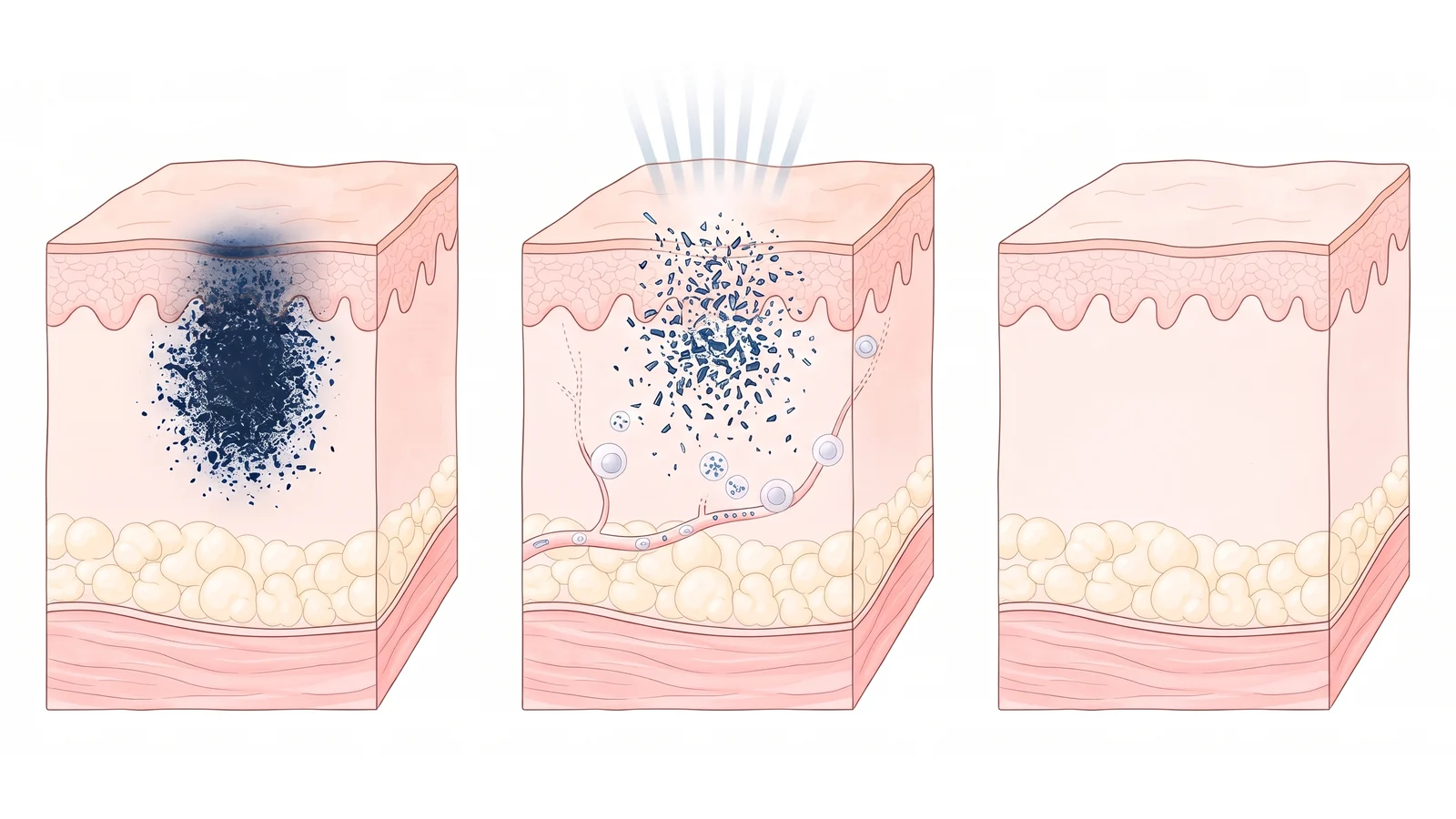
Tattoo ink sits in the dermis as pigment particles too large for the body to clear, and tattoo removal in Seoul at ENTER Plastic Surgery uses the Clarity II laser from Lutronic to break them into fragments that the immune system can carry away. A visit takes 15–30 minutes under numbing cream, and sessions are spaced 6–8 weeks apart.
Is it for you?
Who laser tattoo removal in Seoul suits
Two things decide how a tattoo responds: what is in the ink and what the skin around it can tolerate. Dark, single-color line work absorbs laser light across a broad range, so it tends to lighten steadily. Mixed palettes, layered professional pieces and pale shades break up unevenly, and a tattoo can lighten in some areas while one color lingers.
Timing matters as much as the tattoo itself. The skin needs a calm surface to absorb energy evenly, so a fresh tattoo, a sunburn or an active rash in the area is a reason to wait. Because the course spans months, the plan also has to fit how often you can be in Seoul.
Usually a good fit
- A black or dark blue tattoo you want lightened or removed
- A design you want faded before a cover-up tattoo
- A tattoo that fits within a 9 × 9 cm square
- Able to return for sessions 6–8 weeks apart
- Willing to keep the area out of the sun between visits
We may suggest waiting
- A new tattoo or skin that has not fully healed
- Sunburned, freshly tanned or irritated skin over the design
- Active infection, rash or eczema in the area
- Pregnancy or breastfeeding
- Expecting every color gone after one visit
How it works
How the laser breaks up tattoo ink
Each pigment particle absorbs a specific band of light. When a laser pulse is short and strong enough, the particle heats faster than it can pass that heat to the surrounding skin and shatters, while the tissue around it is largely spared. Macrophages then pick up the smaller fragments and clear them through the lymphatic system over the following weeks, which is why the tattoo keeps fading between visits.
Color decides how well this works. A review of the field found that matching the wavelength to the ink color is the main factor in success, and that some cosmetic, white and skin-toned inks can turn darker after treatment (Choudhary, 2010). An earlier review called laser removal an imperfect treatment for multicolored tattoos, since no single laser clears every ink, and recorded texture change, scarring and pigment change as the main side effects (Kupermanbeade, 2001).
The device at ENTER Plastic Surgery is the Clarity II laser made by Lutronic. Published tattoo studies largely used Q-switched or picosecond lasers, so the figures in this literature describe how the technology behaves in general; they are not results recorded with this device. Skin type, ink color and energy settings all shape the outcome and the side-effect profile (Kurniadi, 2020).
Size and ink check
At consultationThe tattoo is measured against the three size tiers, and its colors, depth and the skin around it are looked at before a session is planned.
Numbing the skin
A numbing cream is spread over the tattoo and left in place for a while so the skin is less sensitive when the laser starts.
Laser passes over the ink
15–30 minutes, by sizeShort laser pulses are delivered across the design. The treated ink briefly turns whitish and the skin around it reddens and swells a little.
Protective tape dressing
A healing tape is placed over the area. It stays on for about 7–10 days and is changed once or twice a day when fluid makes it turn white.
Tattoo size tiers on the ENTER Plastic Surgery menu
| What to compare | Up to 3 × 3 cm | Up to 6 × 6 cm | Up to 9 × 9 cm |
|---|---|---|---|
| Tattoo fits inside | A 3 cm square | A 6 cm square | A 9 cm square |
| Price per session | ₩200,000 + VAT | ₩300,000 + VAT | ₩400,000 + VAT |
| Numbing | Numbing cream | Numbing cream | Numbing cream |
| Spacing (clinic guidance) | 6–8 weeks | 6–8 weeks | 6–8 weeks |
| Earliest flight home | The next day | The next day | The next day |
The tier follows the smallest square the whole design fits into; larger tattoos need an individual quote.
Session by session
| When | What to expect |
|---|---|
| First session | The tattoo lightens over the weeks after the visit as fragments are cleared. |
| Every 6–8 weeks | The next session is booked once the skin has healed and the previous round of fading has run its course. |
| Across 5–10 sessions | The clinic's guidance range, set by the colors in the ink and the size of the design. |

Your doctor
Chief Director · Korean board-certified plastic surgeon
“Natural, yet clearly visible change.”Eyelid and facelift surgery at ENTER is planned and performed by Dr. Jang himself.
- NowChief Director, ENTER Plastic Surgery
- TrainingPlastic surgery, Kyung Hee University Medical Center
- FormerChief Director, Jang Plastic Surgery
- FormerDirector, Secret Plastic Surgery
- MemberKSPRS · KSAPS · ISAPS · ESOPRS · ASPS
At a glance
Tattoo removal at a glance
| Procedure time | 15–30 minutes, depending on size |
|---|---|
| Anesthesia | Numbing cream |
| Downtime | Scab darkens around day 3, falls off at days 7–10 |
| Recommended sessions | 5–10, spaced 6–8 weeks apart, by color and size |
| How long results last | Long-lasting once the course ends; some ink can remain |
| Return to exercise | Generally, strenuous exercise, swimming and saunas are avoided for about 5–10 days after laser treatment (varies with device and settings) |
| Earliest flight home | The next day |
Prices
Tattoo removal price list in South Korea
The fee is charged per session, and the tier depends on the smallest square the whole design fits inside. Each price excludes VAT (10% VAT is added at payment). Because a course is several sessions, the total for your tattoo is the per-session line multiplied by the number of visits it takes, which depends on the ink.
Designs larger than 9 × 9 cm are not covered by these three lines and need a quote of their own. When you ask for one, request that dressings or aftercare products be listed as separate lines so the total is clear before you book travel.
Prices exclude VAT (10% VAT is added at payment).
Recovery
Caring for the skin after a tattoo removal session
Redness, mild swelling and a whitish frosting over the ink are expected. The healing tape goes on before you leave, and sunscreen starts on the surrounding skin.
Change the tape once or twice a day whenever fluid under it makes it puff up and turn white. Keep reapplying sunscreen every 3–4 hours on exposed skin.
The scab over the tattoo turns darker. Leave it alone; picking or scratching it raises the chance of a mark or pigment change.
The scab falls away by itself, and the tape can come off once the wound has closed.
The skin stays sensitive, so skip scrubs, peels and exfoliating products. Contact the clinic straight away if the area becomes hot, painful or oozes pus.
The fading from this round has had time to show, and the skin is ready to be assessed for the next session.
Safety
Side effects and risks of laser tattoo removal
Laser removal works by injuring ink particles inside living skin, so the skin reacts each time. Short-term reactions settle with the dressing routine, but some changes can last.
- Blistering, crusting and pinpoint bleeding in the first days after a session.
- Lighter patches (hypopigmentation) or darker patches (hyperpigmentation) in the treated skin; one review reported temporary lightening in up to half of patients treated with a Q-switched alexandrite laser (Kupermanbeade, 2001).
- Changes in skin texture or a raised scar, with a higher chance if the scab is picked or the area becomes infected.
- Paradoxical darkening of some cosmetic, white or skin-toned inks.
- Allergic reactions as ink fragments are released, particularly with red and some colored pigments.
- Incomplete clearance, where a faint outline or a single color stays visible after the course.
A 2025 continuing-education review summarized the same complication list and the safety steps used to reduce it, including test areas and conservative energy on darker skin (Kassirer, 2025).
Evidence
Research behind this page
- Laser Removal of TattoosAmerican Journal of Clinical Dermatology · 2001 · Kupermanbeade M et al. · doi:10.2165/00128071-200102010-00004
Review of Q-switched laser tattoo removal: texture change, scarring and pigment change are the main side effects, temporary lightening reached up to 50% with the alexandrite laser, and multicolored tattoos cannot all be cleared with one laser.
- Laser tattoo removal: Fundamental principles and practical approachDermatologic Therapy · 2020 · Kurniadi I et al. · doi:10.1111/dth.14418
Review of the principles of laser tattoo removal: skin type, ink color, wavelength, energy and pulse settings all shape results, and poor matching leads to weaker outcomes and more side effects.
- Laser tattoo removal strategies: Part II: A review of the methods, techniques, and complications involved in tattoo removalJournal of the American Academy of Dermatology · 2025 · Kassirer S et al. · doi:10.1016/j.jaad.2024.05.097
Continuing-education review of laser tattoo removal methods, technique choices, safety considerations and complications.
- Lasers for tattoo removal: a reviewLasers in Medical Science · 2010 · Choudhary S et al. · doi:10.1007/s10103-010-0800-2
Review of lasers for tattoo removal: choosing a laser that matches the ink color is central to success, with pigment changes, allergy and ink darkening listed as complications and prevention steps.
FAQ
Tattoo removal in Seoul: questions
How long does skin take to heal after a tattoo removal session?
About 7–10 days for the surface. The scab over the tattoo darkens around day 3 and falls off on its own between days 7 and 10, while the healing tape stays on until the wound has closed. Skip scrubs, peels and exfoliating products for 2 weeks.
Can I fly home the day after tattoo removal in Seoul?
Yes. The clinic's guidance is that you can fly the next day. Keep the healing tape on during the trip, change it if it turns white with fluid, and carry sunscreen. The next session is 6–8 weeks later, so plan return visits or a longer stay in Korea.
What qualifications do the doctors at ENTER Plastic Surgery have?
Dr. Jang Jin-woo is a Korean board-certified plastic surgeon who leads the clinic. Dr. Choi Yul is a family medicine specialist who focuses on Botox, injections and pigment treatment at the clinic. Tattoo removal is a laser treatment carried out at the clinic under that medical team.
Is the tattoo removal price per session or for the whole course?
Per session. The fee follows three size tiers, up to 3 × 3 cm at ₩200,000 + VAT, up to 6 × 6 cm and up to 9 × 9 cm, and each excludes Korea's 10% VAT. The course total equals the per-session fee times the number of visits your ink needs.
How do I send details of my tattoo from abroad?
Send the form on this page or message us on WhatsApp with the tattoo's size in centimeters, its colors and your travel dates, and we will get back to you as soon as possible. English-speaking staff are available at the clinic for your visit.
Do I pay a deposit to reserve a tattoo removal visit?
Terms are set for each booking, so ask for the deposit amount and the cancellation rules in writing before paying. A course runs over months, so also ask how a missed or moved session is handled before you commit to dates.
Which tattoo colors (colours, in UK spelling) are hardest to remove?
Black and dark blue respond most readily because they absorb a broad range of laser light. Green, light blue, yellow and pale shades are harder to clear, and some white, skin-toned and cosmetic inks can darken after a pulse. A multicolored piece can fade unevenly from color to color.
Can a tattoo be faded enough for a cover-up instead of fully removed?
Yes. Fading for a cover-up can be the goal from the first visit. The aim is to fade the old lines so a new design can sit over them. Tell the clinic about the cover-up plan so the course is set around that goal.
Will laser tattoo removal leave a scar?
It can. Texture change and scarring are recognized side effects, and the risk rises when a scab is picked or the area becomes infected. Following the tape routine, avoiding sun and leaving the scab to fall off by itself all lower that risk, though none of them removes it.
Why are tattoo removal sessions 6–8 weeks apart?
The body needs that time to clear the ink fragments broken up in one session and for the skin to recover fully. Treating again too early adds stress to the skin without adding much fading, so the clinic spaces sessions 6–8 weeks apart, adjusted to color and size.
What should I avoid before a tattoo removal appointment?
Avoid sunburn, tanning and self-tanner on the area in the weeks before, since pigmented or irritated skin absorbs laser energy unevenly. Arrive with clean skin and no creams over the tattoo, and mention any medicines that make you sensitive to light.
Google reviews
Reviews on Google Maps
Great experience! Dr. is very sweet and kind. He listened to what I wanted to fix and correct. He explained everything very well. Wasn’t pushy and didn’t try to sell anything extra. This isn’t a clinic that comes out on instagram, which I…
 Jennifer LyuA month ago
I came to Enter Plastic Surgery on a friend’s recommendation for under-eye fat repositioning. I was pretty nervous going in, but the doctor took the time to explain what would work for my under-eyes, what the procedure involved, and what…
 Michael2 months ago
The staff are incredibly friendly, and the consultation was very thorough. I was very worried since it was my first procedure, but the director explained the aftercare in detail, so I felt completely confident trusting them!!
 ROOHEUI SHIN (RHS)2 months ago · Translated by Google