

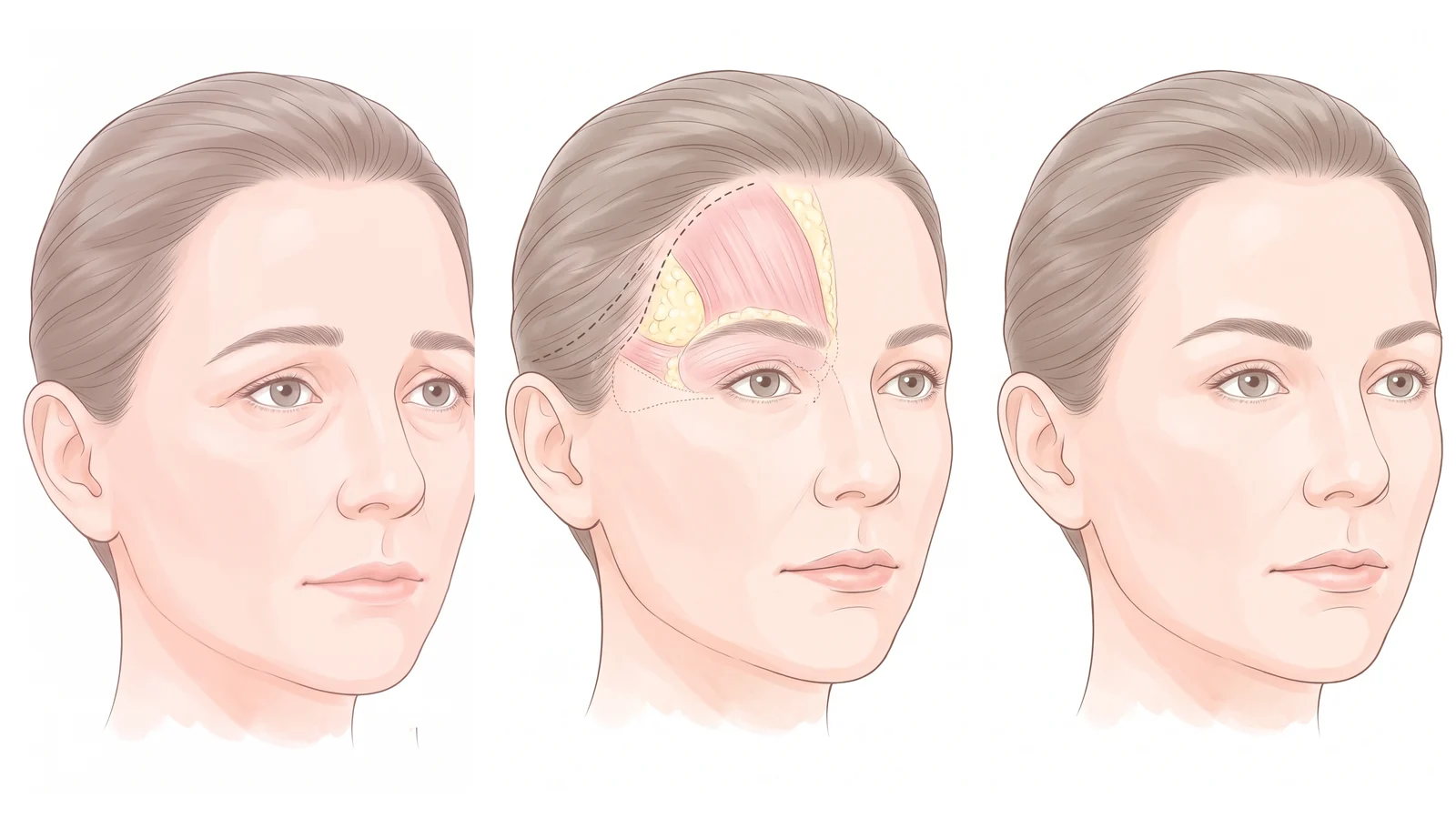
When the tail of the eyebrow and the outer corner of the eye slope down toward the cheek, a temple lift, also called a temporal brow lift, raises that side of the upper face from the temple. At ENTER Plastic Surgery, Dr. Jang Jin-woo performs the temple lift in Korea under IV sedation, and the stitches come out between days 7 and 14.
Is it for you?
Who a temple lift in Korea suits
The temple lift works on one specific vector. Gravity and loosening tissue at the side of the forehead pull the brow tail downward and outward, which crowds the outer upper eyelid and gives the eyes a tired, downturned look even when the eyelid skin itself is in fair condition. Lifting at the temple pulls that corner up and back.
It does not address the middle of the forehead, and it removes no eyelid skin. If the whole brow sits low and deep lines cross the forehead, an endoscopic brow lift covers the full width. If heavy skin on the upper lid is the main issue, upper eyelid surgery is the operation discussed. The aim is a lifted outer eye area that still looks like your own face.
Usually a good fit
- A brow tail that has dropped toward the outer eye corner
- Hooding concentrated at the outer half of the upper lid
- A downturned outer eye shape that has developed with age
- Mild sagging at the upper cheek beside the eye
- Free to remain in Seoul through the stitch-removal visit
We may suggest waiting
- A brow that is low across its full width, with deep forehead lines
- Excess upper eyelid skin as the main concern
- Jowls or neck laxity as the main concern
- Very thin hair or a receding hairline at the temples
- Pregnancy, or a condition that rules out IV sedation
Before & after
Temple lift before and after
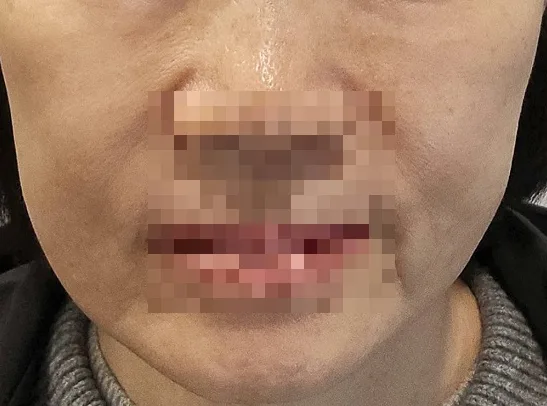 BEFORE
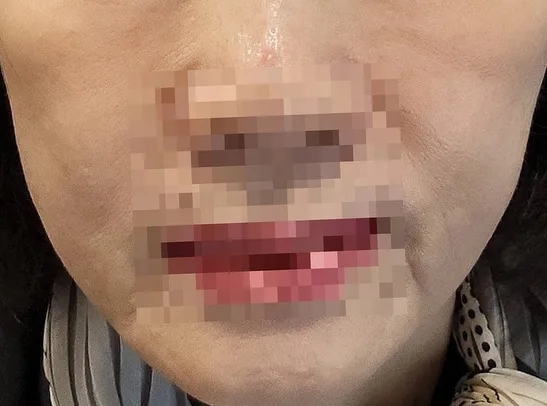 AFTER
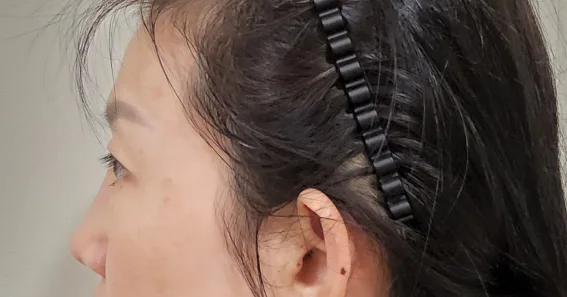 BEFORE
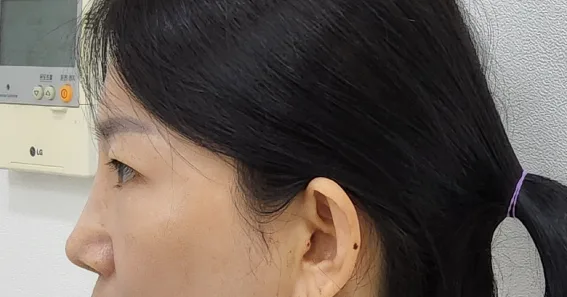 AFTER
How it works
How the temporal lift raises the brow tail
The temple sits between the hairline and the outer orbit, and its tissue lies in layers: skin and fat, a thin superficial fascia, and below that the firm deep temporal fascia over the chewing muscle. The frontal branch of the facial nerve, which lifts the eyebrow, runs through this region in the layer between them. Every version of the operation is planned around that nerve.
In the published techniques, the incision is placed within the hair-bearing scalp of the temple. Tissue at the side of the forehead and outer brow is freed, moved up and back, and secured to the deep temporal fascia, and surplus scalp is trimmed before closure. Surgeons describe working in the plane just under the skin or deeper, beneath the superficial fascia; a 2023 series of 40 patients extended the deeper route to lift the mid-face as well (Şirinoğlu, 2023). A technical review describes the subcutaneous version as a way to raise the outer brow while keeping the dissection away from the nerve (Savetsky, 2022).
The evidence comes mostly from surgeon-reported series. A systematic review of the subcutaneous temporal lift with an orbicularis muscle flap found it reproducible in the authors' hands, but built on very low-grade evidence (Pascali, 2022). Which plane and incision line Dr. Jang uses for your face is explained at your consultation.
Planning the lift vector
At consultationDr. Jang Jin-woo assesses how far the brow tail and outer eye corner have dropped and marks the direction and amount of lift for each side.
Sedation and temple incision
Under IV sedation, the incision is made in the temple region, and the tissue at the side of the forehead is released from its attachments.
Lifting and anchoring
The freed tissue is drawn up and back and fixed to the firm deep fascia of the temple, and the excess scalp is trimmed.
Closure and stitch removal
Stitches out at days 7–14The incision is closed with stitches that are taken out between days 7 and 14, and makeup can resume the day after removal.
Brow and upper-face lifts on the ENTER Plastic Surgery menu
| Point of comparison | Temple lift | Endoscopic brow lift | Sub-brow lift |
|---|---|---|---|
| Main area lifted | Brow tail and outer eye corner | Whole brow and forehead | Upper-lid skin under the brow |
| Incision | Temple region | About 4 short cuts behind the hairline | Along the lower edge of the brow |
| Anesthesia | IV sedation | IV sedation or general | Local, sedation if needed |
| Stitches out | Days 7–14 | Days 7–14 | About days 5–7 |
| Earliest flight home | 7–10 days, after stitch removal | 7–10 days, after stitch removal | 5–7 days, after stitch removal |
| How long it lasts (clinic guidance) | About 3–5 years | About 5–10 years | About 5–10 years |
Durations are the clinic's own guidance; the face keeps aging and individual results vary.

Your doctor
Chief Director · Korean board-certified plastic surgeon
“Natural, yet clearly visible change.”Eyelid and facelift surgery at ENTER is planned and performed by Dr. Jang himself.
- NowChief Director, ENTER Plastic Surgery
- TrainingPlastic surgery, Kyung Hee University Medical Center
- FormerChief Director, Jang Plastic Surgery
- FormerDirector, Secret Plastic Surgery
- MemberKSPRS · KSAPS · ISAPS · ESOPRS · ASPS
At a glance
Temple lift: surgical facts
| Anesthesia | IV sedation |
|---|---|
| Recovery | Bruising and swelling 1–2 weeks; stitches out at days 7–14 |
| Stitches | Removed 7–14 days after surgery |
| Return to exercise | Generally, gentle walks for the first 1–2 weeks; strenuous exercise, bending over and heavy lifting are avoided for about 3–4 weeks, and full workouts build up gradually from about 1 month (published guidance) |
| Earliest flight home | 7–10 days after surgery, once stitches are out |
| How long results last | About 3–5 years |
Prices
Temporal brow lift cost in South Korea
A temple lift is billed as two lines. The first is the surgery fee. The second is IV sedation, which the clinic lists as its own charge on every operation. Neither figure includes VAT (10% VAT is added at payment), so the sedation line and the tax both belong in your budget alongside the surgery fee.
After surgery, prescribed medicine is taken twice a day. Ask for medication and any aftercare items to appear as separate lines in your written quote, so you can see the full total before booking a flight that has to wait for stitch removal.
Prices exclude VAT (10% VAT is added at payment).
Recovery
The first month after a temple lift
Start the prescribed medicine, taken morning and evening. A feeling of tightness at the temples is expected.
Showering lightly is fine from this day. Keep water pressure off the incision and pat the area dry.
Partial face washing can begin. Bruising may spread toward the outer eyes as it settles downward.
The stitches are removed within this window, and makeup is allowed from the day after removal. The clinic's guidance is that flying home is possible once they are out.
Bruising and swelling fade over 1–2 weeks. Until the end of week 3, do not rub or massage the operated area, even after the stitches are gone.
For four weeks, avoid opening your mouth wide and skip hard, chewy foods, since jaw movement pulls on the temple.
Hair coloring and perms can resume. Report any swelling that grows, a brow that will not lift, or a wound that opens straight away.
Safety
What can go wrong after a temple lift
The temple is a small area, but the nerve that moves the brow and the blood vessels of the scalp both pass through it. Swelling that keeps increasing on one side, severe pain or a wound that separates needs a call to the clinic without delay.
- Weakness of the frontal branch of the facial nerve, making one brow harder to raise; in one series of 40 patients this occurred temporarily in 5 (Şirinoğlu, 2023).
- Bleeding under the skin (hematoma) or a collection of fluid that needs drainage.
- Hair thinning or hair loss along the incision line.
- A hollow at the temple, a widened scar or a visible step in the hairline.
- Asymmetry between the two brows or eye corners.
- Numbness or altered sensation in the scalp around the incision, and infection.
- Gradual relapse of the lift as the face continues to age.
The same 2023 series reported no major complications, but also one temporal hollow, one case of hair loss at the suture line, and an early recovery the authors described as somewhat difficult (Şirinoğlu, 2023).
Evidence
Research behind this page
- Temporal Facelift: A New Method for Temporal and Mid-face LiftingJournal of Craniofacial Surgery · 2023 · Şirinoğlu H · doi:10.1097/scs.0000000000009525
Cohort of 40 temporal facelift patients followed for a mean of 15 months: no major complications, but 5 temporary one-sided frontal nerve weakness, 1 temporal hollow and 1 suture-line hair loss, with a somewhat difficult early recovery.
- The Temporal Subcutaneous Brow Lift with Orbicularis Oculi Muscle Elastic Flap: Technical Considerations, Systematic Review, and Terminology StandardizationFacial Plastic Surgery · 2022 · Pascali M · doi:10.1055/a-1953-2304
Systematic review and technique report on the subcutaneous temporal brow lift with an orbicularis muscle flap: reproducible lift of the outer eye area without major complications in the authors' hands, on very low-grade evidence.
- Subcutaneous Lateral Temporal LiftClinics in Plastic Surgery · 2022 · Savetsky I et al. · doi:10.1016/j.cps.2022.02.001
Technique review presenting the subcutaneous lateral temporal lift as a way to raise the outer brow steadily while keeping complications low, based on surgeon experience.
- Long-term Stability in Endoscopic Brow Lift: A Systematic Review and Meta-Analysis of the LiteratureAesthetic Surgery Journal · 2024 · Şibar S et al. · doi:10.1093/asj/sjae225
Meta-analysis of 12 endoscopic brow lift studies: long-term elevation was 3.25 mm medially, 3.86 mm centrally and 4.35 mm laterally, with more long-term data needed by fixation method; useful context when comparing brow lift options.
FAQ
Temple lift FAQ
When does bruising fade after a temple lift?
Bruising and swelling fade over about one to two weeks. Bruising can drift down toward the outer eyes before it clears, which is expected. Until the end of week 3, avoid rubbing or massaging the area, and report swelling that keeps growing on one side.
When can I fly home after a temple lift in Korea?
The clinic's guidance is 7–10 days after surgery, once the stitches are removed. Stitch removal falls between days 7 and 14, so booking a return flight around two weeks after surgery leaves room if removal happens later in that window.
Is the surgeon who performs the temple lift a plastic surgeon?
Yes. Dr. Jang Jin-woo, a Korean board-certified plastic surgeon, performs the temple lift at ENTER Plastic Surgery. Dr. Jang trained in plastic surgery at Kyung Hee University Medical Center and is a member of the Korean Society of Plastic and Reconstructive Surgeons and ISAPS.
Is IV sedation part of the temple lift fee?
No. IV sedation is a separate line at ₩300,000 + VAT, added to the surgery fee of ₩3,300,000 + VAT. Both are listed before Korea's 10% VAT, which is added when you pay. Ask for medication to be itemized in your quote as well.
Can I arrange a temple lift consultation before I travel?
Yes. Send the form on this page or message us on WhatsApp with photos of your brow from the front and side and your travel dates, and we will get back to you as soon as possible. English-speaking staff are available at the clinic when you arrive.
What should I check about the deposit and cancellation before booking?
Deposit and cancellation terms are set per booking, so get them in writing before you pay. Check how a change of surgery date affects the stitch-removal visit, because that visit, not the operation day, decides the earliest date you can fly home.
How is a temple lift different from an endoscopic brow lift?
A temple lift works on the brow tail and outer eye corner from the temple. An endoscopic brow lift raises the whole brow and forehead through about four short incisions behind the hairline. Both are on the ENTER Plastic Surgery menu, and the shape of your brow decides between them.
Where is the temple lift incision, and will the scar show?
Published techniques place the incision inside the hair-bearing scalp of the temple, so the healed line sits behind hair. It is still a scar: it can widen, and hair along it can thin. Thin temple hair makes a scar easier to see, which is why hair density matters at planning.
Does a temple lift also lift the cheeks?
Its main effect is on the brow tail and outer eye corner. Some published variants dissect deeper and extend the lift to the upper cheek beside the eye, as in a 2023 series of 40 patients. Whether the plan includes that area depends on how your mid-face has descended.
How long do temple lift results last?
The clinic's guidance is about three to five years. The tissue lifted at surgery stays in its new position for a time, but the skin and ligaments of the face keep aging, so the outer brow gradually descends again. Results differ from person to person.
When can I dye or colour (UK spelling) my hair after a temple lift?
Hair dye and perms can resume one month after surgery. Chemicals on a healing scalp incision can irritate it, so wait the full month even if the wound looks closed. A light shower is fine from the day after surgery.
Why should I avoid opening my mouth wide after a temple lift?
The chewing muscle runs under the temple, so wide yawning and hard, chewy food pull on the area that was lifted and fixed. For four weeks after surgery, keep jaw movements gentle and choose softer food to protect the anchoring while it heals.
Google reviews
Reviews on Google Maps
Great experience! Dr. is very sweet and kind. He listened to what I wanted to fix and correct. He explained everything very well. Wasn’t pushy and didn’t try to sell anything extra. This isn’t a clinic that comes out on instagram, which I…
 Jennifer LyuA month ago
I came to Enter Plastic Surgery on a friend’s recommendation for under-eye fat repositioning. I was pretty nervous going in, but the doctor took the time to explain what would work for my under-eyes, what the procedure involved, and what…
 Michael2 months ago
The staff are incredibly friendly, and the consultation was very thorough. I was very worried since it was my first procedure, but the director explained the aftercare in detail, so I felt completely confident trusting them!!
 ROOHEUI SHIN (RHS)2 months ago · Translated by Google