

Ptosis correction tightens the levator muscle, which lifts the upper eyelid, so a lid that covers part of the iris opens higher. At ENTER Plastic Surgery, ptosis correction in Seoul, Korea takes 40–60 minutes under local anesthesia through the crease incision, or 20–30 minutes by the non-incisional method, and Dr. Jang Jin-woo adds it to upper eyelid or incisional double eyelid surgery.
Is it for you?
Signs that point to ptosis correction
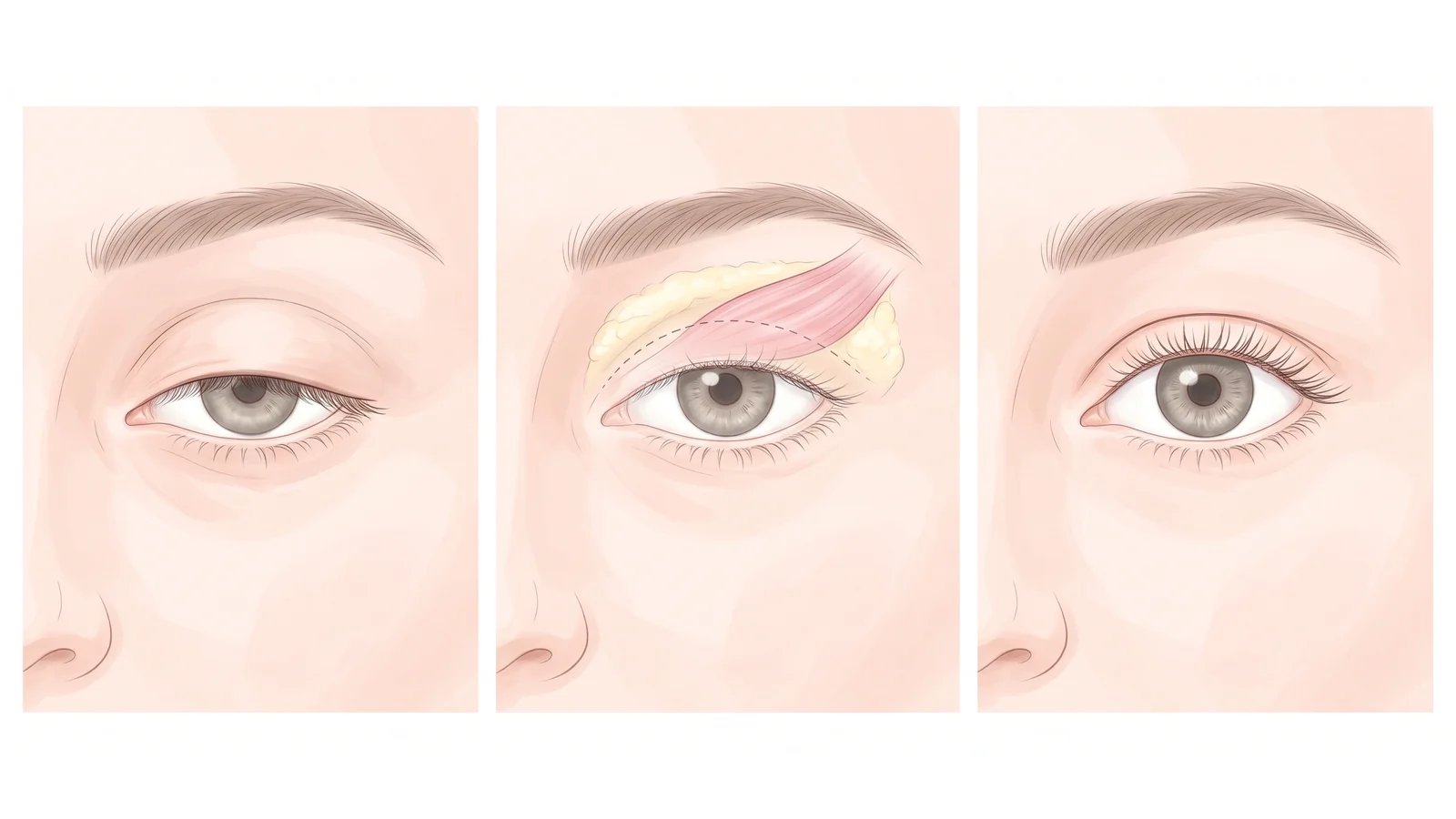
Two different problems make an eye look heavy. In one, the skin of the upper lid has stretched and folds down over the lashes. In the other, the eyelid margin itself sits low because the muscle that raises it has weakened or its tendon has slipped from its attachment. Ptosis correction treats the second. A quick way to see the difference: lift the loose skin gently with a fingertip, and if the lash line still sits over the upper part of the iris, the muscle is part of the picture.
The two can also occur together. A sign of the muscle problem is raising the eyebrows to see, or a forehead that feels tired by evening, because the brow muscle is compensating for the low lid. Mild, previously unnoticed ptosis is also found in people planning cosmetic upper-lid surgery; in one cohort of 97 Asian patients, adding a measured levator advancement to cosmetic upper blepharoplasty made the result more predictable over a mean 15 months (Wong, 2023).
Ptosis that came on suddenly, changes through the day or arrives with double vision is a different matter. Those patterns can point to a nerve or muscle disorder, so they need a medical work-up before any cosmetic lid surgery is considered.
Usually a good fit
- Upper lid margin that covers part of the iris
- Raising the brows to keep the eyes open
- Eyes that look sleepy even when rested
- One lid sitting lower than the other
- Planning upper-lid or double eyelid surgery anyway
- Able to stay about 7 days for stitch removal
We may suggest waiting
- Heaviness caused only by loose upper-lid skin
- Sudden ptosis or lids that worsen through the day
- Double vision or other eye-movement problems
- Severe dry eye or difficulty closing the eyes
- Pregnancy, breastfeeding or active eye infection
Before & after
Ptosis correction results at ENTER Plastic Surgery
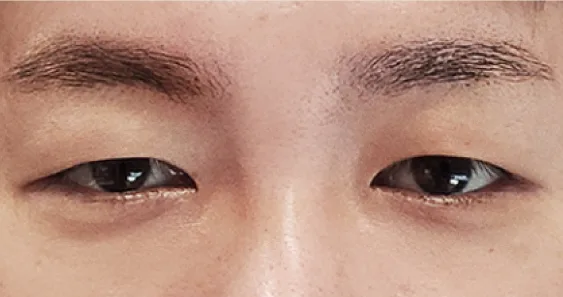 BEFORE
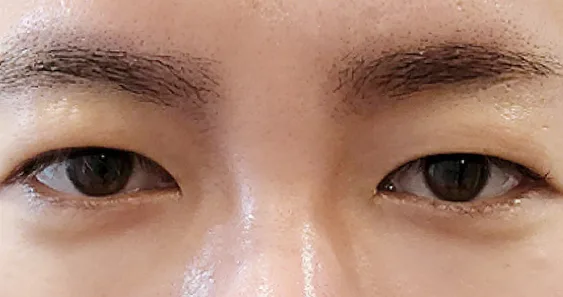 AFTER
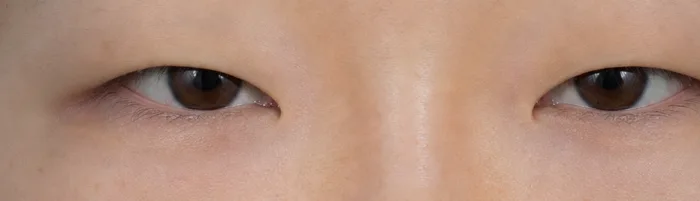 BEFORE
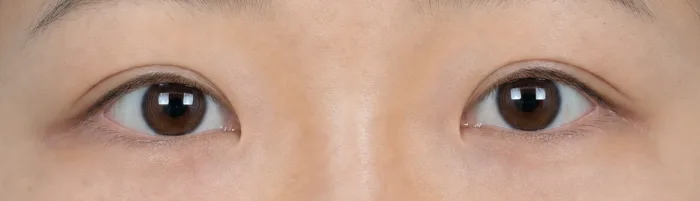 AFTER
How it works
How ptosis correction raises the upper eyelid
The upper eyelid is opened mainly by the levator palpebrae superioris, a long muscle that runs from the back of the eye socket and ends in a flat tendon (the levator aponeurosis) attached to the tarsal plate, the firm strip inside the lid. A thinner muscle beneath it, Müller's muscle, adds a millimeter or two of lift. With age, long-term contact lens wear or rubbing, the tendon can stretch or loosen, and the lid margin drops even though the muscle still works.
Correction shortens or reattaches that system so each contraction lifts the lid further. In the incisional method, Dr. Jang reaches the levator aponeurosis through an incision placed in the upper-lid crease, and advances it onto the tarsal plate. Local anesthesia lets the lid height be checked while you open your eyes. Excess skin can be trimmed through the same opening. The non-incisional method uses buried stitches placed through tiny openings to fold the muscle, with no skin removal and no stitches to take out.
The two routes have different trade-offs. A 2023 meta-analysis of 1,038 eyes found that a conjunctival-side Müller's muscle procedure and external levator advancement both corrected ptosis, while the external route had significantly more overcorrection and reoperation (Karam, 2023). Non-incisional folding suits milder cases: in 34 patients with mild ptosis, a transconjunctival Müller's muscle tuck held its lift for six months, with some crease loosening and asymmetry reported (Han, 2019).
Measuring the lid height
At consultationDr. Jang Jin-woo checks how far the lid margin covers the iris, how strongly the levator moves and how much skin overhangs the lashes, then chooses the incisional or non-incisional route.
Local anesthesia
The upper lids are numbed with local anesthesia. IV sedation can be added if needed. Under local anesthesia you can open your eyes on request so the height can be judged.
Tightening the levator
40–60 minutes (incisional)Through the crease incision, the levator aponeurosis is advanced and fixed to the tarsal plate. With the non-incisional method, buried stitches fold the muscle in about 20–30 minutes.
Balancing both sides
You open and close your eyes while both lid heights and crease lines are compared, and the stitch tension is adjusted before closing.
Closing and aftercare
Stitches out at 5–7 daysSkin stitches close the crease incision and come out after five to seven days. Cold compresses start the same day.
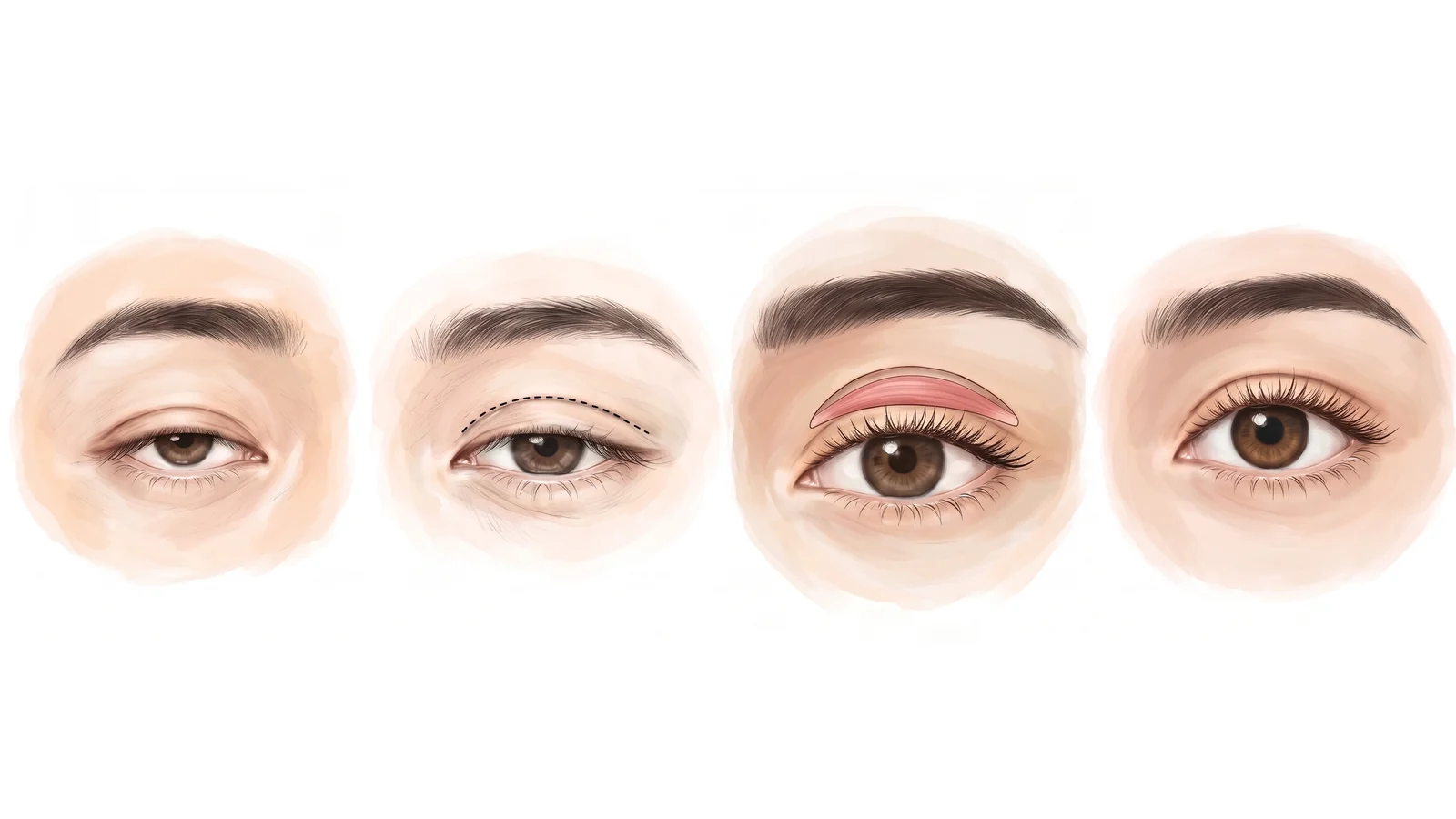
Ways to treat a heavy upper lid at ENTER Plastic Surgery
| Point of comparison | Incisional ptosis correction | Non-incisional ptosis correction | Upper blepharoplasty |
|---|---|---|---|
| What is changed | Levator tendon advanced; skin trimmed if needed | Muscle folded with buried stitches | Excess upper-lid skin removed |
| Lifts a low lid margin | Yes | Yes, for milder ptosis | No |
| Incision | Along the upper-lid crease | Tiny openings only | Along the upper-lid crease |
| Procedure time | 40–60 minutes | 20–30 minutes | 30–60 minutes |
| Anesthesia | Local; IV sedation if needed | Local | Local; IV sedation if needed |
| Stitches | Removed at 5–7 days | None to remove | Removed at 5–7 days |
| Earliest flight home (clinic guidance) | About 7 days | 2–3 days | About 7 days |
| How it is billed | Add-on to upper blepharoplasty or incisional double eyelid surgery | Add-on; fee itemized in your quote | Surgery fee of its own |
Times and flight guidance are the clinic's own figures; healing varies between people.

Your doctor
Chief Director · Korean board-certified plastic surgeon
“Natural, yet clearly visible change.”Eyelid and facelift surgery at ENTER is planned and performed by Dr. Jang himself.
- NowChief Director, ENTER Plastic Surgery
- TrainingPlastic surgery, Kyung Hee University Medical Center
- FormerChief Director, Jang Plastic Surgery
- FormerDirector, Secret Plastic Surgery
- MemberKSPRS · KSAPS · ISAPS · ESOPRS · ASPS
At a glance
Ptosis correction facts for trip planning
| Procedure time | 40–60 min incisional; 20–30 min non-incisional |
|---|---|
| Anesthesia | Local anesthesia; IV sedation added if needed |
| Recovery | Swelling 1–2 weeks; lid line settles in 1–3 months |
| Follow-up visits | 1–2 follow-up visits |
| Stitches | Removed about 5–7 days after surgery (incisional method) |
| Return to exercise | Generally, light walking within comfortable limits is fine; strenuous exercise is avoided for about 2 weeks |
| Earliest flight home | About 7 days, after stitch removal |
Prices
Ptosis correction cost in South Korea
ENTER Plastic Surgery performs ptosis correction only together with upper blepharoplasty or incisional double eyelid surgery, so the fee appears as an add-on line beside the main eyelid operation. Your quote therefore has three parts: the main surgery, the ptosis add-on and, if you choose it, IV sedation, which the clinic bills as an extra line for every surgery. All three exclude VAT (10% VAT is added at payment).
The fee for the non-incisional method and the operation it is paired with are listed in your written quote. Ask for medication and aftercare items to be itemized there too, so the total is clear before you book flights.
Prices exclude VAT (10% VAT is added at payment).
Recovery
Healing after ptosis correction
Your lids feel tight and swell within hours. Rest with your head raised and start cold compresses. A little blood on gauze is expected for the first one to two days.
Keep using cold compresses for three days. Do not blow your nose for two weeks and take care when sneezing, because pressure reaches the healing lids.
Change to warm compresses, 30 seconds of warmth followed by 5 minutes of rest, repeated. Bruising can be hidden with glasses if you go out.
The crease stitches come out at your follow-up. Recovery reaches about one week, and the clinic's guidance is that you can fly home after removal.
Swelling and bruising fade over one to two weeks. The lids can look slightly high or uneven while the remaining swelling settles.
Lid height and crease line keep settling for about one to three months. Judge symmetry at the end of that period.
Safety
Risks of ptosis correction
Lid height is set in millimeters and both sides heal at their own pace, so asymmetry is the risk people ask about most. A small series of acquired ptosis after double eyelid surgery shows that the lid can also drop after earlier eyelid work; correction through the inner lid reduced the side-to-side gap, and short-lived swelling of the lining resolved within a month (Jeong, 2024). Call the clinic at once for pain that keeps rising, swelling that spreads on one side or any change in vision.
- Asymmetry between the two lids, in height or crease shape.
- Undercorrection, where the lid stays lower than planned, or overcorrection, where it sits too high.
- Incomplete closure of the eyes for a period, with dryness, grittiness or watering.
- Swelling of the inner lid lining (chemosis), bruising or bleeding under the skin.
- Crease irregularity, or loosening of buried stitches after the non-incisional method.
- Infection, or a return of ptosis that leads to revision surgery.
Evidence
Research behind this page
- Muller's muscle conjunctival resection versus external levator advancement for ptosis repair: systematic review and meta-analysisInternational Ophthalmology · 2023 · Karam M et al. · doi:10.1007/s10792-023-02633-1
Meta-analysis of 1,038 eyes: Müller's muscle-conjunctival resection and external levator advancement both corrected ptosis, but the external route had significantly higher overcorrection and reoperation rates.
- Subclinical Upper Eyelid Ptosis in Asian Patients: The Role of Levator Advancement in Optimizing Outcomes in “Cosmetic” Upper BlepharoplastyAesthetic Plastic Surgery · 2023 · Wong C et al. · doi:10.1007/s00266-023-03697-1
Uncontrolled cohort of 97 Asian patients: adding precise levator advancement to cosmetic upper blepharoplasty for subtle ptosis made outcomes more predictable over a mean 15 months.
- Transconjunctival Müller’s muscle Tucking Method for Non-incisional Correction of Mild Ptosis: The Effectiveness and MaintenanceAesthetic Plastic Surgery · 2019 · Han H · doi:10.1007/s00266-019-01379-5
Series of 34 patients with mild ptosis: a non-incisional transconjunctival Müller's muscle tuck kept its lift for six months, with crease loosening, asymmetry and recurrence in some cases.
- Transconjunctival Levator Aponeurosis-Müller Muscle Complex Plication to Correct the Acquired Ptosis Following Double-Eyelid SurgeryJournal of Craniofacial Surgery · 2024 · Jeong Y et al. · doi:10.1097/scs.0000000000010222
Small case series: acquired ptosis after double eyelid surgery was corrected through the inner lid, narrowing the side-to-side difference; transient chemosis settled within a month.
FAQ
Ptosis correction FAQ
When do swelling and bruising settle after ptosis correction?
Swelling and bruising fade over about one to two weeks after incisional ptosis correction, and the lid line keeps settling for one to three months. After the non-incisional method, swelling lasts about three to seven days. Glasses help hide bruising if you need to go out in the first week.
How many days should I stay in Korea for ptosis correction?
Plan on about seven days for the incisional method. The crease stitches come out after five to seven days, and the clinic's guidance is that you can fly home once they are removed. With the non-incisional method there are no stitches to take out, and flying after two to three days is possible.
Who performs ptosis correction at ENTER Plastic Surgery?
Dr. Jang Jin-woo, a Korean board-certified plastic surgeon, performs it. Eyelid and upper-face surgery are the focus of Dr. Jang's practice, and Dr. Jang is a member of the European Society of Ophthalmic Plastic and Reconstructive Surgery (ESOPRS) and the International Society of Aesthetic Plastic Surgery (ISAPS).
Can I book ptosis correction without another eyelid operation?
No. The clinic performs ptosis correction together with upper blepharoplasty or incisional double eyelid surgery, and it is priced as an add-on of ₩1,300,000 + VAT. If you are unsure which operation your lids need, describe them when you write in and ask which combination is offered.
Is IV sedation included in the ptosis correction fee?
No. Ptosis correction is done under local anesthesia, and IV sedation (sedation anaesthesia, as it is spelled in British English) is an optional extra at ₩300,000 + VAT per surgery. Every fee on this page is listed before Korea's 10% VAT, which is added when you pay.
How can I get in touch from outside Korea?
Message us on WhatsApp or fill in the form at the end of this page, and we will reply as soon as possible. English-speaking staff are available at the clinic. Include your planned travel dates, since the stitch removal visit sets the length of your stay.
Is a deposit required, and can I move my surgery date?
Deposit and rescheduling terms depend on the booking, so ask for them in writing before you transfer any money. Moving the surgery date also moves your stitch removal and your earliest flight home, so check both against your travel plans.
Where is the scar after ptosis correction?
With the incisional method, the incision runs along the upper-lid crease, so the healed line sits in the fold of the lid. It is red at first and fades over the following months. The non-incisional method uses only tiny openings for the buried stitches, with no skin removed.
Who is a good candidate for non-incisional ptosis correction?
Mild ptosis with good levator movement and little excess skin is the pattern the non-incisional method is designed for. It takes about 20–30 minutes under local anesthesia with no stitches to remove. Buried stitches can loosen over time, so stronger ptosis or heavy skin is a reason to choose the incisional route.
Does double eyelid surgery fix a droopy eyelid?
Not by itself. A double eyelid operation creates a crease in the skin, while ptosis comes from a weak or stretched muscle. When both are present, the clinic adds ptosis correction to incisional double eyelid surgery so the lid height and the new crease are set together.
Is ptosis surgery worth it?
It depends on what bothers you. If you raise your brows to see or your lids look tired even after sleep, a higher lid margin addresses that cause directly. The procedure carries risks, mainly asymmetry and over- or undercorrection, which are listed above, so weigh them against how much the low lid affects you.
Can a drooping eyelid be a sign of a medical problem?
Yes, sometimes. Ptosis that appears suddenly, varies during the day, or comes with double vision or a headache can be a sign of a nerve or muscle condition. Those cases need a medical examination before cosmetic eyelid surgery is considered.
Google reviews
Reviews on Google Maps
Great experience! Dr. is very sweet and kind. He listened to what I wanted to fix and correct. He explained everything very well. Wasn’t pushy and didn’t try to sell anything extra. This isn’t a clinic that comes out on instagram, which I…
 Jennifer LyuA month ago
I came to Enter Plastic Surgery on a friend’s recommendation for under-eye fat repositioning. I was pretty nervous going in, but the doctor took the time to explain what would work for my under-eyes, what the procedure involved, and what…
 Michael2 months ago
The staff are incredibly friendly, and the consultation was very thorough. I was very worried since it was my first procedure, but the director explained the aftercare in detail, so I felt completely confident trusting them!!
 ROOHEUI SHIN (RHS)2 months ago · Translated by Google